What is the correct order in the NEET 2026 falling-ruler question?
The NEET 2026 falling-ruler question has correct answer option C, the third option: person B allows the greatest fall and person C the smallest. This Physics question belongs to Kinematics. The question bank rates it medium and sets an expected solving time of 45 seconds.
A ruler is released vertically from rest in five separate trials. Each person catches it after their stated reaction time. Neglect air resistance, as assumed in the supplied free-fall solution; the ruler accelerates downward until caught.
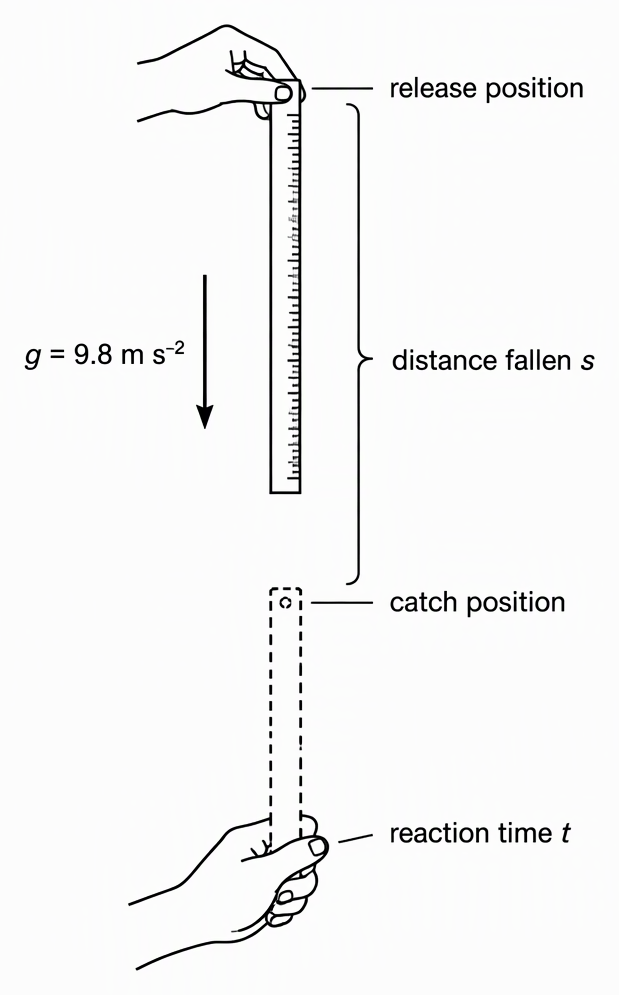
The reaction times are:
- Person A: 0.20 s.
- Person B: 0.22 s.
- Person C: 0.18 s.
- Person D: 0.19 s.
- Person E: 0.21 s.
Which option gives the descending order of distance fallen, greatest first? Letters within each sequence identify people, not answer options.
How does reaction time determine the ruler’s falling distance?
The reaction time is the interval during which the released ruler falls before being caught. Falling distance is proportional to time squared, not time itself. All five trials have the same gravitational acceleration.
Take downward as positive. The constant-acceleration equation is:
Release from rest means the initial velocity is zero:
Substituting gives:
Use the given gravitational acceleration:
Therefore:
Here, time is in seconds and distance is in metres. Since gravity is identical in every trial:
The ruler keeps gaining speed while falling. Under these conditions, doubling the available time quadruples the distance rather than merely doubling it.
How can you select option C without calculating five distances?
Rank the reaction times from longest to shortest, then keep that order for distances. Every reaction time is positive, so squaring preserves the order. Multiplying those squares by the same positive factor, half the gravitational acceleration, also preserves it.
The descending numerical order is:
Map these values to the people:
The official solution therefore gives:
Correct answer: option C, which is the third option. Person C is last in the distance ranking; that is separate from the answer option’s letter.
Calculating five distances is unnecessary. Even the numerical value of gravity does not affect the order when it is common to every trial. Use the proportionality method for the 45-second target.
What are the five falling distances when calculated fully?
Person B’s ruler falls 0.23716 m, the greatest distance, while person C’s falls 0.15876 m, the smallest. These calculations are verification for learning, not extra work required during the exam. Each entry shows the reaction time, its square, the substitution and the distance.
- Person A:
- Person B:
- Person C:
- Person D:
- Person E:
Compare the unrounded calculated values, all in metres. They confirm the proportionality ranking:
Why does ranking reaction speed incorrectly lead to option D?
Option D results from answering who reacts fastest, rather than whose trial gives the ruler the longest time to fall. Those are opposite rankings. A quicker catch stops the ruler sooner, so it allows less falling distance.
From quickest to slowest reaction, the people are:
Mistakenly presenting that sequence as a descending distance order produces:
That is exactly option D, which reverses the required relationship. The mistake is in choosing what to rank, not in arithmetic.
Use an endpoint check before marking the answer. Person C catches after 0.18 s, whereas person B catches after 0.22 s. Person C must allow less falling distance than person B under the same conditions.
Longer reaction time means more elapsed free-fall time and therefore greater distance. Rank the time available to fall, not reaction speed.
How do you solve related reaction-time and distance-ratio questions?
Rearrange the free-fall equation to find a reaction time, and divide two versions of it to compare distances. Both questions below are original related practice, not additional NEET PYQs.
What is the reaction time if a body falls 0.441 m?
The reaction time is 0.30 s. A body is released from rest and falls 0.441 m before being caught; find the reaction time using gravitational acceleration of 9.8 metres per second squared.
Start with:
Rearrange and substitute:
Take the square root:
Elapsed time after release takes the positive root. The negative mathematical root does not describe this catching interval.
What happens to distance when reaction time rises from 0.20 s to 0.30 s?
The new distance is 2.25 times the original. Under identical free-fall conditions, a body starts from rest in each trial; compare the distance for a reaction time of 0.30 s with that for 0.20 s.
The common gravitational factor cancels:
The reaction time increases by 50%, but the falling distance increases by 125%. The new distance is 225% of the original, not a 225% increase. Before checking a distance-ratio answer, square the time ratio and distinguish the final percentage from the percentage increase.
Next step: photograph a doubt on NEET JEEnius AI and photograph any question you are stuck on and get a step-by-step solution across Physics, Chemistry and Biology (20 free a month).
Keep going with Free NEET Biology Mock Test: Choose the Right Format.
Frequently asked questions
What is the correct answer to the NEET 2026 falling-ruler question?
The correct answer is option C: B > E > A > D > C in descending order of distance fallen. Person B has the longest reaction time, 0.22 s, and allows the greatest fall; person C has the shortest, 0.18 s, and allows the smallest.
How can I rank falling distances without calculating each one?
For a ruler released from rest with air resistance neglected, s = (1/2)gt². Since gravitational acceleration is identical in all trials and reaction times are positive, rank the times from longest to shortest to obtain the descending distance order.
Why is option D wrong in the falling-ruler question?
Option D ranks people from quickest to slowest reaction, giving C > D > A > E > B. The question asks for greatest falling distance first, so the longest reaction time must come first, not the quickest reaction.
How much does falling distance increase when reaction time changes from 0.20 s to 0.30 s?
For release from rest under the same gravitational acceleration, the distance ratio is (0.30/0.20)² = 2.25. The new distance is 225% of the original, which means a 125% increase.