What is the answer to the transcription unit NEET 2026 question?
Option 4 is correct: all five statements are valid in the transcription unit NEET 2026 question. Statement B uses the coding strand’s positional convention, not the template strand’s end labels. The question bank classifies this Biology question as medium difficulty and gives an expected solving time of 60 seconds, not an observed student average.
The promoter and terminator flank the structural gene. The two DNA strands run antiparallel, so their end labels are opposite at the same physical location.
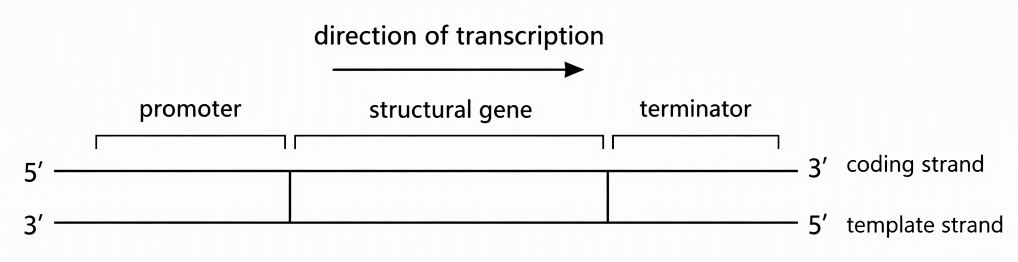
Identify the valid claims:
- A: Promoter, structural gene and terminator are the three principal regions.
- B: The promoter lies on the structural gene’s 5′ side.
- C: The promoter is a DNA sequence providing a binding site for RNA polymerase.
- D: Promoter orientation establishes template and coding strand assignments.
- E: The terminator lies towards the coding strand’s 3′ end and usually defines transcription ending.
The options are:
- A, B, C and D only
- A, C, D and E only
- B, C, D and E only
- A, B, C, D and E
Answer: option 4, all five statements are correct.
Why are statements A, B and C correct?
The three principal regions are promoter, structural gene and terminator. The promoter lies on the coding strand’s 5′ side and provides a binding site for RNA polymerase. Check region names, position and function separately: the template strand’s end label does not make B false.
Step 1, statement A: A transcription unit is defined primarily by the promoter, structural gene and terminator. The promoter and terminator flank the structural gene, placing it between them.
“Flank” means lie on either side, not inside the structural gene. Verdict: A is correct.
Step 2, statement B: The promoter lies towards the structural gene’s 5′ end under the coding-strand convention. In the figure, that is the left-hand side.
At this same end, the lower template strand carries its 3′ label. The location has not changed; only the reference strand has changed. Verdict: B is correct.
Step 3, statement C: The promoter is a DNA sequence that provides a binding site for RNA polymerase. The promoter is the binding sequence; RNA polymerase is the enzyme that binds there. Verdict: C is correct.
Why are statements D and E also correct?
Promoter orientation sets the transcription direction and therefore the strand roles for that unit. The terminator lies towards the coding strand’s 3′ end and usually defines transcription ending. These facts support D and E without changing the coding-strand convention used to check B.
Step 4, statement D: Promoter orientation determines which DNA strand serves as the template and which serves as the coding strand. RNA polymerase reads the template in this direction:
The RNA is synthesised in the opposite polarity:
These assignments apply to this transcription unit. One physical DNA strand does not have to remain the template for every gene. Verdict: D is correct.
Step 5, statement E: In the figure, the terminator is on the right, towards the coding strand’s 3′ end. It usually defines the end of transcription, matching the official solution’s qualification. Verdict: E is correct.
How do the five verdicts give option 4?
Only option 4 includes the complete verified set: A correct, B correct, C correct, D correct, E correct. Compare that full sequence with the options, not just one statement you recognise.
- Option 1 omits E, which is correct.
- Option 2 omits B, which is correct.
- Option 3 omits A, which is correct.
- Option 4 contains all five correct statements.
Use this order: verify every statement first, then match the complete set to an option. Do not reject a valid statement just to fit an option.
How can mixing strand references lead to option 2?
Rejecting B while accepting A, C, D and E produces option 2. That rejection can come from switching reference strands midway through the reasoning:
RNA polymerase reads the template from its 3′ end towards its 5′ end. The promoter is therefore near the template’s 3′ side, so statement B’s reference to the 5′ side must be false.
The invalid step is transferring the template strand’s end label into a statement using the coding-strand positional convention. In the illustrated unit, template 3′ and coding 5′ lie on the same side.
Name the reference strand before assigning 5′ or 3′ labels. For upstream and downstream, also establish the transcription direction: upstream is towards the promoter, and downstream follows transcription. This keeps strand polarity separate from physical position.
Can you solve three related transcription questions?
Use coding-strand polarity for position, complementary pairing for RNA sequence, and promoter orientation for strand assignment. These are original related practice questions from Genetics and Evolution, not additional verified NEET PYQs.
Question 1: A coding strand runs from its 5′ end on the left to its 3′ end on the right. Where are the promoter and terminator relative to the structural gene?
Worked answer: The promoter is on the left and the terminator on the right. These are the coding strand’s 5′ and 3′ sides, respectively.
Question 2: Write the RNA segment produced from this transcribed template segment:
Worked answer:
Template T pairs with RNA A, A with U, C with G, and G with C. The RNA is complementary and antiparallel to the template.
For a sequence check, the RNA contains one G and two C bases among six total bases. Its GC percentage is:
Question 3: Must the same physical DNA strand be the template for two genes whose promoters direct transcription in opposite directions?
Worked answer: No. Promoter orientation establishes the template strand for each unit; opposite transcription directions use opposite template strands. For each gene, mark the transcription direction first, then identify the strand read from its 3′ end towards its 5′ end.
Next step: photograph a doubt on NEET JEEnius AI and photograph any question you are stuck on and get a step-by-step solution across Physics, Chemistry and Biology (20 free a month).
For a worked example of the same idea, see Amino Acids NEET 2026: Structure and Classification.
Frequently asked questions
What is the correct answer to the transcription unit NEET 2026 question?
Option 4 is correct because all five statements, A through E, are valid. They correctly describe the transcription unit's regions, promoter position and function, strand assignment, and terminator position.
Is the promoter at the 5′ end or the 3′ end?
The promoter lies on the structural gene's 5′ side under the coding-strand convention. At the same physical location, the antiparallel template strand has its 3′ side. Always identify the reference strand before using end labels to judge a statement.
What are the three main regions of a transcription unit?
A transcription unit has three principal regions: promoter, structural gene and terminator. The promoter and terminator flank the structural gene, meaning they lie on either side of it.
How does promoter orientation determine the template strand?
Promoter orientation sets the transcription direction for a unit. The template is the DNA strand read by RNA polymerase in the 3′ to 5′ direction, while RNA is synthesised 5′ to 3′. The same physical DNA strand need not be the template for every gene.