Which statements are correct in the amino acids NEET 2026 question?
Option (3), A and C only, is correct in the amino acids NEET 2026 question. This Chemistry question belongs to Biomolecules, topic Amino Acids. The question bank rates it medium and supplies an expected solving time of 45 seconds, not a measured student average.
Select the combination containing the correct claims:
The numbered choices are:
Several statements can be true, but you select one numbered combination. The bank’s “Multiple Correct Choice” label does not mean marking multiple answers on the OMR.
Why is statement A true for the alpha-carbon framework?
A is true because the alpha carbon has four attachments: an amino group, a carboxyl group, hydrogen and a variable R group. “Substituted methane” describes this central carbon’s bonding framework, not the molecular formula of the whole amino acid. This is the official solution’s first check.
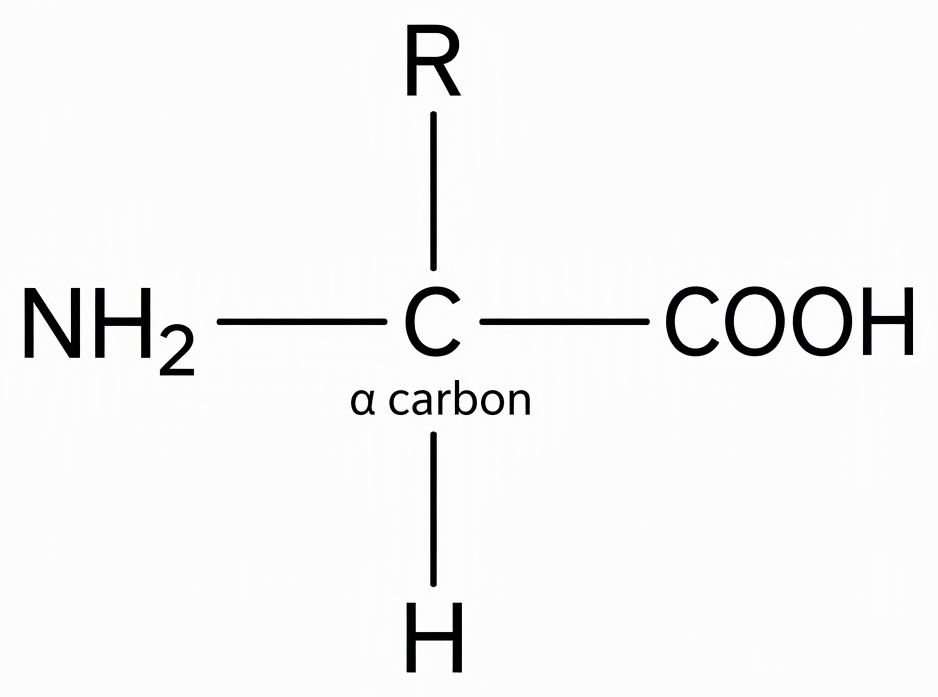
The general structure is:
Methane provides the reference framework: one carbon with four single bonds. Replacing hydrogen attachments gives a substituted-methane structure; it does not leave the molecule chemically unchanged.
Do not claim that all four attachments must be different. In glycine, the R position is occupied by hydrogen, so the alpha carbon carries two hydrogens. That exception does not invalidate the framework: A depends on the four attachments, not on their all being different.
How do the side chains establish C, B and D?
C is true, B is false and D is false: valine is neutral, serine is non-aromatic and lysine is basic. Following the supplied solution’s order, examine each side chain. Keep the classifications separate: polarity concerns charge distribution and interaction with water; aromaticity requires a suitable ring structure; acidic–basic classification concerns ionisable groups.
- Valine, statement C: Its side chain is a nonpolar, aliphatic hydrocarbon group:
It supplies neither an additional amino group nor an additional carboxyl group, so valine is classified as a neutral amino acid. Therefore, C is true.
Here, “neutral” is a classification, not a claim that valine lacks ionisable groups. Its backbone still contains amino and carboxyl groups, and its net charge can change with pH. Do not read “neutral amino acid” as “uncharged at every pH”.
- Serine, statement B: Its side chain contains an alcoholic hydroxyl group:
This hydroxyl group makes the side chain polar, but there is no aromatic ring. Therefore, B is false. A hydroxyl group alone cannot establish aromaticity: check the ring structure rather than treating the presence of oxygen as evidence.
- Lysine, statement D: Its side chain contains an additional amino group:
The additional amino group can accept a proton. Lysine is therefore classified as basic, not acidic, making D false. This acid–base verdict comes from the additional amino group, not from a polarity or aromaticity label.
Which numbered option matches the truth values?
Correct answer: option (3), A and C only. The complete sequence is A true, B false, C true, D false.
Match the entire set of true statements, not just one statement you recognise. Use this sequence: inspect the framework, inspect R, assign truth values, then match the combination.
How can a method mistake produce option (1)?
Calling lysine acidic because it contains a carboxyl group can make D look true. But all the amino acids discussed here have that backbone group. Its presence alone cannot distinguish acidic from basic amino acids; lysine’s additional side-chain amino group determines its basic classification.
This reasoning can lead to option (1) only if A is also wrongly rejected. One route is reading “substituted methane” as “unchanged methane” and objecting that amino acids do not have methane’s molecular formula:
That tests the wrong claim. A concerns the central-carbon framework, not the whole molecule’s formula.
Restore A as true, change D to false and retain C: the result is option (3). Under a marking scheme awarding 4 marks for a correct answer and deducting 1 for a wrong answer, the correction changes the score by:
How do the same checks solve three related Biomolecules questions?
Check the alpha-carbon attachments for a framework question; inspect the side chain for polarity, aromaticity or acid–base classification. These are original practice questions from Biomolecules, not additional verified PYQs.
What occupies the R position in glycine?
Answer: (1), hydrogen. Use the general alpha-amino-acid structure to compare the choices:
The framework already includes one hydrogen on the alpha carbon. Putting hydrogen in the R position means that glycine’s alpha carbon carries two hydrogens, not four different attachments:
Which description fits an amino acid with serine’s side chain?
Answer: (2), polar, non-aromatic and neutral. The side chain being tested is:
The alcoholic hydroxyl group gives polarity, but the side chain contains no aromatic ring. It also adds neither an amino group nor a carboxyl group, so serine is neutral in this classification. The hydroxyl group establishes polarity, not aromaticity or an acidic classification.
Which side chain identifies a basic amino acid?
Answer: (3), the side chain with an additional amino group. Compare the group beyond the shared amino-acid backbone:
- (1)
- (2)
- (3)
- (4)
The additional amino group in option (3) identifies lysine’s basic side chain. Option (4) instead contains an additional carboxyl group, supporting an acidic classification.
Before choosing, identify the extra side-chain group. Do not classify an amino acid from the carboxyl group shared by the backbone.
Next step: the past-paper archive on NEET JEEnius AI and search past NEET papers by year, subject or chapter, each with a worked solution (100 free searches a month).
If that step was the hard part, work through Motional EMF NEET 2026: Why the Active Length Is 3 cm.
Frequently asked questions
What is the correct answer to the amino acids NEET 2026 question?
Option (3), A and C only, is correct. The substituted-methane framework statement and valine's neutral classification are true; the claims that serine is aromatic and lysine is acidic are false.
Why are alpha-amino acids described as substituted methane?
Their alpha carbon has four attachments: an amino group, a carboxyl group, hydrogen and an R group. The description refers to this bonding framework, not the molecular formula of methane. In glycine, R is hydrogen, so the alpha carbon has two hydrogens without invalidating the framework.
Why is valine classified as a neutral amino acid?
Valine has a nonpolar hydrocarbon side chain that adds neither an amino group nor a carboxyl group. It is therefore classified as neutral, but its backbone still contains ionisable groups and its net charge can change with pH.
Is serine aromatic or polar?
Serine is polar, non-aromatic and neutral in the classification used here. Its side-chain hydroxyl group gives polarity, but the side chain has no aromatic ring.
Why is lysine basic and not acidic?
Lysine has an additional amino group in its side chain that can accept a proton, making it basic. The backbone carboxyl group alone does not determine its classification because that group is shared by the amino acids discussed.