What is the answer to the motional EMF NEET 2026 question?
Option D is correct: use the 3 cm side, not the 8 cm side. The motional EMF NEET 2026 question is a single-correct Physics question from Electromagnetic Induction and Alternating Currents, tagged medium on this question bank’s scale.
A rectangular wire loop measuring 8 cm by 3 cm has a small break and is leaving a uniform magnetic field of 0.3 T, perpendicular to the loop’s plane. It moves at 2 cm/s perpendicular to its 3 cm side; you must find the emf across the break.
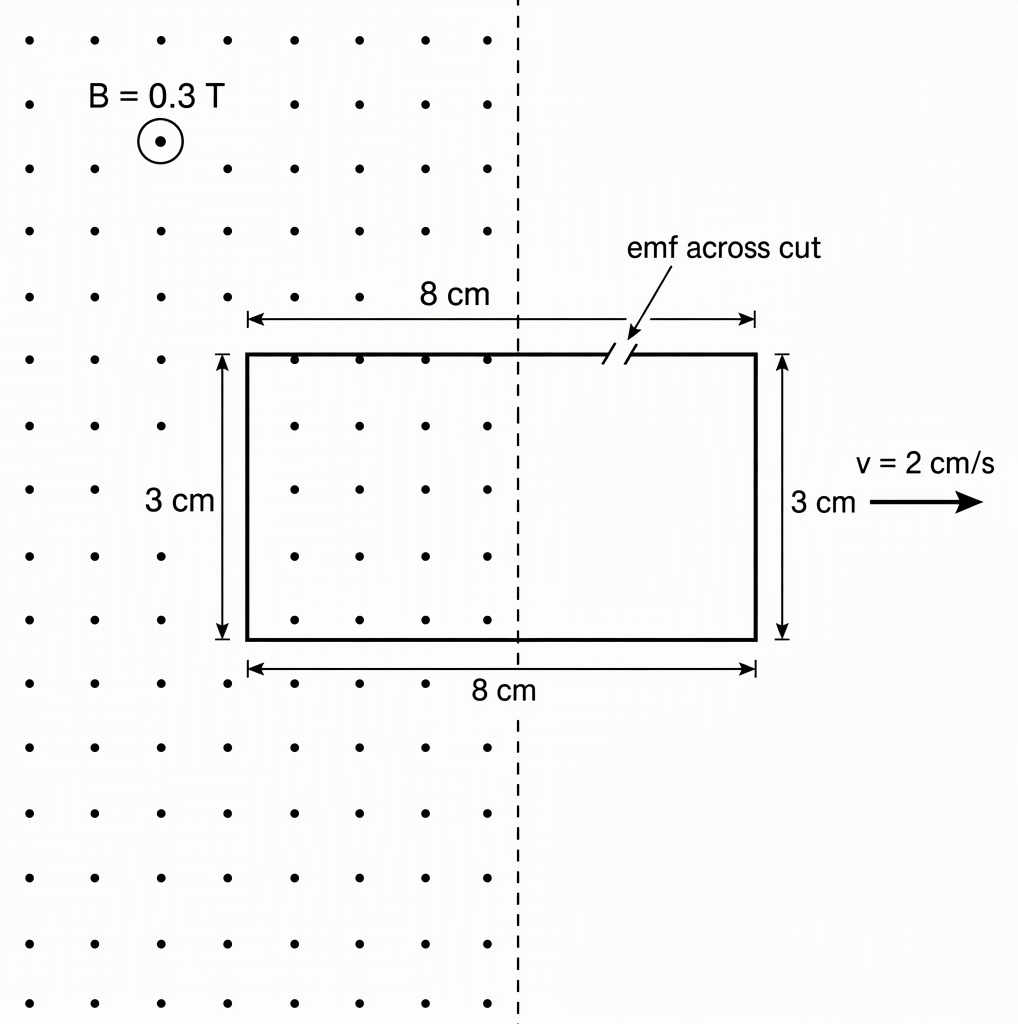
The out-of-page field is a drawing convention. The question asks for magnitude, not polarity.
The supplied answers are:
- A
- B
- C
- D
Why is the active length 3 cm rather than 8 cm?
The velocity is perpendicular to the shorter side, so the active length is 3 cm. The relevant side is the vertical 3 cm segment still inside the magnetic field.
The official solution uses this relation for mutually perpendicular magnetic field, velocity and active conductor length:
Here:
The 8 cm sides run parallel to the motion in the sketch. They are not the conductor length perpendicular to motion required in this calculation.
The active length is neither the loop perimeter nor whichever dimension is larger. Choose it from the directions of the field and motion, not from the size of the rectangle.
The small cut prevents a sustained circulating conduction current. It does not prevent an emf across the gap: magnetic force can separate charges even though the conducting path is open.
How do you convert the units and calculate option D?
Convert both centimetre quantities to SI units before multiplying. The speed needs metres per second, and the active length needs metres. Converting only one of them leaves a factor-of-100 error.
Write the given values:
Substitute into the official formula:
Separate the numerical multiplication from the powers of ten:
Therefore:
The correct answer is D. As a unit check, the same magnitude in millivolts is:
That is an equivalent value, not another supplied option. The bank’s expected solving time is 60 seconds, not a measured student average or an exam-imposed limit.
Use this execution sequence:
- Select the perpendicular length.
- Convert both centimetre quantities.
- Multiply.
- Match the option.
Why does using 8 cm give option A, and why is it wrong?
Using 8 cm produces option A exactly, but the physical choice of length is wrong. It substitutes a dimension parallel to the velocity instead of the active length perpendicular to it.
The wrong-length calculation is:
The unit conversions and multiplication are correct. Changing the arithmetic cannot fix this error; the selected side must change.
Because the formula is directly proportional to active length, this substitution inflates the answer by exactly:
Do not start by choosing the longer side. Point to the velocity arrow, identify the perpendicular side, and only then write the active length. Check the geometry before doing any arithmetic.
Which two practice questions check the same method?
The two questions below test scaling and rearrangement using the same active length. Both are author-created practice based on the solved question, not additional verified NEET PYQs. Keep the original arrangement unchanged and attempt each before reading its working.
What happens to the emf if the speed doubles to 4 cm/s?
The emf doubles because the magnetic field and active length stay fixed. Question 1 changes only the speed, from 2 cm/s to 4 cm/s. Use a ratio rather than repeating every substitution:
What speed gives an emf of 1.8 millivolts?
The required speed is 0.2 m/s, or 20 cm/s. Question 2 keeps the magnetic field at 0.3 T and the active length at 3 cm, but asks for the speed giving:
Rearrange the same formula, keeping the length in metres:
The requested emf is ten times the original, so the speed must also be ten times the original when the field and active length remain fixed. Now cover the workings and solve both again, using the speed ratio to check each answer.
Next step: photograph a doubt on NEET JEEnius AI and photograph any question you are stuck on and get a step-by-step solution across Physics, Chemistry and Biology (20 free a month).
Read next: Waves Practice Questions NEET: 6 MCQs With Worked Answers.
Frequently asked questions
What is the correct answer to the motional EMF NEET 2026 loop question?
Option D is correct: the emf across the break is 1.8 × 10⁻⁴ V. Using E = Bvl, substitute B = 0.3 T, v = 0.02 m/s and l = 0.03 m. Both the speed and the active length must be converted to SI units before multiplying.
Why do we use 3 cm instead of 8 cm in E = Bvl?
The loop moves perpendicular to its 3 cm side, so that side is the active conductor length for this arrangement. The 8 cm sides are parallel to the motion and are not the required length. Using 8 cm gives 4.8 × 10⁻⁴ V, option A, but the geometry is wrong.
Can an emf exist across a break in an open wire loop?
Yes, an emf can exist across the break because magnetic force can separate charges in the moving conductor. The break prevents a sustained circulating conduction current; it does not prevent an emf across the gap.
What happens to the motional emf if the speed doubles?
With the magnetic field, active length and geometry unchanged, E = Bvl makes the emf directly proportional to speed. Increasing the speed from 2 cm/s to 4 cm/s doubles the emf from 1.8 × 10⁻⁴ V to 3.6 × 10⁻⁴ V.