
Which free Waves practice questions for NEET should you choose?
Use NCERT exercises when concepts are unclear, source-checked NEET previous-year questions for exam-style application, and the original MCQs below for an immediate diagnostic. This page compares free Waves practice questions for NEET by the errors they help fix, with six questions and worked answers available here.
The scope is mechanical waves and sound, not Wave Optics. Keep full-length mocks for later, when you need to test mixed-subject execution. A full paper can expose time-management errors, but it is not the first remedy for misunderstanding wave propagation.
How do NCERT, NEET PYQs, this diagnostic and full mocks compare?
NCERT rebuilds fundamentals; source-checked PYQs test authentic exam wording; this diagnostic identifies specific errors; full mocks test execution across subjects. Choose by the mistake you need to fix, not by the size of a question bank.
- Practice option: NCERT Waves exercises through the official digital textbook
- Best use: Fundamentals and relationships between physical quantities.
- Question format: Textbook exercises, not uniformly single-correct MCQs.
- Answers or explanations: Chapter explanations and any supplied exercise answers, not a fully worked NEET question bank.
- Limitation: It does not reproduce the MCQ format throughout.
- When to choose it: You remember a formula but cannot explain its assumptions.
- Practice option: Source-checked NEET PYQs
- Best use: Authentic exam wording and application.
- Question format: Accept a question as a PYQ only when its paper provenance and answer key can be checked.
- Answers or explanations: Check the applicable official answer key through NTA, including neet.nta.nic.in. An answer key identifies the accepted option; it is not a worked explanation.
- Limitation: Do not assume third-party explanations are available or accurate.
- When to choose it: You can solve basic questions without notes.
- Practice option: This original diagnostic
- Best use: Locating a specific conceptual gap.
- Question format: Six free, single-correct MCQs.
- Answers or explanations: Worked solutions immediately after the questions.
- Limitation: Neither a complete chapter bank nor a past NEET paper.
- When to choose it: You need to identify what to revise now.
- Practice option: NEET JEEnius AI full-length mocks
- Best use: Mixed-subject execution.
- Question format: 180 questions, 720 marks and 180 minutes.
- Answers or explanations: A scored per-subject breakdown; no worked-solution service is claimed here.
- Limitation: A Waves-only filter, fixed Waves question allocation and chapter-level analytics are not established by the supplied product facts.
- When to choose it: Waves is manageable alone but difficult inside a full paper. There are 30 free mocks a month.
Which option fits your current preparation?
Your ability to explain a solution matters more than your class or attempt number. A Class 11 student with sound reasoning can move to PYQs, while a dropper may still need the textbook for one weak idea.
- Class 11, confusing particle motion with wave propagation: Start with the NCERT explanation and relevant exercises. Explain how a disturbance travels along a string while each string element moves transversely. Then attempt the diagnostic without notes.
- Class 12, remembering formulas but misreading signs or pipe ends: Attempt the diagnostic first. Repair the named error, such as phase interpretation or boundary conditions, before moving to source-checked PYQs.
- Dropper, recognising memorised PYQ answers: Use fresh original questions. Write the governing relation and explain why it applies before selecting an option. Recognising a familiar answer is not independent solving ability.
- Student solving Waves comfortably but losing marks in mixed papers: Use a full-length mock. Examine your execution and the available Physics score breakdown, then check whether rushing, question selection or calculation caused the loss.
For parents, ask the student to explain one solution without looking at it. That tells you more than a claim of having completed hundreds of questions.
Free practice is not inferior because it is free. Judge whether the question tests the right concept and its answer can be justified.
Can you solve these six original Waves MCQs without notes?
Attempt all six before reading the answers, and record your reasoning as well as your option. Each question is original NEET-style practice, not a PYQ, an official question or a prediction. Each has exactly one correct answer.
Use the idealisations stated in each question. This set tests specific decisions, not complete syllabus coverage.
1. Original NEET-style practice: travelling wave
A transverse wave on an ideal string is described below. The wave number and angular frequency are positive. Choose its propagation direction and speed, not the velocity of a string particle.
2. Original NEET-style practice: medium boundary
A sinusoidal mechanical wave driven by an unchanged source enters a stationary region where its speed is greater. Consider the transmitted wave. Which statement describes its frequency and wavelength?
- A: Frequency increases; wavelength stays unchanged.
- B: Frequency stays unchanged; wavelength decreases.
- C: Frequency stays unchanged; wavelength increases.
- D: Frequency and wavelength both stay unchanged.
3. Original NEET-style practice: stretched string
An ideal stretched string has fixed linear mass density. Its tension changes as shown; assume its other relevant properties remain unchanged. How does the final wave speed compare with the initial speed?
- A: The speed becomes four times its initial value.
- B: The speed becomes twice its initial value.
- C: The speed becomes half its initial value.
- D: The speed stays unchanged.
4. Original NEET-style practice: air columns
An open-open pipe and a closed-open pipe have equal effective lengths and the same sound speed. The effective lengths account for the boundary positions used in the model. How do their fundamental frequencies compare?
- A: The open-open frequency is half the closed-open value.
- B: Their frequencies are equal.
- C: The open-open frequency is four times the closed-open value.
- D: The open-open frequency is twice the closed-open value.
5. Original NEET-style practice: beats
Two steady sound waves of comparable amplitudes have the nearby frequencies below. What is the beat frequency, meaning the number of loudness cycles per second?
6. Original NEET-style practice: standing waves
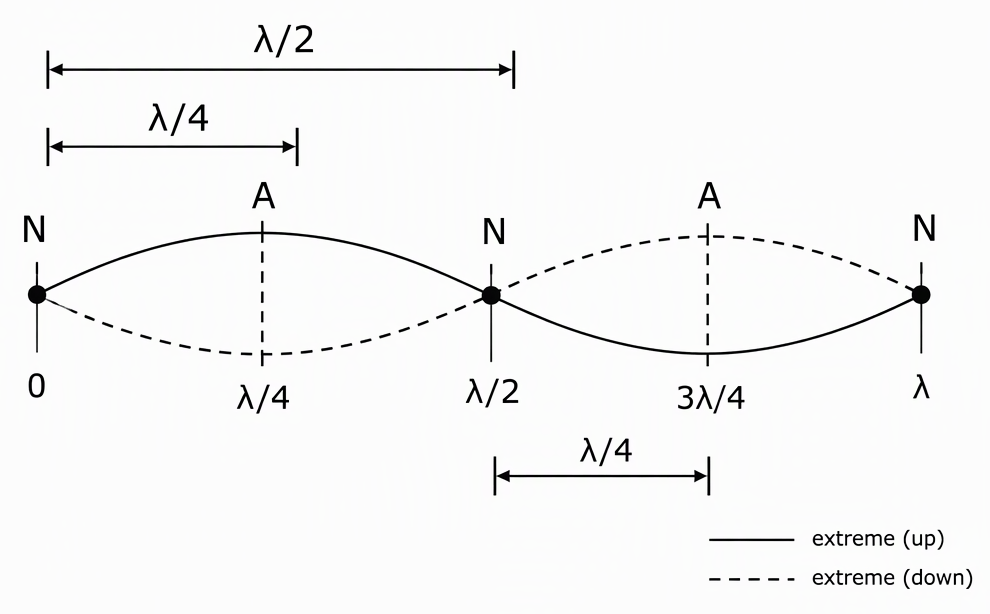
Two identical sinusoidal waves travel in opposite directions on an ideal string, forming a standing wave. Their wavelength is given below. What is the distance between adjacent nodes, rather than between a node and its nearest antinode?
What are the correct answers, and what does each mistake reveal?
The answer key is 1 B, 2 C, 3 B, 4 D, 5 A and 6 C. Check your reasoning even when the option is correct: a guess does not demonstrate understanding. Revise the concept named in the solution rather than restarting the entire chapter after one wrong answer.
1. B: Phase interpretation
Track a point of constant phase, such as a crest. As time increases, its position must increase.
The positive wave velocity establishes the propagation direction. Transverse particle velocity describes the up-and-down motion of one string element and is different:
2. C: Frequency continuity
The unchanged source fixes the frequency. At a stationary boundary, the transmitted wave retains that frequency; the greater propagation speed therefore requires a longer wavelength.
3. B: Proportional reasoning
Speed depends on the square root of tension, not directly on tension. Keep linear mass density fixed when taking the ratio.
4. D: Boundary conditions
An open end is a displacement antinode; a closed end is a displacement node. With equal effective lengths, the open-open fundamental fits half a wavelength, while the closed-open fundamental fits a quarter.
5. A: Beat-frequency confusion
Beat frequency is the absolute frequency difference. Neither the sum nor half the difference gives the number of loudness cycles per second.
6. C: Standing-wave geometry
Adjacent nodes are half a wavelength apart. A nearest antinode lies halfway between them, so node-to-antinode spacing is only a quarter wavelength.
What should you practise next, and when is a full mock useful?
Use a full mock after you can explain your Waves solutions without notes; before that, fix the specific error and retest it. Your next questions should test the corrected idea, not your memory of these answers.
- Attempt without notes.
- Mark each answer correct, wrong or unattempted.
- Classify the error using the solution labels.
- Revisit the relevant explanation or NCERT passage.
- Solve a fresh question testing the same idea, and explain your method.
You may apply the official marking rule to practice. Unattempted answers receive zero.
Here, the letters represent score, correct answers and wrong answers respectively. Do not convert this short diagnostic score into a predicted NEET score, rank or readiness percentile.
Current full papers contain 180 compulsory single-correct questions in 180 minutes, including 45 Physics questions. There is no optional Section B. The paper-wide average is one minute per question, not a compulsory limit for every Waves calculation.
Looking for interference and diffraction instead? Use Wave Optics Practice Questions NEET: 6 Solved MCQs.
Once the chapter-level errors are repaired, NEET JEEnius AI offers 30 free full-length mocks a month, with 45 Physics, 45 Chemistry and 90 Biology questions and a scored per-subject breakdown. Use one to check whether your corrected Waves reasoning survives a mixed paper.
Frequently asked questions
Where can I get free Waves practice questions for NEET?
Use NCERT Waves exercises through the official digital textbook to rebuild fundamentals, then attempt source-checked NEET previous-year questions for exam-style application. This article also provides six free original MCQs with worked solutions to identify specific conceptual errors.
Are these Waves questions actual NEET PYQs?
No, all six questions are original NEET-style practice, not previous-year questions, official questions or predictions. Each has one correct answer and a worked solution explaining the governing concept.
Do these Waves questions cover Wave Optics?
No, this diagnostic covers mechanical waves and sound, not Wave Optics. It tests wave direction, frequency at a boundary, string tension, air columns, beats and standing-wave spacing.
Should I practise Waves separately or take a full NEET mock?
Practise Waves separately until you can explain your solutions without notes, repairing specific errors and testing each corrected idea with a fresh question. Use a full mock when you can solve chapter questions but struggle with execution in a mixed paper. NEET JEEnius AI offers 30 free full-length mocks a month with a scored per-subject breakdown.