
Should I start Thermodynamics practice with chapter MCQs, PYQs or mocks?
For Thermodynamics practice questions for NEET, choose worked chapter MCQs to repair concepts, authenticated NEET PYQs to calibrate exam-style application, and full mocks to test performance across subjects. This page provides six free original Physics and Chemistry questions, with answers separated below. Full mocks are not an efficient substitute for targeted chapter repair. Identify the error first, then choose the practice route that addresses it.
How do free chapter questions compare with NEET PYQs and full mocks?
Chapter MCQs diagnose specific ideas, PYQs test application to actual exam wording, and mocks expose mixed-paper performance problems. Compare them by the mistake you need to investigate, not by advertised question-bank size.
- Purpose
- This page: Repair concepts through original practice questions with worked solutions.
- Authenticated NEET PYQs: Calibrate your understanding against questions actually asked.
- Full-length mocks: Test pacing, question selection and performance across subjects.
- Chapter focus
- This page: Six Thermodynamics questions, three Physics and three Chemistry.
- Authenticated NEET PYQs: Chapter-selected questions allow focused practice.
- Full-length mocks: Mixed-subject papers. No Thermodynamics question count is established for these mocks.
- Provenance
- This page: Original NEET-style practice, not actual NEET questions.
- Authenticated NEET PYQs: Check wording and keys against official released material where available, through neet.nta.nic.in.
- Full-length mocks: Practice papers, not authenticated past papers.
- Solution availability
- This page: Every worked answer is visible below.
- Authenticated NEET PYQs: Do not assume every free collection includes worked explanations.
- Full-length mocks: The verified provision includes a scored per-subject breakdown; that does not establish worked-solution availability.
- Diagnostic value
- This page: Exposes specific sign, process and thermochemistry errors.
- Authenticated NEET PYQs: Reveals difficulty applying concepts to actual exam wording.
- Full-length mocks: Shows subject-level performance. A per-subject breakdown is not a Thermodynamics-specific diagnosis.
- Exam realism
- This page: Single-correct MCQs without whole-paper pressure.
- Authenticated NEET PYQs: Actual historical exam wording, but isolated chapter practice removes mixed-paper demands.
- Full-length mocks: For mixed-paper practice, NEET JEEnius AI provides 30 free a month, each with 180 questions, 720 marks and 180 minutes: 45 Physics, 45 Chemistry and 90 Biology questions.
- Limitations
- This page: A narrow diagnostic, not complete chapter coverage.
- Authenticated NEET PYQs: Establish what was asked, not what will repeat.
- Full-length mocks: Spread attention across subjects, making them inefficient for repairing one repeated misconception.
Which Thermodynamics practice route should I choose right now?
Choose by your error, not your class label. A dropper repeating sign errors needs convention repair; a student who solves chapter questions correctly but loses marks in mixed papers needs to examine pacing and attempt decisions.
- Class 11, chapter just completed: If you cannot explain the signs of heat and work, begin with untimed chapter MCQs. Explain each sign before calculating.
- Class 12, revising the chapter: If solutions make sense but unfamiliar wording defeats you, check the relevant concepts, then attempt authenticated PYQs.
- Dropper, repeating sign or process errors: Return to targeted chapter questions rather than using more full papers to practise around the same misconception.
- Correct in chapter practice, weaker in mixed papers: Use full mocks to examine pacing, attempt decisions and performance across subjects.
Physics readers should begin with P1–P3 in the next section. Chemistry readers can go directly to C1–C3 under the Chemistry heading. Attempt your set before reading the worked answers.
Can I attempt free Physics Thermodynamics questions now?
P1–P3 below are free original NEET-style practice questions, not PYQs, and each has exactly one correct answer. They test work conventions, state functions and adiabatic expansion. Attempt them untimed and write one sentence explaining each choice to distinguish reasoning from guessing.
P1. What is the internal-energy change?
A closed system absorbs heat and does work on its surroundings. Use the positive magnitudes defined below; work is positive when done by the system.
Which expression gives its internal-energy change?
- A:
- B:
- C:
- D:
P2. What must return to its initial value?
A closed system completes a thermodynamic cycle and returns to its initial state. Heat transferred into the system is positive, and work done by the system is positive. Which quantity must have zero net change or net transfer over the cycle?
- A: Net heat transferred.
- B: Net work done.
- C: Internal energy.
- D: Both net heat and net work individually.
P3. What happens during adiabatic expansion?
A fixed amount of ideal gas in an insulated piston-cylinder undergoes reversible adiabatic expansion. Work done by the gas on its surroundings is positive. What happens to its temperature?
- A: It remains constant because no heat enters or leaves.
- B: It decreases.
- C: It increases because the gas expands.
- D: It must remain constant in every reversible process.
Can I attempt free Chemistry Thermodynamics questions too?
C1–C3 are free original NEET-style practice questions, not PYQs, covering reaction energy, enthalpy transformations and spontaneity. Each has four options and exactly one correct answer, with worked answers in the following section. Keep reaction quantities attached to the stated stoichiometric equation, and remember that thermodynamic spontaneity does not establish reaction speed.
C1. How are reaction enthalpy and internal energy related?
For a reaction at temperature expressed in kelvin, gases obey the ideal-gas approximation. Neglect condensed-phase volume contributions and use these symbols:
Which relation is correct?
- A:
- B:
- C:
- D:
C2. How does reversing and doubling affect enthalpy?
A reaction has the original enthalpy change defined below. The reaction is reversed, and all stoichiometric coefficients are doubled.
What is the enthalpy change for the new equation?
- A:
- B:
- C:
- D:
C3. When is the forward process spontaneous?
At constant temperature and pressure, a process has the following changes:
Assume both are approximately temperature-independent over the range considered. Using the Gibbs relation below, when is the forward process thermodynamically spontaneous?
- A:
- B:
- C:
- D: Never, because the process is endothermic.
What are the correct answers, and why do the tempting options fail?
The key is P1 A, P2 C, P3 B, C1 B, C2 D and C3 C. Check the governing principle even when your option matches. A correct choice based on the wrong work convention or a guessed temperature trend still needs correction.
P1: A. Apply conservation of energy with a defined work convention.
Heat absorbed adds energy; work done on the surroundings transfers energy out. With work positive when done by the system:
Chemistry commonly defines work as positive when done on the system. Its form of the first law is:
For the same process:
These are consistent definitions, not conflicting physical laws. Option B incorrectly treats work done by the system as energy entering it.
P2: C. Internal energy is a state function.
Its change depends only on the initial and final states. Those states coincide after a complete cycle:
Heat and work are path-dependent transfers, not stored state quantities. Neither must individually vanish; under the Physics convention, their net amounts satisfy:
Option D confuses zero change in stored energy with zero energy transfer. Energy can enter as heat and leave as work during the same cycle.
P3: B. Adiabatic does not mean isothermal.
Insulation prevents heat transfer, but the expanding gas still does positive work. That work comes from its internal energy.
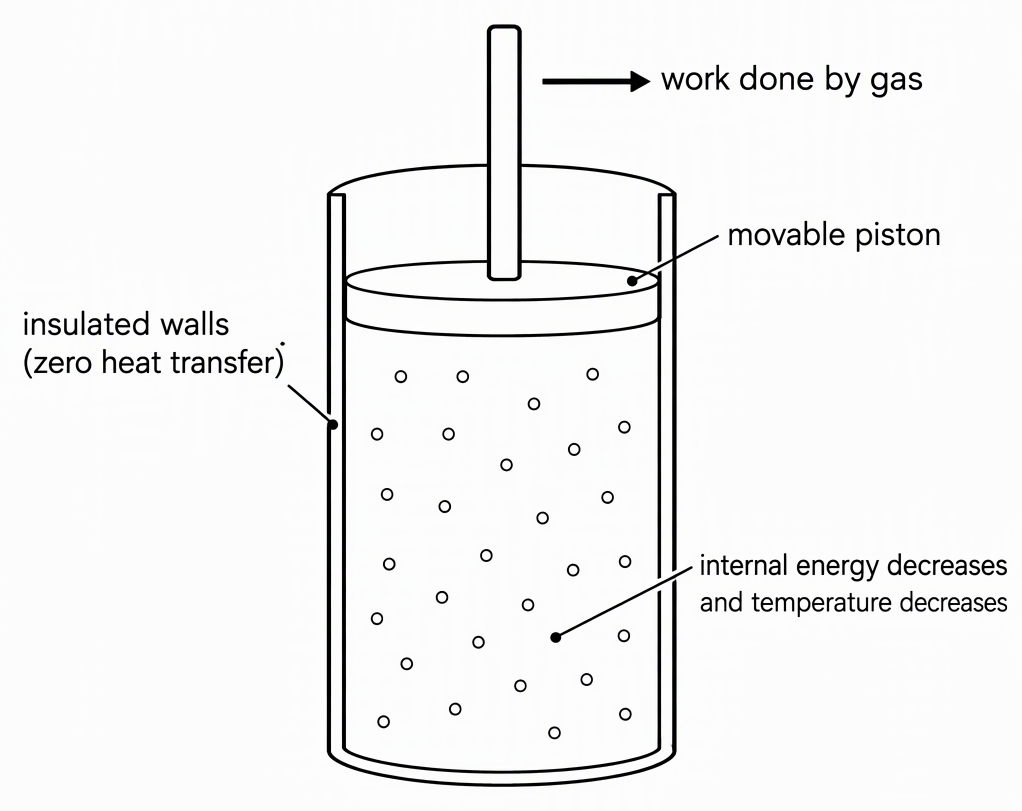
For a fixed amount of ideal gas, internal energy depends only on temperature. For constant positive molar heat capacity:
The temperature therefore falls. Option A confuses no heat transfer with no temperature change.
C1: B. Start from the definition of enthalpy.
Enthalpy includes internal energy and the pressure-volume term. Its definition is:
Under the stated approximation, the reaction change in that term comes from the change in gaseous stoichiometric amount. Apply the ideal-gas relation at the stated temperature:
Count only gaseous coefficients, products minus reactants. Option C assumes that the gaseous mole change is always one; option A reverses its sign.
C2: D. Apply reversal and scaling separately.
Reaction enthalpy changes sign when the reaction is reversed. Doubling the entire equation then doubles that reversed enthalpy change:
These operations follow the state-function basis of Hess’s law. Option A ignores reversal, while option B ignores doubling.
C3: C. Spontaneity requires negative Gibbs energy change.
At constant temperature and pressure, the forward process is thermodynamically spontaneous when its Gibbs energy change is negative. Substitute the given enthalpy and entropy signs into that condition:
Because the entropy change is positive, rearrangement gives:
At equality, the Gibbs energy change is zero, the equilibrium boundary under these assumptions, not a negative driving force. Option D ignores the favourable entropy contribution at sufficiently high temperature.
Use kelvin for temperature. The enthalpy term and the temperature-times-entropy term must have compatible energy units, so convert joules and kilojoules before subtracting. A negative Gibbs energy change does not tell you how quickly the reaction proceeds.
How should I use my mistakes to choose the next free practice step?
Turn each wrong answer into a specific revision task, then test the corrected idea with a different question. Immediate recall of the answer you just read is not proof of mastery. This six-question diagnostic cannot establish a predicted NEET score or a readiness threshold.
- P1: Revise work conventions and energy entering or leaving the system.
- P2: Separate state functions from path-dependent transfers.
- P3: Revise adiabatic processes and ideal-gas internal energy.
- C1: Rebuild the enthalpy–internal-energy relation and gaseous mole counting.
- C2: Practise Hess’s law, equation reversal and coefficient scaling.
- C3: Revise Gibbs energy, equilibrium and unit consistency.
For every error, record the mistaken assumption, write the corrected principle and attempt a different question testing that principle. Move to authenticated PYQs when you can explain the reasoning without looking back at the solution.
If knowledge is sound but attempt decisions cost marks, use NEET Question Selection: What to Attempt, Skip and Revisit. The current paper has 180 compulsory questions and no optional Section B, so mixed-paper practice must include deliberate skip-and-return decisions.
When you are ready for that step, NEET JEEnius AI offers 30 free full-length mocks a month with a scored per-subject breakdown. Use one to examine pacing and subject-level performance, then return to targeted questions for any Thermodynamics error you can explain precisely.
Frequently asked questions
Should I practise Thermodynamics chapter MCQs, NEET PYQs or mocks first?
Start with targeted chapter MCQs if you repeat sign, process or thermochemistry errors. Use authenticated NEET PYQs when you can explain the concepts but struggle with unfamiliar exam wording. Move to full mocks when pacing and attempt decisions across subjects are the main problem.
Are these Thermodynamics questions actual NEET PYQs?
No. These are six original NEET-style questions: three Physics and three Chemistry MCQs, each with one correct answer and a worked solution. They provide a narrow diagnostic, not complete chapter coverage or a predicted NEET score.
Why do Physics and Chemistry use different signs for work in Thermodynamics?
The sign depends on how work is defined. With work W positive when done by the system, the first law is ΔU = Q − W. Chemistry commonly takes work w as positive when done on the system, giving ΔU = q + w. For the same process, q = Q and w = −W, so both equations express the same energy balance.
Why does temperature decrease during reversible adiabatic expansion of an ideal gas?
No heat enters or leaves during an adiabatic process, but the expanding gas does positive work on its surroundings. That work reduces its internal energy. For a fixed amount of ideal gas, internal energy depends only on temperature, so the temperature falls.