
Which questions should I attempt first in NEET?
Attempt questions whose answers you can justify quickly: that is the core of NEET question selection. Start in the subject where timed mocks consistently show your most reliable opening performance. A familiar chapter name is not enough; you need a fact or principle that leads to a defensible answer.
The current paper has 180 compulsory single-correct questions in 180 minutes. Compulsory means there is no optional question pool, not that every answer must be marked. The marking scheme is:
- Choose your starting subject from timed mocks. Compare correct opening attempts, stalled questions and recording errors across repeated mocks. Biology is a reasonable default to test because it contributes 90 questions and 360 marks. That does not prove every student should start there.
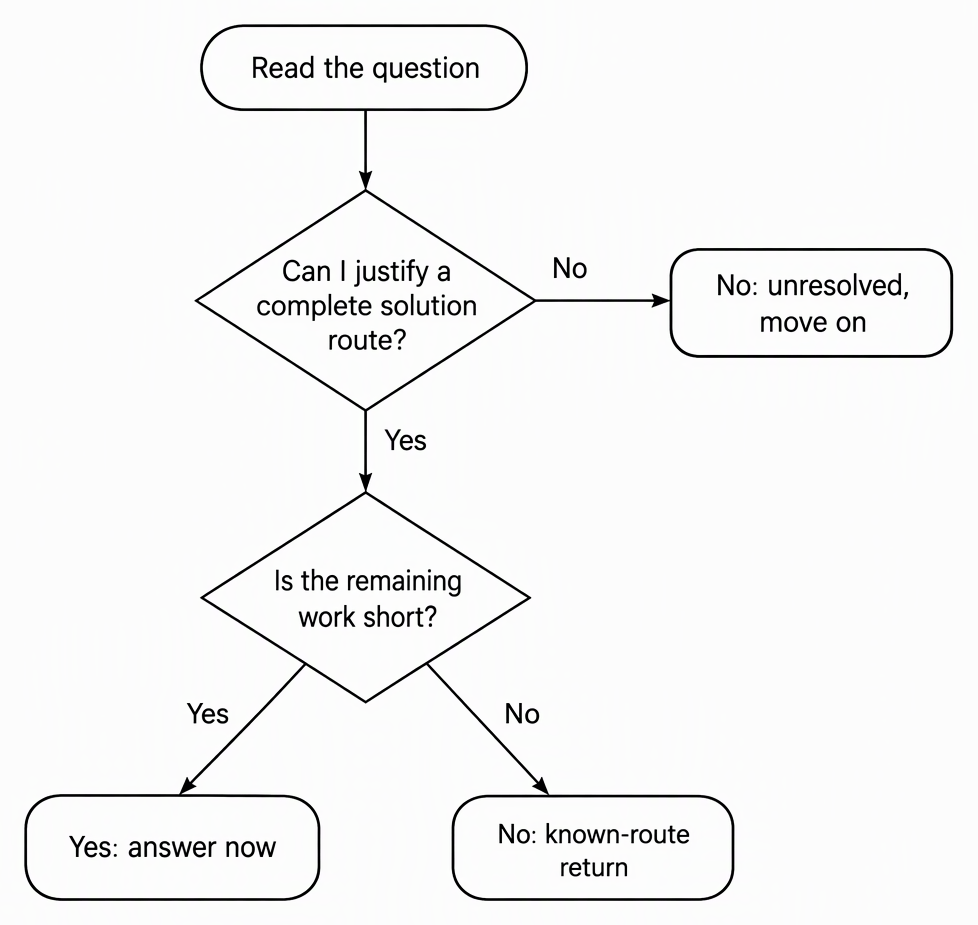
- Classify each question as you read it. Use three categories: answer now, return with a known route, or unresolved. Do not conduct a separate scan of the entire paper; classify while reading to solve.
- Require a complete route before choosing “answer now”. Identify the tested fact or principle, then check that the remaining work is short and clear. Recognising the chapter does not establish either condition.
A long statement question can be direct if you can verify every statement. A short question can be unresolved if you cannot identify its concept. Length measures reading, not difficulty.
When should I stop, and how should I return without OMR errors?
Stop when the attempt stops producing useful information, not when an arbitrary stopwatch limit expires. Return according to what remains to be solved, rather than booklet order. Keep answer recording separate from navigation: your question booklet holds return marks; your OMR holds answers.
- Exit when progress stops. Leave when rereading gives no new interpretation, a calculation repeats without progress, or the expected method fails and no alternative is clear. For a solvable return, retain the equation or factually eliminated options and add a simple “R” in the booklet; use “U” for unresolved. Never put navigation marks on the OMR.
- Return to bounded work first. A question needing one unit check belongs ahead of an earlier question whose governing principle remains unknown. Elimination counts only when supported by a fact. “This option looks familiar” is not elimination.
- Use the OMR routine already tested in your mocks. Do not adopt a new universal batch size on exam day. Whenever a skip creates a gap, match the printed question number to the OMR row before filling the bubble. Never infer the row merely from the previous answer.
This OMR advice applies to the confirmed offline format through 2026. A computer-based format for 2027 is not confirmed; check neet.nta.nic.in for official updates.
Keep guessing separate from first-pass prioritisation: unresolved questions must not displace secure answers. Any late uncertain attempt must account for negative marking and the time remaining. Selection does not make uncertain answers safe or guarantee a score increase. Use NEET Time Management: A 180-Minute Plan With OMR Checks for the wider timing plan.
Should I finish every Biology question before moving on?
No. Starting with Biology means beginning a Biology pass, not treating every Biology question as an immediate task. Classify each question by its solution route. The following is an illustrative scenario, not an actual NEET paper or a measured student result.
The opening question asks: “In DNA fingerprinting, does transfer to a membrane occur before or after hybridisation with a labelled probe?” The student recognises the topic but cannot recall the order. This question is unresolved.
The next question asks which statements about typical flowering-plant reproduction are correct. The student can explain each statement:
- The egg apparatus contains one egg cell and two synergids.
- Triple fusion involves one male gamete and the two polar nuclei or their fused secondary nucleus.
- After fertilisation, the ovule develops into a seed and the ovary into a fruit.
The student can select the option containing all three statements. Despite being longer, this is answer now.
Mark the sequence question “U” in the booklet, answer the statement question, then check its printed question number before filling the OMR. This order puts the justified answer first.
Recognising “DNA fingerprinting” is not recalling its sequence. Skipping schedules the question for later; it does not declare the chapter weak.
Can a Physics question deserve priority over a Chemistry recall question?
Yes. A Physics question with a complete solution route deserves priority over a Chemistry question supported only by recognition. Judge the work needed for the individual answer, not a subject-wide label such as “Physics is difficult”. This comparison is illustrative.
Consider: “What is the electric field inside the conducting material of a conductor in electrostatic equilibrium?” The field is zero:
A nonzero internal field would drive free charges, contradicting electrostatic equilibrium. The wording specifies conducting material, not an unspecified cavity, where the answer can depend on charges inside it. This is answer now: the principle and conclusion are both available.
Now consider a Chemistry question asking for ligands in increasing field strength. The student recognises the ligand names but cannot justify their order. That is unresolved until the student recalls the order or eliminates options for a valid factual reason.
This comparison does not require switching subjects after every question. Apply it within a planned subject pass or when choosing work from the return queue. “Physics last” must never become “all Physics questions deserve delay regardless of their actual demands”.
How do I leave a stalled calculation without wasting the work?
Keep the correct setup, identify the smallest useful check, and leave before repeating the same calculation. A known equation earns return priority only if the remaining check is bounded. This illustrative calculation shows both the exit and the return.
A capacitor has the following capacitance and potential difference. The question asks for its charge:
- Option A:
- Option B:
- Option C:
- Option D:
The student identifies the correct equation. But they substitute the capacitance without converting microfarads:
No option matches, and repeating the multiplication changes nothing. The student retains the equation, writes “R: check microfarads” in the booklet and moves on.
On return, this bounded unit check takes priority over an earlier skipped question whose governing principle is still unknown. The student finds that the capacitance was not converted into the units used in the equation:
Option B now matches both the value and the unit. If the check had not resolved the mismatch, and no new route emerged, the student should park the question again. Time already spent is not a reason to spend more.
How should I practise question selection before a full mock?
Start with covered-topic sets in Class 11, then extend the method into mixed-subject sets and full-length mocks in Class 12 or as a dropper. Audit your selection decisions, not just your correct answers. The aim is to check whether your initial classification matched the work actually needed.
During practice, use quick booklet labels: “A” for answer now, “R” for known-route return and “U” for unresolved. After checking answers, record the outcome and a short reason for delay or error. Keep logging short enough that it does not replace solving.
Review these three mistakes:
- Answer now, but wrong: Was the principle wrong, a qualifier missed, or familiarity mistaken for recall?
- Known-route return became a time sink: Was the remaining work genuinely bounded, or was the route incomplete?
- Skipped, but actually direct: Which fact or wording cue should have made the route visible?
Change your starting subject only after comparing repeated timed mocks. Judge correct answers, stalled attempts and answer-recording errors, not confidence alone or one uncomfortable paper.
Include physical OMR rehearsal with deliberately skipped questions. Practise leaving an unanswered row and correctly filling the next intended row.
For topic-level classification practice, NEET JEEnius AI practice mode provides sets that skip questions already seen, with 60 free sets a month. Use it for selection practice, not as a full-paper or OMR simulator.
Secure route: solve. Known but lengthy route: schedule a return. No defensible route: move on and reassess later.
Next step: daily practice problems on NEET JEEnius AI and get a fresh set on a topic every day (20 free attempts a month).
Frequently asked questions
Which questions should I attempt first in NEET?
Attempt questions where you can identify the tested fact or principle and complete the remaining work quickly. Choose your starting subject using repeated timed mocks, comparing correct opening attempts, stalled questions and recording errors. Biology is a reasonable default to test, not a compulsory starting point.
Do I have to answer all 180 compulsory questions in NEET?
No. Compulsory means there is no optional question pool, not that every answer must be marked. A correct answer earns 4 marks, a wrong answer loses 1 mark, and an unattempted question earns 0.
When should I skip a question in NEET?
Leave when rereading produces no new interpretation, a calculation repeats without progress, or your method fails with no clear alternative. Keep any correct equation or factually eliminated options in the booklet. On return, prioritise bounded work, such as a unit check, over questions whose governing principle remains unknown.
How do I avoid OMR mistakes after skipping questions?
Whenever a skip creates a gap, match the printed question number to the OMR row before filling the bubble. Keep return marks in the question booklet, never on the OMR. Use the recording routine tested in your mocks rather than adopting a new batch size on exam day.
How can I practise NEET question selection?
Start with covered-topic sets, then progress to mixed-subject sets and full-length mocks. Label questions as answer now, known-route return or unresolved, and review whether each classification matched the work actually needed. Include physical OMR practice with deliberately skipped questions.