
How should I manage the 180 minutes in NEET?
- Protect the final 10 minutes for an OMR audit. NEET time management must cover recording answers, not just solving questions. Set elapsed-time checkpoints before starting: Biology 0–55 minutes, Chemistry 55–95, Physics 95–155, flagged questions 155–170, and final OMR audit 170–180. These blocks total 180 minutes; this is a practice recommendation, not an official or universally optimal split.
- Start with the subject that gives reliable marks quickly. Use performance in full mocks to choose, not comfort with a favourite chapter. Biology-first is the worked template because Biology carries half the paper. Compare Chemistry-first or Physics-first in practice if either consistently gives you a better start without damaging later sections.
- Make solve, flag and skip decisions on the first pass. Answer clear questions, flag those with a known but lengthy route, and move past those with no workable approach. As trial guardrails, move on if no route appears after roughly 30 seconds, or about 90 seconds brings no meaningful progress. These are adjustable triggers, not official limits or compulsory cutoffs.
- Transfer answers to the OMR in small, rehearsed batches. Try filling after every five attempted questions, with that work included inside each subject’s budget. Match the printed question number on every transfer, especially after a skip: the next answer does not necessarily belong in the next row. Follow the exam’s marking instructions and never plan on erasing a bubbled answer.
- Move on at each subject checkpoint instead of borrowing silently. If you miss a checkpoint, calculate the remaining minutes and explicitly reset the remaining blocks. Recover time by deferring uncertain questions, not by rushing every calculation and reading every option faster. Keep OMR transfers within the revised blocks and preserve the audit.
- Return selectively, then stop solving for the audit. Choose flagged questions with the clearest route to a correct answer, rather than restarting everything in booklet order. At minute 170, stop solving and check pending decided answers, question-number alignment and unintended blanks. Do not casually change answers during this check or treat filled bubbles as erasable.
The official facts are separate from that proposed schedule. The current paper has 180 compulsory single-correct questions in 180 minutes: Biology contributes 90, and Chemistry and Physics contribute 45 each. Correct answers earn 4 marks, wrong answers lose 1, and unattempted questions earn 0. No optional Section B remains; “compulsory” means no optional question selection, not an obligation to guess every answer.
The calculation below gives only an overall average. Reading, calculation, OMR transfer and review all share those minutes, while individual questions take unequal time.
OMR guidance applies to the confirmed offline format through 2026. A 2027 computer-based switch is not confirmed, so check your year’s official bulletin at neet.nta.nic.in before choosing the format for full-paper rehearsal.
What should I do if Biology has flagged questions at minute 55?
Begin Chemistry at minute 55 rather than extending Biology to make it look complete. In this illustrative practice scenario, the student has considered all 90 Biology questions, marked 82 answers on the OMR and flagged eight unresolved questions in the booklet. This and the following examples are constructed practice scenarios, not actual candidate records or measured platform outcomes.
Keep the remaining checkpoints unchanged. Each subject’s first-pass deadline includes its OMR transfers:
- Minute 95: Finish the Chemistry first pass and its OMR transfers.
- Minute 155: Finish the Physics first pass and its OMR transfers.
- Minute 170: End flagged-question work.
- Minute 180: Complete the final OMR audit.
A first-pass checkpoint means you have moved through the section and recorded decided answers. It does not promise that every question will be answered within that block. Those eight flags are acceptable if the alternative was leaving Chemistry or Physics questions unseen.
At minute 155, compare flagged questions across all three subjects. A Chemistry question with a clear substitution may deserve attention before a Biology question still stuck between two options. Choose by clarity of approach and likely time required, not by which subject came first.
How do I recover if Biology takes 65 minutes?
Reset the remaining blocks and keep the OMR audit intact. In this illustrative practice scenario, Biology’s first pass ends at elapsed minute 65, ten minutes beyond the 55-minute checkpoint. Calculate the time still available:
One recovery option is to reduce Chemistry’s first pass from 40 to 35 minutes and Physics’s from 60 to 55 minutes. Keep the return block and final audit unchanged.
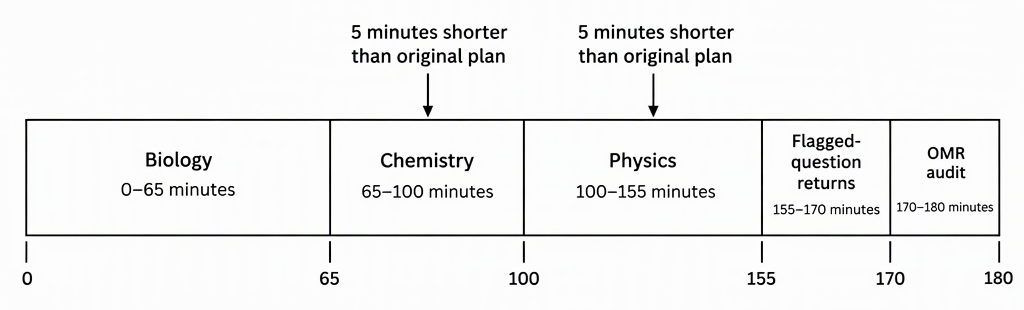
- Chemistry, 65–100: 35 minutes.
- Physics, 100–155: 55 minutes.
- Returns, 155–170: 15 minutes.
- Final audit, 170–180: 10 minutes.
The ten minutes come from five fewer first-pass minutes in each remaining subject. Defer uncertain or lengthy questions earlier; do not assume your calculation speed can suddenly improve. Continue the rehearsed OMR batches within both shortened subject blocks.
Use this split only if your practice supports it. If Physics needs more time, trim a different block explicitly, such as the return block, while retaining a final audit.
An overrun may reduce the number of questions attempted because less solving time remains. No honest method makes lost minutes disappear. Do not reclaim the ten minutes by postponing all OMR work until the end.
When should I abandon a Physics calculation that is taking too long?
Flag it when repeated work produces no useful progress, even if you have already invested time. In this illustrative practice scenario, a Physics calculation starts at elapsed minute 148. By minute 150, repeated algebra has not produced a usable result or a clearer route.
Two minutes already spent do not justify spending two more. The trial stop trigger has already been crossed, so inspect the remaining first-pass questions instead.
From minute 150 to 155, prioritise untouched questions with a clear approach. Transfer decided answers using the established OMR routine, including any pending batch before leaving the section. There is no guaranteed number you will finish in those five minutes.
At minute 155, compare the stuck calculation with other flags. Return only if a workable route is now clear and it is a better use of the return block.
At minute 170, stop solving and audit. If the skipped question is Q142, row 142 stays blank unless you later answer it; the answer to Q143 belongs in row 143, not the next empty row.
An intentional blank is different from a decided answer accidentally omitted during transfer. Check for that distinction without assuming an already misbubbled answer can be erased or overwritten.
How should I test and improve my NEET time management plan?
Run the proposed schedule in three full-length, 180-minute mocks. Use the applicable exam format, including a paper OMR for offline rehearsal. Three mocks are a suggested initial trial, not proof that the strategy is optimal.
After each mock, record:
- Subject start and finish times.
- Correct, wrong and unattempted counts by subject.
- Questions left unseen at each first-pass deadline.
- Time lost on stuck questions or repeated checking.
- OMR errors, including missed transfers and question-number mismatches.
Compare score as well as speed. Finishing early with more wrong answers is not automatically better NEET time management.
Change one variable at a time: subject order, a subject’s allocation, the skip trigger or OMR batch size. Keep the total at 180 minutes and preserve an explicit audit block. Otherwise, you cannot tell which change helped.
Match the next drill to the bottleneck:
- No method comes to mind: Revise the concept before another timed attempt.
- The route is known but slow: Practise that calculation type.
- Repeated checking consumes time: Rehearse the decision to flag and move on.
Between mocks, use short timed topic sets to practise solve, flag and skip decisions. Semiconductor Practice Questions NEET: 6 Explained MCQs offers a small Physics drill, but six topic questions cannot validate a complete paper strategy.
For fresh questions between full mocks, NEET JEEnius AI practice mode provides topic sets that skip questions already seen, with 60 free sets a month. Use a set to rehearse one decision rule, then test its effect in your next full paper.
Frequently asked questions
How should I divide the 180 minutes in NEET?
Try Biology from minutes 0–55, Chemistry 55–95, Physics 95–155, flagged questions 155–170 and a final OMR audit 170–180. Include OMR transfers within each subject’s block. This is a practice template, not an official split; adjust it using full-mock performance.
Which subject should I attempt first in NEET?
Start with the subject that consistently gives you reliable marks quickly in full mocks. Biology-first is a useful trial because Biology carries half the paper, but it is not compulsory. Test Chemistry-first or Physics-first if either improves your start without hurting later sections.
When should I fill the OMR sheet in NEET?
Transfer answers in small, rehearsed batches, such as after every five attempted questions, within each subject’s time budget. Match the printed question number on every transfer, especially after skipping a question. Keep the final 10 minutes for an audit rather than postponing all bubbling until the end, and never assume a filled bubble can be erased.
What should I do if Biology takes 65 minutes?
You have 115 minutes left, so explicitly reset the remaining blocks. One recovery option is Chemistry from minutes 65–100, Physics 100–155, flagged questions 155–170 and the OMR audit 170–180. Use this split only if your practice supports it, and recover time by deferring uncertain questions rather than rushing every calculation.
How can I improve my NEET time management in mocks?
Start by testing your schedule in three full-length, 180-minute mocks using the applicable exam format. Record subject timings, correct and wrong answers, unseen questions, time lost on stuck questions and OMR errors. Change one variable at a time and compare scores as well as speed, keeping the total at 180 minutes with an explicit audit block.