
How should I study and solve Rotational Motion in six steps?
- Choose the axis before the formula in Rotational Motion for NEET. Start by checking four skills: drawing a free-body diagram, finding a force’s perpendicular lever arm, applying Newton’s second law and using work–energy.
Try a short question on each skill. Revisit whichever task fails rather than restarting all of mechanics. A lever-arm error needs torque practice, not another complete reading of kinematics.
- Read NCERT in dependency order. Start with centre of mass and equilibrium, then angular variables and linear–angular relations. Continue with moment of inertia and axis theorems, torque and rotational dynamics, then angular momentum and conservation.
Treat rolling as an application combining translation and rotation, not as an isolated formula list. Make a compact notebook sheet with three columns: relation, axis or geometry, and conditions. Use these entries:
- Relation: net torque and angular acceleration. Axis or geometry: chosen fixed axis. Conditions: constant moment of inertia in the situations considered here.
- Relation: parallel-axis theorem. Axis or geometry: an axis through the centre of mass and a parallel displaced axis. Conditions: use the perpendicular separation between those axes.
- Relation: rolling constraint. Axis or geometry: centre-of-mass speed and angular speed of a circular body. Conditions: rolling without slipping on a stationary surface.
Linear–rotational analogies are memory aids, not permission to substitute blindly:
- Force corresponds to torque.
- Mass corresponds to moment of inertia.
- Linear acceleration corresponds to angular acceleration.
Mass does not depend on the axis; moment of inertia does. Check the axis before using any inertia value from memory.
- Identify the system, axis and forces before substituting. Write what belongs to your system, mark the rotation axis and draw the forces. Record whether the body rotates about a fixed axis, changes its mass distribution or also translates.
These choices control the torque calculation and the correct moment of inertia. Never write an inertia formula without naming its axis.
- Choose the law from the physical cue. Use net torque when the question asks for angular acceleration. Use angular-momentum conservation only when net external torque about the chosen axis is zero over the relevant interval.
For speed after a displacement, prefer an energy balance, accounting for losses. Sticking rules out kinetic-energy conservation, but not necessarily angular-momentum conservation.
- Write the constraint explicitly. Distinguish fixed-axis rotation from rolling. For rolling without slipping, write the speed relation above before replacing angular speed in an energy equation.
Zero external torque does not imply constant angular velocity when moment of inertia changes. It implies constant angular momentum about the appropriate axis.
- Check and classify the result. Check units, direction and limiting behaviour: doubling the applied torque doubles angular acceleration if inertia stays unchanged. Label each mistake axis, law, constraint or algebra, then re-solve the failed question without viewing its solution.
How do I find the angular acceleration of a rod pivoted at one end?
Use the rod as the system, the vertical pivot axis as the axis, net torque as the law and fixed-axis rotation as the constraint. Choosing the pivot removes its unknown force from the torque calculation, but requires the rod’s inertia about that end.
Illustrative practice problem, not a NEET PYQ: A uniform rod rotates in a horizontal plane about a frictionless vertical pivot through one end. A horizontal force acts perpendicular to the rod at its free end.
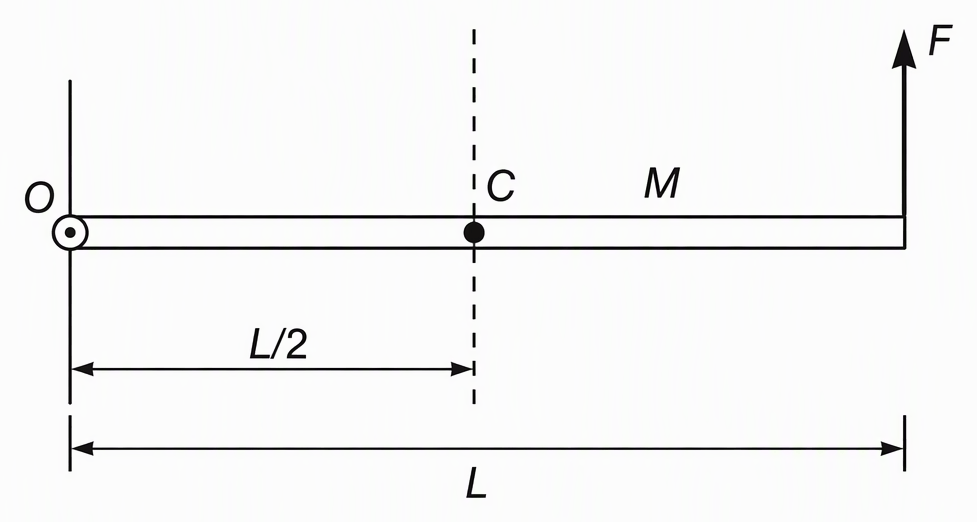
The centre-of-mass value requires a parallel-axis correction. Both axes are perpendicular to the rod:
The pivot force has zero moment about the pivot. Weight has no torque component about the vertical axis.
For a numerical check:
Tempting wrong answer: using the centre-of-mass inertia directly gives four times the correct acceleration. The error is the axis, not the algebra.
Transfer check: move the same perpendicular force to the midpoint. Torque and angular acceleration halve; the pivot-axis inertia stays unchanged.
Why can angular momentum be conserved when a particle sticks to a disc?
Use disc plus particle as the system, the axle as the axis, angular-momentum conservation during impact as the law, and common rotation after sticking as the constraint. The axle can exert an external impulse, so linear momentum need not be conserved. Its torque about its own axis is zero.
Constructed practice problem: A stationary uniform disc is mounted on a frictionless fixed axle. A particle approaches tangentially in the disc’s plane and sticks to its rim, with quantities defined below.
Initially, only the particle has angular momentum. After impact, both objects contribute to inertia:
Conservation about the axle gives:
Compare kinetic energies rather than assuming they are equal:
Half the initial kinetic energy is lost, converted into internal energy during sticking. Angular momentum remains conserved because its condition concerns external torque, not kinetic-energy loss.
The two traps are conserving kinetic energy during sticking and omitting the particle’s final moment of inertia. Check both before substituting.
For unseen follow-up questions, NEET JEEnius AI’s practice mode offers topic sets that skip questions already seen, with 60 free sets a month.
How do I find the speed of a cylinder rolling down an incline?
Use the cylinder and Earth for the energy balance, inertia about the cylinder’s centre of mass, mechanical-energy conservation as the law and rolling without slipping as the constraint. Unlike the sticking problem, this ideal motion has no mechanical-energy loss. Angular momentum about the centre of mass is not conserved because friction supplies torque.
Illustrative practice problem: A uniform solid cylinder starts from rest and rolls without slipping down a fixed incline through a vertical height. Assume sufficient static friction, no rolling resistance and no other energy losses.
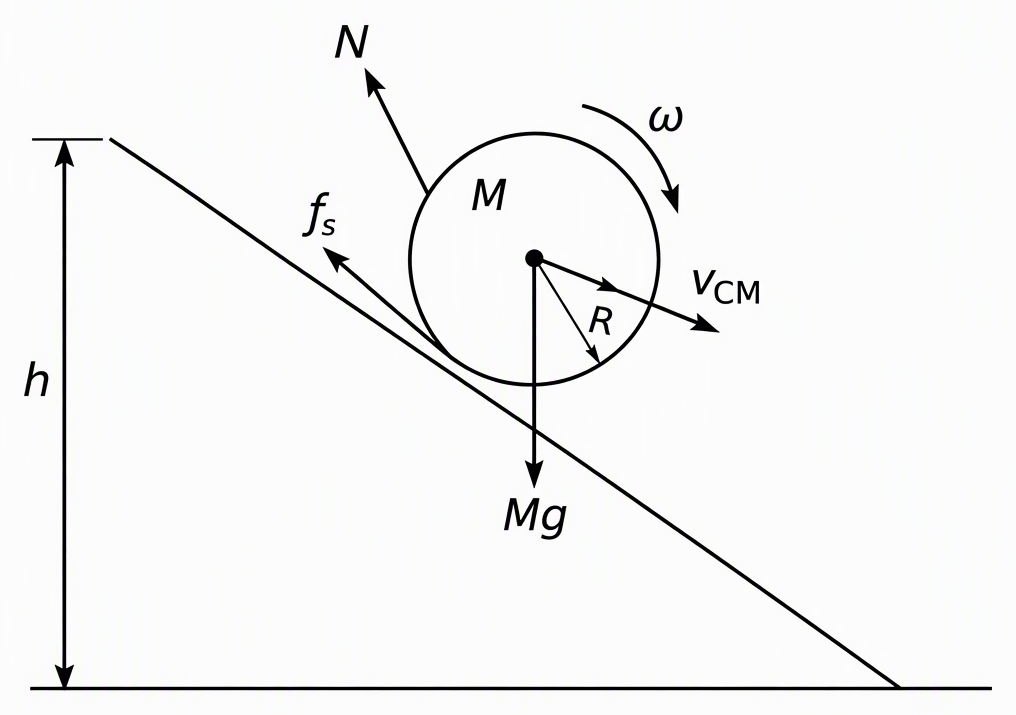
The energy balance includes both translational and rotational kinetic energy. Use the centre-of-mass speed:
Substitution gives:
Ideal static friction does no work on the rolling body because the instantaneous contact point is at rest on the stationary surface. It still provides the torque needed for rotation.
A thin ring under the same assumptions has:
The cylinder reaches the bottom with greater speed. The ring stores a larger share of its kinetic energy in rotation.
Avoid these traps:
- Counting only translational kinetic energy.
- Imposing the no-slip relation during slipping.
- Conserving angular momentum about the centre despite frictional torque.
What should I practise next to improve accuracy?
A first-time learner should follow the full sequence below. A revising student should start with mixed questions and return only to the categories that fail. This is a learning sequence, not a claim about chapter weightage or question frequency.
- Centre-of-mass and equilibrium questions.
- Lever-arm and axis-selection questions.
- Moment-of-inertia questions.
- Fixed-axis torque questions.
- Angular-momentum questions.
- Energy and rolling questions.
- A mixed set without topic labels.
Use relevant NCERT worked examples and exercises first, then NEET PYQs from a source that identifies the exam year. The three examples here are constructed teaching problems, not PYQs.
Before calculating, write a short axis–law–constraint line for every question. Remove this written support only when your choices become reliable, not merely because writing feels slow.
Keep an error log with the chosen axis, mistaken equation or missing condition, and corrected trigger. For example, “particle sticks” should trigger “check external torque and include the particle’s final inertia”, not “conserve kinetic energy”.
Reattempt errors without notes before moving to unseen mixed questions. If the same error returns, practise that decision separately before mixing again.
For this targeted follow-up, NEET JEEnius AI’s daily practice problems provide a fresh set on a topic every day, with 20 free attempts a month. These are attempts, distinct from practice-mode sets. Use one readiness test: can you explain the axis, conservation-law conditions and constraint before looking at the answer options?
Next step: daily practice problems on NEET JEEnius AI and get a fresh set on a topic every day (20 free attempts a month).
If that step was the hard part, work through Properties of Matter Practice Questions NEET: 6 Solved MCQs.
Frequently asked questions
In what order should I study Rotational Motion for NEET?
Start with centre of mass and equilibrium, then angular variables and linear–angular relations. Continue with moment of inertia and axis theorems, torque and rotational dynamics, then angular momentum and conservation. Study rolling last as an application combining translation and rotation.
How do I stop making mistakes in Rotational Motion questions?
Before calculating, identify the system and write an axis–law–constraint line. Check that your moment of inertia matches the chosen axis and that the selected law's conditions hold. Classify mistakes as axis, law, constraint or algebra, then reattempt failed questions without viewing the solution.
Is angular momentum conserved when a particle sticks to a disc?
For a disc on a frictionless fixed axle, angular momentum of the disc-plus-particle system is conserved about the axle during impact when net external torque about that axis is zero. Include both the disc and the particle in the final moment of inertia. Kinetic energy is not conserved during sticking.
Does friction do work during rolling without slipping?
In ideal rolling without slipping on a stationary surface, static friction does no work on the body because the instantaneous contact point is at rest. It can still provide torque about the centre of mass. For a cylinder rolling down an incline, include both translational and rotational kinetic energy in the energy balance.