
Should I start Properties of Matter practice with chapter MCQs or full mocks?
Start with explained chapter MCQs, then verified previous-year questions, not a full mock. These free Properties of Matter practice questions for NEET include six original MCQs with worked answers. All answers appear after the complete question set.
Use chapter MCQs to repair concepts, verified NEET previous-year questions (PYQs) to check exam phrasing, and full mocks to test performance across the paper. Choose the format that addresses your current weakness.
The scope here is mechanical properties of solids and fluids, with a clearly labelled thermal-expansion question because some resources group thermal properties under “Properties of Matter”. This is a starter set, not an exhaustive question bank or a collection of actual PYQs.
How do free chapter questions, verified NEET PYQs and full mocks compare?
Chapter questions give focused practice; verified PYQs give authentic exam wording; full mocks test whole-paper execution. Choose by the weakness you need to fix, not the largest advertised question count. This comparison does not rank third-party websites or claim their access conditions have been checked.
- Best use: Original chapter MCQs on this page: learn and repair concepts. Verified NEET PYQs: check how concepts were asked in past exams. NEET JEEnius AI full-length mocks: practise whole-paper performance.
- Chapter focus: This page: selected solids and fluids concepts, plus one thermal extension. PYQs: chapter-focused when you select relevant questions. Full mocks: the whole paper, not a dedicated Properties of Matter set.
- Answer support: This page: worked explanations. PYQs: a matching official final key establishes the answer, but need not explain it. Full mocks: a scored per-subject breakdown.
- Exam-context value: This page: original NEET-style single-correct practice. PYQs: authentic past-exam wording when provenance is verified. Full mocks: 180 questions, 720 marks and 180 minutes.
- Free access: This page: all six questions and explanations are free. PYQs: use papers and matching keys you can access freely. Full mocks: 30 free full-length tests a month.
- Principal limitation: This page: only a starter set. PYQs: remembered answers can hide weak reasoning. Full mocks: neither chapter filtering nor chapter-level analytics is established by the supplied product facts.
Which practice format should I choose at my current level?
Choose by readiness, not class alone. A Class 12 student revisiting weak basics may need the same untimed practice as a Class 11 student. A dropper who recognises PYQ answers needs unfamiliar questions to test reasoning, not another count of remembered options.
- Class 11, confused about basics: If stress and strain, or pressure and force, blur together, begin with untimed chapter MCQs. State the governing relation and explain its quantities before calculating.
- Class 12, returning to an older chapter: Attempt the questions below without notes. Repair the concepts behind failed attempts, then move to verified PYQs.
- Dropper, remembering PYQ answers: Use unfamiliar original questions. Explain why each distractor fails instead of counting a remembered option as mastery.
- Comfortable with chapters, unable to finish papers: Choose full mocks to practise question selection, pacing and recovery after a difficult question. Isolated formula questions do not test time management across subjects.
For parents: a high question count is not evidence of learning if the student cannot explain a correction. Ask for the corrected reasoning, not just the daily total.
These are complementary stages, not mutually exclusive purchases. Return to chapter practice whenever a mock exposes a conceptual gap.
Can I try free Properties of Matter MCQs with answers here?
Attempt all six original NEET-style, single-correct MCQs before reading the answers below. Each has four options and one correct answer. Write the governing relation and its conditions beside your chosen option. These are original practice questions, not actual NEET PYQs.
1. Elasticity: how does wire radius affect extension?
Two wires have the same material, original length and applied tensile force. The second wire has twice the radius of the first. Both remain in the linear elastic regime. Compared with the first wire, the second wire’s extension is:
- A. The same
- B. Half
- C. One-quarter
- D. Four times
2. Hydrostatics: does vessel shape change pressure?
A narrow cylinder, a broad beaker and a vessel that widens upwards contain the same stationary liquid. All are open to the same atmosphere. At equal vertical depths below their respective liquid surfaces, the gauge pressures are:
- A. Greatest in the broad beaker
- B. Greatest in the narrow cylinder
- C. Greatest in the vessel that widens upwards
- D. Equal in all three
3. Continuity: what happens in a narrower pipe?
A liquid flows steadily through a completely filled pipe without leakage or branches. Treat the liquid as incompressible. If the cross-sectional area becomes half its initial value, the flow speed becomes:
- A. Half
- B. Twice
- C. Four times
- D. Unchanged
4. Viscosity: how does sphere size affect terminal speed?
Two isolated spheres of the same material, denser than the fluid, fall at terminal speed through the same fluid. The second sphere has twice the radius of the first. Stokes-flow conditions hold for both, and wall effects are negligible. Its terminal speed is:
- A. Four times that of the first
- B. Twice that of the first
- C. Half that of the first
- D. The same as that of the first
5. Surface tension: what happens in a wider capillary?
Two narrow capillary tubes contain the same wetting liquid at the same temperature and contact angle. The second tube has twice the internal radius of the first. Neglecting meniscus volume, its equilibrium rise is:
- A. Twice that in the first
- B. The same as in the first
- C. Half that in the first
- D. One-quarter that in the first
6. Thermal-properties extension: what happens to a hole on heating?
An isotropic metal sheet with a circular hole is heated uniformly. The sheet expands freely and has a positive coefficient of thermal expansion. The hole:
- A. Shrinks because metal expands into it
- B. Expands as though filled with the same metal
- C. Remains unchanged because it contains no metal
- D. Must become elliptical
What are the correct answers and worked explanations?
The answer key is 1 C, 2 D, 3 B, 4 A, 5 C and 6 B. Check the reasoning even where your option matches. A correct option based on an incorrect assumption does not demonstrate understanding.
1. C: the extension becomes one-quarter.
Extension is inversely proportional to cross-sectional area when force, length and Young’s modulus are fixed. Doubling the radius makes the area four times as large:
The decisive assumption is linear elastic behaviour. Option B incorrectly treats area as proportional to radius rather than its square.
2. D: the gauge pressures are equal.
Hydrostatic gauge pressure depends on liquid density and vertical depth, not vessel shape. The liquid must be stationary, and each depth must be measured from its own free surface.
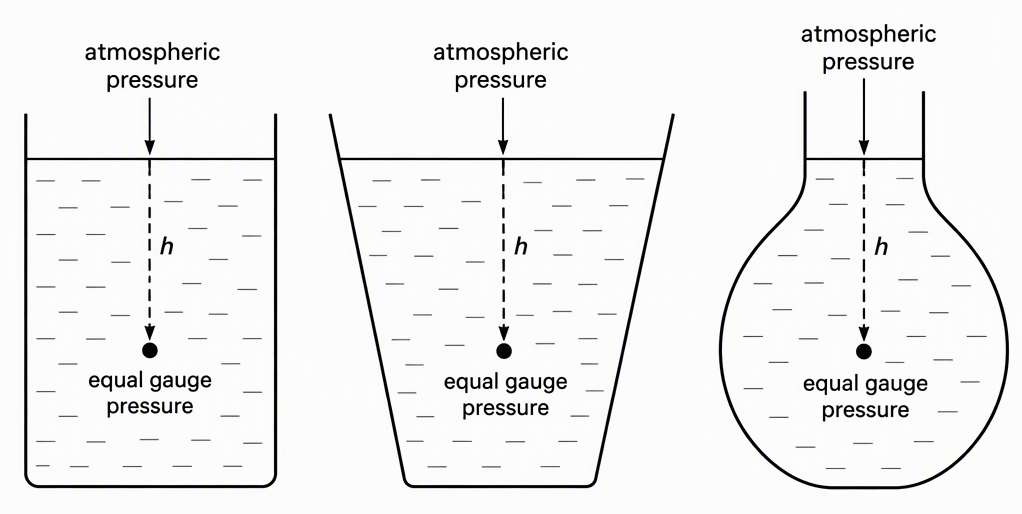
Option A confuses the amount of liquid with pressure at a point. A wider vessel may contain more liquid without producing greater pressure at the stated depth.
3. B: the speed doubles.
For steady incompressible flow without leakage or branches, volume flow rate is conserved. The pipe must remain full:
Option A reverses the relation. The smaller area requires greater speed to carry the same volume per unit time.
4. A: the terminal speed becomes four times as large.
At terminal speed, weight minus buoyancy balances Stokes drag. Both spheres must remain in the Stokes-flow regime, with negligible wall effects:
Option B assumes a linear radius dependence. The result is not a universal rule for large spheres or faster flows.
5. C: the capillary rise becomes half.
Upward surface-tension force balances the liquid column’s weight, neglecting meniscus volume. Surface tension, density and contact angle remain the same:
Option D imports an inverse-square radius rule. Here, rise is inversely proportional to radius, not area.
6. B: the hole expands.
Uniform, free expansion scales every linear dimension, including the hole’s diameter. For small expansion:
This relation assumes uniform heating and isotropic expansion without constraint. Option A treats the surrounding metal as moving only inward; the hole instead expands as though the missing piece were present.
How should I use mistakes to choose more MCQs or PYQs?
Stay with chapter MCQs until you can explain the mistake and solve a changed version without notes. Move to verified PYQs when you can solve unfamiliar variants and state when each formula applies. Neither an incorrect answer nor a correct guess demonstrates secure understanding.
- Elasticity: Rebuild the radius-to-area step before calculating extension.
- Hydrostatic pressure: Separate vertical depth from vessel shape and total liquid volume.
- Continuity: Explain conservation of volume flow before using the area-speed relation.
- Viscosity: Write the Stokes-flow and negligible-wall-effect assumptions beside the terminal-speed formula.
- Capillarity: Separate radius dependence from contact-angle dependence.
- Thermal expansion: Separate free expansion from expansion under constraint.
Keep each error-log entry short: mistaken assumption, correct principle, changed question to attempt later. After confusing radius with area, retry the wire problem with a different radius ratio, then change the applied force.
Before treating a “PYQ” as authentic, check its year, paper or booklet identification, and matching official final answer key through the official NTA site, neet.nta.nic.in. Account for option-order differences between booklets.
This starter set does not exhaust the chapter. Continue with stress–strain behaviour, buoyancy, Bernoulli applications, and excess pressure in drops and bubbles.
When does a free full mock become the better next step?
Choose a full mock after chapter repair when the remaining problem is whole-paper execution. It tests question selection, time management across subjects and recovery after getting stuck, not just Properties of Matter.
NEET JEEnius AI provides 30 free full-length mock tests a month, each with 180 questions, 720 marks, 180 minutes and a scored per-subject breakdown. The subject split is:
- Physics: 45 questions
- Chemistry: 45 questions
- Biology: 90 questions
Biology accounts for half the questions, so a full mock is not a Physics-only practice session. Use the complete sitting to practise the complete paper.
The current marking scheme awards 4 marks for a correct answer, deducts 1 for a wrong answer, and gives 0 for an unattempted question. All 180 questions belong to the compulsory paper structure, with no optional Section B; you can still leave a question unattempted.
Choose your next session by the problem you need to fix. Repair a concept with chapter MCQs, check it against verified PYQs, then test execution in a full mock.
Next step: full-length mock tests on NEET JEEnius AI and sit a full 180-question, 720-mark, 180-minute paper, 45 Physics, 45 Chemistry and 90 Biology, and get a scored per-subject breakdown (30 free a month).
Read next: Plasticity NEET 2026: Heterophylly and the Correct Answer.
Frequently asked questions
Should I start Properties of Matter with chapter MCQs or full mocks?
Start with explained chapter MCQs if your concepts are weak, then attempt verified NEET previous-year questions. Choose full mocks when your main difficulty is whole-paper pacing, question selection or recovering after a difficult question.
Are these Properties of Matter questions actual NEET PYQs?
No. These are six original NEET-style, single-correct MCQs with worked explanations, not actual previous-year questions. To verify a PYQ, check its year, paper or booklet identification, and matching official final answer key.
Which topics do these Properties of Matter MCQs cover?
The set covers elasticity, hydrostatic pressure, continuity, viscosity and capillary rise. It also includes one clearly labelled thermal-expansion question about a hole in a heated metal sheet. This is a starter set, not exhaustive chapter coverage.
When should I move from chapter MCQs to NEET PYQs?
Move to verified PYQs when you can solve unfamiliar variants without notes and state the conditions under which each formula applies. A correct guess or remembered option is not evidence of mastery. For each mistake, record the mistaken assumption, correct principle and a changed question to attempt later.