Which Ray Optics practice mode should you choose first?
For Ray Optics practice questions for NEET, use solved questions to learn, a closed-book chapter self-test to check, and full mocks to rehearse. Six free, original MCQs follow, with explanations kept separate. These are practice questions, not claimed NEET previous-year questions.
Choose worked practice if you cannot explain your sign choices or trace the relevant rays. Choose the self-test if you know the formulas but need to check whether you can select and apply them without help.
Choose full-length mocks when you are ready to use chapter knowledge within the whole paper. A full mock is not a substitute for learning Ray Optics.
How do solved MCQs, a chapter self-test and full mocks compare?
Use solved MCQs to repair your method, the self-test to check independent reasoning, and full mocks to examine whole-paper execution. Solved practice and the chapter self-test are two ways to use the same on-page questions, not separate platform products.
- Practice mode: Solved MCQs
- Best use: Learning the method and repairing misconceptions.
- When to view solutions: Attempt each question first, then read its explanation.
- What it can diagnose: Faulty signs, ray construction and misunderstood conditions.
- Main limitation: A visible solution can create false confidence.
- What is free here: All six questions and explanations.
- Practice mode: Chapter self-test
- Best use: Checking independent formula selection and application.
- When to view solutions: After attempting the entire set closed-book.
- What it can diagnose: Which answers you recognise but cannot justify.
- Main limitation: A short set cannot certify chapter mastery.
- What is free here: The same six questions, attempted without explanations.
- Practice mode: NEET JEEnius AI full-length mocks
- Best use: Whole-paper execution.
- When to view solutions: Finish the paper before reviewing.
- What it can diagnose: Time-allocation problems and subject-level performance.
- Main limitation: No guaranteed Ray Optics question count or Ray Optics-specific diagnostic report.
- What is free here: 30 mocks a month, each with 180 questions, 720 marks and 180 minutes: 45 Physics, 45 Chemistry and 90 Biology questions, plus a scored per-subject breakdown.
Which mode should you pick in Class 11, Class 12 or a drop year?
Pick by what you can explain without help, not by your class or attempt number. A student studying ahead may need worked examples; a dropper may need them too. Move to independent testing when you can justify the method, not merely recognise the answer.
- Class 11, studying ahead: Start with worked practice if reflection, refraction or image formation is new. Being ahead in the calendar does not establish readiness. For each answer, explain what the rays actually do.
- Class 12, chapter just completed: Attempt the set closed-book. Return to worked practice for any concept whose answer you cannot justify, even if your selected option was correct.
- Drop year, familiar-looking questions: State the ray path, sign choice or governing condition before selecting an option. Recognising an answer from an old solution is not mastery.
- Correct chapter work, weaker full papers: Use full mocks to examine time allocation and attempt decisions. Check whether one difficult Physics question pulls time away from questions you could answer elsewhere.
Parents should look for reasoning written before checking and errors corrected afterwards, not the number of questions opened. Use that evidence, not a fixed score threshold, to decide when to change modes.
Can you solve these free Ray Optics practice questions for NEET without help?
Attempt the six questions one at a time for worked practice or together as a closed-book self-test. Record an option and a reason before scrolling to the answers.
This is a targeted diagnostic sample, not exhaustive chapter coverage or a prediction of NEET weightage. Each question has exactly one correct option under its stated conditions; use ideal optical elements and paraxial rays unless specified otherwise.
1. Where does a concave mirror form the image?
A small upright real object stands on the principal axis of a concave spherical mirror, strictly between its principal focus and centre of curvature. Which description gives the image position, nature and orientation?
- A. Between the focus and centre of curvature; real, inverted and diminished.
- B. Beyond the centre of curvature; real, inverted and enlarged.
- C. Behind the mirror; virtual, upright and enlarged.
- D. At the centre of curvature; real, inverted and equal in size.
2. Which signs apply to a virtual image formed by a lens?
Light travels from left to right towards a thin diverging lens. A real object is on its left, and its virtual image lies between the object and lens. Take the optical centre as origin and rightward as positive. What are the signs of object distance, image distance and focal length, in that order?
- A. Negative, positive, negative.
- B. Positive, negative, negative.
- C. Negative, negative, negative.
- D. Negative, negative, positive.
3. How does a submerged point appear from above?
A point object is beneath a flat water-air boundary. An observer in air looks down at it from nearly along the surface normal. Using the near-normal approximation, where does the image appear?
- A. Shallower than the object, because backward extensions of emergent rays meet nearer the surface.
- B. Deeper than the object, because emergent rays bend towards the normal.
- C. At its actual depth, because all near-normal rays remain undeviated.
- D. Above the water, because the emergent rays meet there.
4. When does total internal reflection occur?
Light travels through glass towards a glass-air boundary. Incidence is measured from the normal, and a critical angle exists. Which statement is correct?
- A. Total internal reflection occurs below the critical angle.
- B. Total internal reflection begins exactly at the critical angle.
- C. Total internal reflection requires travel from air into glass.
- D. At the critical angle the refracted ray grazes the boundary; beyond it, total internal reflection occurs.
5. What is symmetric at minimum deviation?
A ray passes through both refracting faces of a prism in air at minimum deviation. Which statement is correct?
- A. The internal refraction angles add to twice the prism angle.
- B. Incidence equals emergence, and each internal refraction angle equals half the prism angle.
- C. The ray meets both prism faces normally.
- D. Incidence equals emergence, but the internal refraction angles differ.
6. Where is a telescope’s final image in normal adjustment?
An astronomical refracting telescope has a convex objective and convex eyepiece. It observes a distant object in normal adjustment, with the objective’s image at the eyepiece’s first focal plane. The final image is:
- A. Real, at the eyepiece focal plane, and inverted.
- B. Virtual, at the near point, and upright.
- C. Virtual, at infinity, and inverted relative to the object.
- D. Virtual, at infinity, and upright relative to the object.
What are the answers, and which mistake does each question expose?
Answer key: 1 B; 2 C; 3 A; 4 D; 5 B; 6 C. Match your reasoning to the explanation, not just your option to the key. A correct guess, or an answer reached after reading the solution, is not evidence of independent understanding.
1. B, image beyond the centre of curvature
Error tag: Image geometry
Reflection sends an axis-parallel ray through the focus; a ray directed through the centre of curvature retraces its path. For an object between these points, the reflected rays meet beyond the centre, producing a real, inverted, enlarged image.
Option C belongs to an object between the focus and pole. It wrongly applies “concave mirror magnifies” without checking whether the image is real or virtual.
2. C, all three distances are negative
Error tag: Cartesian sign convention
Cartesian distance signs follow the chosen coordinate direction. The object and virtual image are left of the optical centre, so both distances are negative. The diverging lens’s image focus is also on the left, giving negative focal length.
These signs enter the thin-lens relation directly, without replacing distances by their magnitudes. The relation is:
Option A treats image distance as automatically positive. The outgoing rays diverge; their backward extensions locate this image on the negative side.
3. A, an apparently shallower image
Error tag: Refraction direction
Light leaving water for air bends away from the normal. Backward extensions locate a virtual image closer to the surface. Under near-normal viewing, apparent depth follows:
Option C overextends a true special case. A ray exactly along the normal is undeviated, but neighbouring rays refract and establish the apparent depth.
4. D, grazing refraction first, total internal reflection beyond
Error tag: Boundary-condition error
Total internal reflection requires travel from an optically denser medium towards a rarer one. At the critical angle, Snell’s law gives a refracted angle of ninety degrees:
Beyond that incidence, no propagating refracted ray satisfies Snell’s law. Option B confuses the boundary condition with the region beyond it: grazing refraction is not yet total internal reflection.
5. B, a symmetric path
Error tag: Minimum-deviation geometry
For a prism in air, minimum deviation occurs on the symmetric path: incidence equals emergence. Snell’s law at the two faces then gives equal internal refraction angles. Prism geometry fixes their sum:
Option D preserves external symmetry but assigns unequal internal angles. That contradicts Snell’s law for the same media at both faces.
6. C, virtual at infinity and inverted
Error tag: Instrument adjustment
The objective forms a real, inverted intermediate image. Placing it at the eyepiece’s first focal plane makes rays from each image point emerge parallel, so the final image is at infinity.
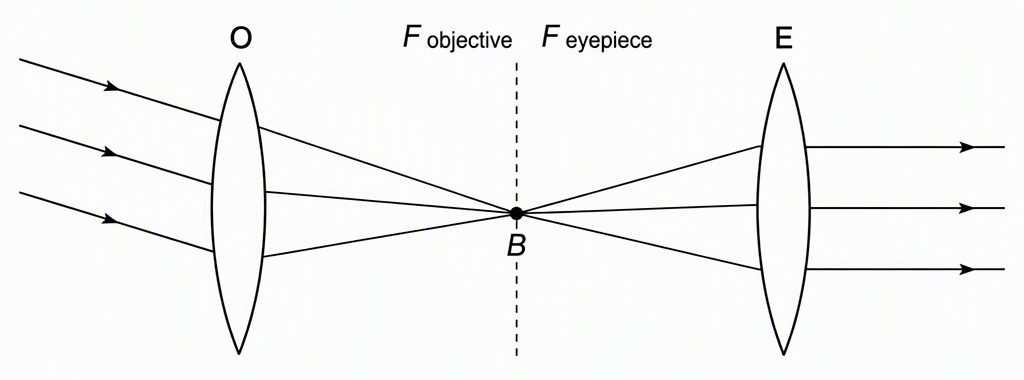
The eyepiece does not undo the objective’s inversion. Option A mistakes the real intermediate image for the final image seen through the eyepiece.
What should you practise next, and when should you take a full mock?
Repair each error before attempting more questions. On your next set, record your chosen answer, reasoning and suspected error type before checking; then confirm or revise the tag.
- Conceptual error: Redraw the rays and restate the physical condition.
- Sign error: Mark the positive coordinate direction before substituting.
- Reading error: Underline the condition that changes the answer, such as “beyond the critical angle” or “normal adjustment”.
Immediately repeating these questions mainly checks recall. Independent transfer needs a fresh, checked question with changed conditions, such as moving the mirror object inside the focus. If scoring this self-test, use the official marking rule:
Do not convert this small-set score into a rank, percentile or mastery claim. The current full paper has 180 compulsory questions in 180 minutes, with no optional Section B; its one-minute overall average is not a mandatory limit for every Physics question.
Once your chapter reasoning holds without solutions, use NEET JEEnius AI’s 30 free full-length mocks a month with scored per-subject breakdowns to examine whole-paper execution. Review where time went and which attempt decisions you should change.
Next step: full-length mock tests on NEET JEEnius AI and sit a full 180-question, 720-mark, 180-minute paper, 45 Physics, 45 Chemistry and 90 Biology, and get a scored per-subject breakdown (30 free a month).
Read next: Biomolecules NEET 2026: Why B, C and E Are Correct.
Frequently asked questions
Are these Ray Optics questions NEET previous-year questions?
No. These are six free, original practice MCQs with separate explanations, not claimed NEET previous-year questions. They form a targeted diagnostic sample, not exhaustive chapter coverage or a prediction of NEET weightage.
Should I use solved Ray Optics questions or take a chapter test?
Use solved practice if you cannot explain your sign choices or trace the relevant rays: attempt each question before reading its explanation. If you know the formulas, attempt all six questions closed-book to check independent selection and application. Both modes use the same on-page questions.
Does total internal reflection occur at the critical angle?
At the critical angle, the refracted ray grazes the boundary. Total internal reflection occurs when incidence exceeds the critical angle, with light travelling from an optically denser medium towards a rarer one.
When should I move from Ray Optics practice to full NEET mocks?
Use full mocks once you can justify your chapter reasoning without looking at solutions. Review time allocation and attempt decisions across the whole paper. NEET JEEnius AI offers 30 free full-length mocks a month with scored per-subject breakdowns, but no guaranteed Ray Optics question count or Ray Optics-specific diagnostic report.