
Should I start Respiration in Plants practice with chapter MCQs or PYQs?
Start with original chapter MCQs, then verified PYQs, then full-length mocks. For Respiration in Plants practice questions for NEET, choose NCERT-aligned chapter MCQs to find concept gaps, verified PYQs to see how concepts were examined, and mocks to test recall during subject switching and time pressure.
Eight original, single-correct questions follow, with answers and explanations readable here without registration. These are not claimed to be PYQs.
How do chapter MCQs, verified PYQs and full-length mocks compare?
Pick the format that exposes your current weakness, not the one offering the most questions. Original MCQs diagnose selected concepts but are not evidence of what NEET asked. Verified PYQs provide that evidence; full mocks test integration and pacing.
- Best use: Original chapter MCQs: targeted diagnosis. Verified chapter PYQs: applying concepts to past exam questions. Full-length mocks: retrieval across subjects.
- Chapter focus: Original MCQs: selected distinctions. Verified PYQs: what the selected papers asked. Full mocks: broad coverage, not every respiration subtopic.
- What a mistake reveals: Original MCQs: a possible concept gap. Verified PYQs: a gap in knowledge or its application. Full mocks: possible recall, reading or pacing failure.
- Explanation quality to check: Original MCQs: reasons distractors fail. Verified PYQs: identifiable exam provenance, a checked answer key and supporting reasoning. Full mocks: reasoning you can use during review.
- Exam-condition realism: Original MCQs: low. Verified PYQs: authentic questions, but isolated practice. Full mocks: strongest for whole-paper demands.
- Main limitation: Original MCQs: no evidence of past exam appearance. Verified PYQs: recognising remembered answers is not solving. Full mocks: incomplete chapter diagnosis.
For full-paper practice, NEET JEEnius AI offers 30 free full-length mocks a month, each with 180 questions, 720 marks, 180 minutes and a scored per-subject breakdown. This article supplies original questions, not an authenticated chapter PYQ collection or a product question bank.
Which practice format should Class 11, Class 12 students and droppers choose?
Choose by readiness before class label. A dropper who confuses pyruvate fates needs chapter repair; a Class 12 student who is accurate in chapter work but inconsistent across complete papers needs mocks. Use these starting points.
- Class 11, just finished respiration: Attempt the inline questions closed-book. For each error, return to the relevant NCERT passage or diagram before attempting a fresh question.
- Class 12, revisiting Class 11 Biology: Use chapter MCQs to expose forgotten distinctions. Follow with verified PYQs, keeping the answer key out of view.
- Dropper, familiar with PYQ answers: Use unfamiliar original questions. Explain why the distractors are wrong before treating a correct response as mastery.
- Accurate chapter work, inconsistent complete papers: Prioritise full-length mocks. Identify where recall, reading or pacing failed.
A weak chapter still needs targeted repair while you are taking mocks. Another complete paper does not, by itself, correct a mistaken pathway location.
Can I attempt eight free Respiration in Plants practice questions for NEET here?
Attempt all eight questions below before reading the answer section. Choose one option per question and write confident, uncertain or guessed beside your response. These are self-review labels, not platform features.
Keep NCERT closed during this attempt. Leave an item unattempted if necessary, and record the distinction that stopped you choosing.
1. Which statement best explains respiratory gas exchange in plants?
- A. Plants use specialised respiratory organs to supply every tissue.
- B. Plants exchange gases through structures such as stomata and lenticels, with internal diffusion serving tissues.
- C. Every living plant cell exchanges gases directly with the outside atmosphere.
- D. Plants obtain all respiratory oxygen from photosynthesis within their own cells.
2. In a typical plant cell, where does glycolysis occur?
- A. The mitochondrial matrix.
- B. The inner mitochondrial membrane.
- C. The cytoplasm.
- D. The mitochondrial intermembrane space.
3. When yeast carries out alcoholic fermentation rather than aerobic oxidation of pyruvate, which products are formed from pyruvate?
- A. Ethanol and carbon dioxide.
- B. Acetyl-CoA and carbon dioxide.
- C. Lactic acid and oxygen.
- D. Carbon dioxide and water alone.
4. Which conversion is the link reaction connecting glycolysis with entry into the citric acid cycle during aerobic respiration?
- A. Conversion of glucose into pyruvate in the cytoplasm.
- B. Conversion of citrate through the reactions of the citric acid cycle.
- C. Conversion of pyruvate into ethanol and carbon dioxide.
- D. Conversion of pyruvate into acetyl-CoA, releasing carbon dioxide and forming NADH.
5. A reaction transfers a phosphate group directly from a phosphorylated substrate to ADP. Which description identifies this process?
- A. Oxidative phosphorylation driven by a proton gradient.
- B. Substrate-level phosphorylation by direct phosphate transfer.
- C. Photophosphorylation driven by absorbed light.
- D. ATP hydrolysis that releases inorganic phosphate.
6. Which statement identifies oxygen’s direct role in aerobic mitochondrial respiration?
- A. It accepts phosphate during the conversion of glucose into pyruvate.
- B. It supplies carbon atoms for the formation of acetyl-CoA.
- C. It accepts electrons at the end of electron transport and contributes to water formation.
- D. It directly transfers phosphate from a substrate to ADP.
7. When both gas volumes are measured at the same temperature and pressure, which ratio defines respiratory quotient?
- A. Volume of oxygen consumed divided by volume of carbon dioxide evolved.
- B. Volume of carbon dioxide evolved divided by volume of oxygen consumed.
- C. Volume of carbon dioxide evolved divided by volume of nitrogen absorbed.
- D. Volume of oxygen evolved divided by volume of carbon dioxide consumed.
8. Which observation best explains why respiration is described as an amphibolic pathway?
- A. Respiration can occur in both illuminated and dark conditions.
- B. Respiration can proceed through aerobic or anaerobic routes.
- C. Respiration includes reactions at several locations within a cell.
- D. Respiration breaks down substrates while its intermediates also supply biosynthetic pathways.
What are the answers, and what does each mistake reveal?
The answer key is: 1 B, 2 C, 3 A, 4 D, 5 B, 6 C, 7 B, 8 D. Check your confidence labels alongside the letters. A confident wrong answer needs correction; a guessed correct answer still needs explanation.
- B, gas exchange. Plants lack animal-style specialised respiratory organs. Stomata, lenticels and internal diffusion support gas exchange; C wrongly places every cell in direct contact with the atmosphere. D ignores non-photosynthetic tissues and darkness. Repair: reread NCERT’s explanation of plant gas exchange.
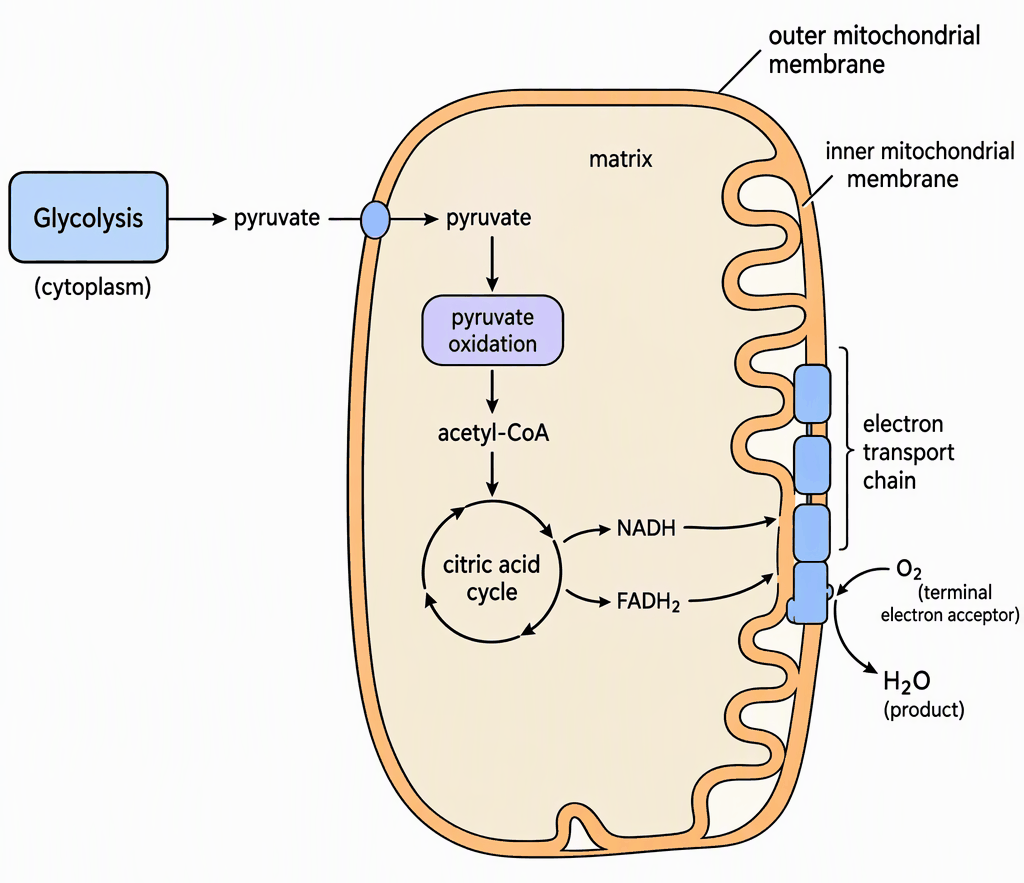
- C, pathway location. Glycolysis occurs in the cytoplasm. The mitochondrial matrix hosts pyruvate oxidation and the citric acid cycle, not glycolysis; neither mitochondrial membrane nor intermembrane space is the glycolytic site. Repair: reconstruct a pathway-location map.
- A, pyruvate fate. Alcoholic fermentation in yeast produces ethanol and carbon dioxide. B describes aerobic pyruvate oxidation; C incorrectly pairs lactic acid with oxygen, while D describes complete oxidation products. Repair: compare alcoholic fermentation with aerobic pyruvate oxidation.
- D, link reaction. Pyruvate undergoes oxidative decarboxylation to form acetyl-CoA, carbon dioxide and NADH before cycle entry. A is glycolysis, B concerns the cycle itself, and C is alcoholic fermentation. Repair: place this conversion between glycolysis and the cycle.
- B, phosphorylation mechanism. Substrate-level phosphorylation transfers phosphate directly from a substrate to ADP. A uses a proton gradient and ATP synthase; C concerns light-driven ATP formation; D breaks ATP down. Repair: contrast direct phosphate transfer with gradient-driven ATP formation.
- C, oxygen’s role. Oxygen is the terminal electron acceptor, with water formed. Glycolysis does not directly consume oxygen, but sustained aerobic respiration depends on oxygen accepting electrons. A and D assign it phosphate-transfer roles; B assigns it carbon supply. Repair: trace electron transfer to oxygen.
- B, ratio definition. Respiratory quotient is carbon dioxide evolved divided by oxygen consumed, using gas volumes measured at the same temperature and pressure. A reverses the ratio; C and D substitute the wrong gases or processes. Repair: write the definition before using values.
- D, amphibolic function. Respiration supports both breakdown and biosynthesis because intermediates can be withdrawn to build compounds. B wrongly equates amphibolic function with aerobic or anaerobic routes; light conditions and multiple locations do not define it. Repair: reread NCERT’s explanation of intermediates supplying biosynthesis.
What should I practise next after checking my mistakes?
Repair the type of error before increasing question volume. This short diagnostic is not a predictor of your NEET score, and it has no readiness cutoff. Choose your next questions according to the distinction you missed.
If sites or sequences were confused, reconstruct the pathway-location map before attempting fresh chapter questions. Keep carbon flow separate from electron transfer.
- Correct but guessed: Explain the rejected options, revise, then retry without the key. Do not record the result as secure mastery.
- Concept clear, wording misread: Attempt verified PYQs and compare each response with the checked key.
- Chapter work secure: Use full mocks to practise retrieval across Biology, Chemistry and Physics. Review reading and pacing errors separately from concept errors.
Use the official marking rule for this set: award 4 marks per correct answer, deduct 1 per wrong answer, and give 0 for an unattempted question. Do not force a one-minute limit on every Biology question simply because a full paper has 180 questions in 180 minutes.
After repairing respiration, an optional cross-chapter check is Reproductive Health practice: 8 MCQs.
What should I know about free questions, PYQs and chapter weightage?
Free access does not establish PYQ authenticity or chapter weightage. The questions here are freely readable originals, not evidence of what appeared in past NEET papers.
Are these Respiration in Plants questions free?
Yes. All eight questions, answers and explanations are readable directly in this article without registration.
Are these PYQs, and can original MCQs replace PYQs?
No. These are originals, not authenticated PYQs. The formats complement each other: originals test understanding, while verified PYQs show actual examined wording and concepts.
Is NCERT enough before attempting questions?
NCERT supplies the conceptual foundation. Practice checks whether you can apply its distinctions without cues; revisit the relevant explanation after a concept error.
How many Respiration in Plants questions appear in NEET each year?
No fixed count or weightage percentage is justified because no verified chapter-wise analysis is provided here. Prepare the concepts rather than relying on an annual quota.
Once your chapter errors are repaired, use a NEET JEEnius AI full mock with 45 Physics, 45 Chemistry and 90 Biology questions, then use its scored per-subject breakdown to choose which subject’s errors to review first.
Next step: full-length mock tests on NEET JEEnius AI and sit a full 180-question, 720-mark, 180-minute paper, 45 Physics, 45 Chemistry and 90 Biology, and get a scored per-subject breakdown (30 free a month).
Frequently asked questions
Should I start Respiration in Plants with chapter MCQs or PYQs?
Start with original NCERT-aligned chapter MCQs to identify concept gaps, then attempt verified PYQs to practise actual examined wording and concepts. Use full-length mocks to test recall across subjects and pacing. Repair chapter weaknesses alongside mock practice.
Are these Respiration in Plants questions free NEET PYQs?
All eight questions, answers and explanations are free to read without registration. They are original single-correct MCQs, not authenticated NEET PYQs. Use verified PYQs separately to study what past papers actually asked.
Is NCERT enough before attempting Respiration in Plants MCQs?
NCERT provides the conceptual foundation for these questions. Attempt them closed-book to check whether you can apply the distinctions without cues. After a concept error, revisit the relevant NCERT passage or diagram before trying a fresh question.
How many Respiration in Plants questions come in NEET each year?
This article does not establish a fixed annual question count or weightage percentage because it provides no verified chapter-wise analysis. Prepare the concepts rather than planning around an assumed annual quota.