
Should I start with direct or statement-based Reproductive Health MCQs?
Start with direct NCERT-based questions if recall is weak; choose statement-and-application questions if you remember facts but confuse options. These reproductive health practice questions for NEET use complementary formats, not rival question banks: establish the fact, then test it against changed wording.
Below are eight original, single-correct practice MCQs, divided equally between the formats, with answers and explanations. They are free to attempt here and are not official NEET questions or PYQs.
What do direct and statement-and-application MCQs actually test?
Direct questions mainly test recall; statement-and-application questions test whether you can separate a correct fact from a misleading claim. Identifying what copper-releasing IUDs do is different from rejecting the claim that every IUD has the same mechanism.
- Recall demand: Direct NCERT-based MCQs require a named fact. Statement-and-application MCQs require the fact and a judgement about its use.
- Similar facts: Direct questions distinguish methods or structures. Statement-and-application questions expose swapped mechanisms and overgeneralisation.
- Likely error: Direct: missing or misremembered knowledge. Statement-and-application: accepting a partly true option.
- Before revision: Direct questions locate recall gaps. Statement-and-application questions expose uncertain distinctions, but cannot replace reading.
- After revision: Direct questions check recall without notes. Statement-and-application questions test distinctions under changed wording.
- Next step after an error: For direct questions, revisit the relevant NCERT passage. For statement-and-application questions, identify the exact word or claim that makes the distractor false.
Every question below has one correct option. A statement-based stem does not permit multiple selections. Direct questions are not automatically easy, and long statements are not automatically good questions.
Which set should I attempt first?
Choose by your present understanding, not your school year. Start with Set A unless your recall is reliable and your main problem is choosing plausible distractors. In that case, prioritise Set B and explain each rejected option rather than repeating recognition-only practice.
- Class 11 students studying ahead or first-time learners: Read the relevant NCERT material first. Use Set A to check what you can recall.
- Class 12 students who have just revised: Complete Set A without notes, then attempt Set B before reading either answer key.
- Droppers who remember the chapter but choose plausible distractors: Start with Set B. Write why each rejected option is false.
- Anyone missing both formats on one concept: Return to that specific NCERT subsection, not another random question collection.
- Anyone correct but unable to explain why: Treat the concept as unresolved, not mastered.
The questions deliberately pair concepts. One question can cue another, so the combined set is a learning exercise, not an independent readiness test. Record your answers before reading the keys.
Can I answer four direct NCERT-based Reproductive Health MCQs?
Use Set A to check four distinctions: copper IUD action, the structure interrupted in vasectomy, STI risk reduction and the site of fertilisation in IVF. Choose one option per question before reading the key. Flag any answer you cannot explain.
Q1. Which effect is specifically associated with copper ions released by a copper-releasing IUD?
- A. Suppression of ovulation through contraceptive hormones
- B. Suppression of sperm motility and fertilising capacity
- C. Interruption of the vas deferens
- D. Formation of a barrier covering the penis
Q2. Which structure is cut and tied during vasectomy?
- A. Ureter
- B. Urethra
- C. Vas deferens
- D. Seminiferous tubule
Q3. Which method helps reduce the risk of sexually transmitted infections during sexual intercourse?
- A. An oral contraceptive pill
- B. A copper-releasing IUD
- C. Vasectomy
- D. Correct use of a condom
Q4. Which event defines in vitro fertilisation, or IVF?
- A. Fertilisation of an ovum outside the body under laboratory conditions
- B. Introduction of semen into the uterus
- C. Prevention of sperm transport through the vas deferens
- D. Prevention of ovulation using contraceptive hormones
What are the answers and explanations for Set A?
The correct options are Q1 B, Q2 C, Q3 D and Q4 A. Check that you can explain the biological fact and reject the closest distractor.
- Q1, B: Copper ions suppress sperm motility and fertilising capacity. A describes a hormonal contraceptive action associated with oral pills, not the action of released copper ions.
- Q2, C: Cutting and tying the vas deferens interrupts sperm transport. D confuses sperm production in seminiferous tubules with the transport pathway. Vasectomy does not remove the testes or stop testosterone production.
- Q3, D: Condoms provide a barrier that helps reduce STI transmission risk; they do not guarantee protection against every STI. A is tempting because pills prevent pregnancy, but pregnancy prevention does not imply STI protection.
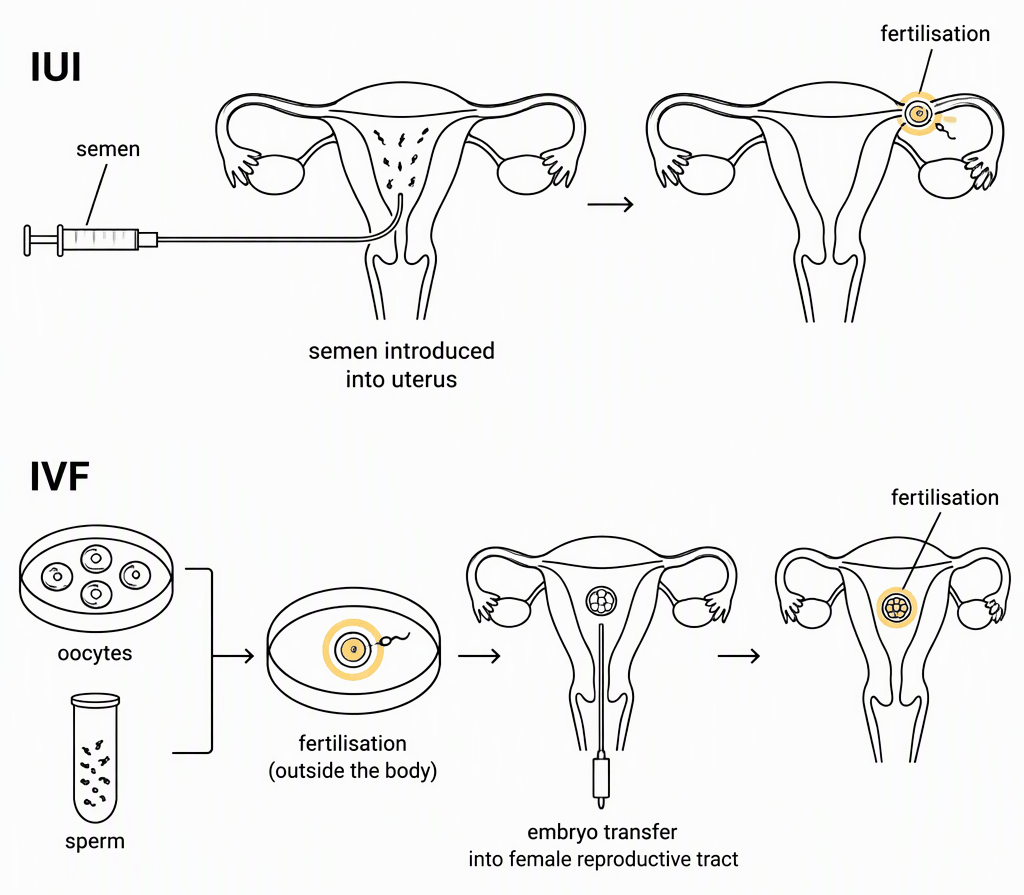
- Q4, A: IVF means fertilisation outside the body. B describes intrauterine insemination, which introduces semen into the uterus rather than carrying out fertilisation in a laboratory.
Can I recognise the same facts in statement-and-application questions?
Use Set B to check whether an absolute claim, a changed mechanism or a similar procedure misleads you. Each question has exactly one correct answer. These are school-biology exam scenarios, not personalised advice about contraception, infection or fertility treatment.
Q5. A student claims, “All IUDs prevent pregnancy through an identical mechanism: suppression of ovulation.” Which response is correct?
- A. Accept the claim because every IUD releases contraceptive hormones.
- B. Reject it because copper-releasing IUDs work by cutting the oviducts.
- C. Reject it because copper ions impair sperm function, while hormone-releasing IUDs also make the uterus unsuitable for implantation and the cervix hostile to sperm.
- D. Accept it because every contraceptive method must prevent egg release.
Q6. After vasectomy, a student predicts that sperm formation and testosterone production must both stop. Which correction is accurate?
- A. Sperm transport is interrupted, but the procedure does not directly stop sperm formation or testosterone production.
- B. Testosterone production stops because the testes are removed.
- C. Sperm formation stops because the seminiferous tubules are tied.
- D. Neither sperm transport nor hormone production is affected.
Q7. Consider these statements about STIs:
- Statement I: A person without noticeable symptoms cannot have an STI.
- Statement II: Condoms help reduce STI transmission risk but do not guarantee complete protection against every STI.
Which option is correct?
- A. Both statements are correct.
- B. Only Statement I is correct.
- C. Neither statement is correct.
- D. Only Statement II is correct.
Q8. Procedure P introduces semen into the uterus. Procedure Q involves fertilisation outside the body followed by embryo transfer. Which interpretation is correct?
- A. Both procedures are IVF because both assist reproduction.
- B. P is intrauterine insemination and Q involves IVF; only Q specifies fertilisation outside the body.
- C. P is IVF and Q is intrauterine insemination.
- D. Both procedures require fertilisation outside the body.
What are the answers and explanations for Set B?
The correct options are Q5 C, Q6 A, Q7 D and Q8 B. Check device mechanism, transport versus production, symptoms versus infection, and insemination versus fertilisation.
- Q5, C: Copper-releasing and hormone-releasing IUDs do not share one identical hormonal mechanism. A wrongly makes every IUD hormonal; B confuses IUD action with interruption of the oviducts; D wrongly makes ovulation suppression essential to all contraception.
- Q6, A: Vasectomy blocks the sperm transport pathway. B falsely implies removal of testes, C names the wrong structure, and D denies the intended interruption of transport.
- Q7, D: Statement I is false because an infection may occur without noticeable symptoms. Statement II correctly describes risk reduction without promising complete protection.
- Q8, B: IUI places semen in the uterus; IVF involves fertilisation outside the body. A and D confuse assisted reproduction with laboratory fertilisation, while C reverses the procedures. Neither method is universally appropriate for every infertility case.
What do my errors mean beyond the total score?
Use paired errors to choose what to revise; use the total only to record marks. Apply the official marking rule: award 4 marks for a correct answer, deduct 1 for an incorrect answer, and award 0 for an unattempted question. Do not treat the result as a chapter-readiness cutoff.
Compare Q1 with Q5, Q2 with Q6, Q3 with Q7, and Q4 with Q8:
- Wrong in both formats: Revisit that concept in NCERT, then explain it without notes.
- Right in direct, wrong in application: Inspect qualifiers such as “all”, “only” and “must”, plus distractors that swap mechanisms.
- Right in application, wrong in direct: Revisit the explanation and check whether guessing or cues produced the correct answer.
- Right in both: Explain why the other options fail before counting the concept as secure.
Keep an error-log entry with concept, incorrect belief and corrected NCERT-grounded sentence. For example: “Vasectomy; I thought sperm production stops; cutting and tying the vas deferens interrupts sperm transport.”
Eight paired questions cannot establish chapter mastery or predict a NEET score. If recall is secure but distractors still mislead you, choose harder chapter questions next.
When should I move from chapter questions to a full-length mock?
Choose a full-length mock when it fits your wider preparation and you need to test recall across unrelated topics, pacing and subject switching. Revise a weak Reproductive Health concept first. A mixed paper is not the automatic remedy for confusing an IUD with a hormonal pill.
Chapter questions isolate biological distinctions. A full mock tests whether you can recall those facts among unrelated questions, manage time across subjects and maintain attention through the paper.
What should I know before choosing more free practice?
Choose more practice by missing topics and recurring errors, not by the size of a question collection. These reproductive health practice questions for NEET sample contraception, STIs and assisted reproduction. They do not cover the entire chapter.
Are these questions NEET PYQs?
No. All eight are original practice questions and must not be represented as previous-year questions. Use verified past papers separately to study questions actually asked in NEET.
Does this set cover everything I need from NCERT?
No. Also revise reproductive-health programmes, population-related issues, medical termination of pregnancy and amniocentesis. NCERT provides the factual foundation; MCQs check whether you can apply and distinguish those facts.
How many more questions should I solve?
There is no magic question-count target. You need topic coverage, understood explanations and correction of recurring errors.
Start with one uncertain concept from this set. Read its NCERT subsection, write the corrected fact without looking, then explain why every distractor in its paired questions fails.
When a full paper fits your preparation, NEET JEEnius AI offers 30 free full-length mock tests a month for mixed-paper practice. Each has 180 questions, 720 marks and 180 minutes, comprising 45 Physics, 45 Chemistry and 90 Biology questions, with a scored per-subject breakdown.
That breakdown is not a verified chapter-level diagnostic. Use your marked Reproductive Health questions and error log to locate chapter gaps; use the mock to examine performance across the full paper.
Next step: full-length mock tests on NEET JEEnius AI and sit a full 180-question, 720-mark, 180-minute paper, 45 Physics, 45 Chemistry and 90 Biology, and get a scored per-subject breakdown (30 free a month).
Read next: Microsporogenesis NEET 2026: Correct Sequence Explained.
Frequently asked questions
Should I start with direct or statement-based Reproductive Health MCQs?
Start with direct NCERT-based questions if your recall is weak. If you remember the facts but keep choosing plausible distractors, prioritise statement-and-application questions and explain why each rejected option is false.
Are these Reproductive Health questions NEET PYQs?
No. All eight are original, single-correct practice MCQs, not official NEET questions or previous-year questions. Use verified past papers separately to study questions actually asked in NEET.
Do these eight questions cover the full Reproductive Health chapter?
No, they sample contraception, STIs and assisted reproduction. You must also revise reproductive-health programmes, population-related issues, medical termination of pregnancy and amniocentesis from NCERT.
How should I score these Reproductive Health practice questions?
Award 4 marks for each correct answer, deduct 1 for each incorrect answer and give 0 for an unattempted question. Compare errors across the paired direct and application questions to choose what to revise. The total is not a chapter-readiness cutoff or a prediction of your NEET score.