
Should I start Rotational Motion practice with chapter questions or a full mock?
Start with chapter drills, not a full mock, if torque, moment of inertia or rolling still confuses you. These free original Rotational Motion practice questions for NEET include single-correct MCQs and worked solutions, not past NEET questions.
Original drills with worked solutions are the best starting point for repairing chapter reasoning. Verified NEET previous-year questions come next: they show how concepts have actually been examined. Full mocks test integration and paper-level decisions.
How do chapter drills, verified NEET PYQs and full mocks compare?
Drills isolate chapter mistakes, verified PYQs show how concepts were examined, and mocks test decisions across subjects. A full mock cannot replace targeted practice when you still choose the wrong axis or conservation law.
- Learning purpose
- Original chapter drills here: Identify errors in axes, conservation and rolling.
- Verified NEET PYQs: Study how concepts were actually examined.
- NEET JEEnius AI full-length mocks: Practise whole-paper decisions.
- Chapter focus
- Drills: Only Rotational Motion.
- PYQs: Select identifiable questions from this chapter.
- Mocks: Mixed subjects, with no promised Rotational Motion question count.
- Solution requirements
- Drills: Worked solutions follow below.
- PYQs: Require an identifiable paper and year, plus its final official answer key. A third-party worked explanation is not an official key.
- Mocks: The verified offer includes a scored per-subject breakdown; do not assume chapter-level analytics.
- When to use
- Drills: While learning or repairing concepts.
- PYQs: Once you can explain the governing principle.
- Mocks: Once chapter reasoning holds up in mixed practice.
- Limitations
- Drills: Original questions, not evidence of past exam difficulty.
- PYQs: Remembered answers can hide weak reasoning.
- Mocks: Not a substitute for targeted chapter practice.
- What is free
- Drills: All six questions and worked solutions here.
- PYQs: A practice category, not a claim that an external collection is free or verified.
- Mocks: 30 free full-length mocks a month, each with 180 questions, 720 marks, 180 minutes, 45 Physics questions, 45 Chemistry questions and 90 Biology questions, plus a scored per-subject breakdown.
Which practice format should I choose for my current preparation?
Choose by the mistake you need to fix. If you are learning the chapter, practise selecting the principle. If you understand it but struggle in mixed papers, practise deciding when to attempt, leave and return.
- Class 11, first time through the chapter: Choose chapter drills. Before checking an option, write why torque, energy or angular momentum applies. A correct answer reached through a wrong principle still needs repair.
- Class 12, revising after a gap: Attempt the diagnostic set without notes. Repair only the concepts it exposes, then move to verified PYQs rather than restarting every chapter lecture.
- Dropper who remembers old answers: Use unfamiliar original questions first to check whether recognition is hiding weak reasoning. Revisit PYQs with written working and explain why the tempting wrong option fails.
- Comfortable with chapter questions, weak in mixed papers: Prioritise full mocks. Review paper-level choices alongside the Physics score: where you guessed, stayed too long or rushed a question you could solve.
For parents, test availability is not evidence of progress. A more useful check is whether the student can explain why an earlier wrong approach failed and solve a changed version without help.
Which free Rotational Motion practice questions for NEET should I try first?
Attempt these six questions without notes, choosing one option each. Record the principle you used beside your answer, not just the letter. The answer key and worked explanations are in the next section.
Original practice questions, not NEET PYQs. Each has exactly one correct answer under the stated assumptions.
1. Torque about a pivot
A nonzero force acts at a point on a rigid body. Its line of action passes through a fixed pivot. What is the torque of this force about that pivot?
- A. Force magnitude multiplied by the distance from the pivot to the application point.
- B. Zero.
- C. Equal to the force magnitude.
- D. Nonzero whenever the body is already rotating.
2. Choosing the correct moment of inertia
A thin hoop and a uniform solid disc have the same mass and radius. Compare their moments of inertia about their respective central axes perpendicular to their planes.
- A. The hoop has half the disc’s moment of inertia.
- B. Their moments of inertia are equal.
- C. The hoop has twice the disc’s moment of inertia.
- D. The hoop has four times the disc’s moment of inertia.
3. Moving to a parallel axis
A rigid body has mass and centre-of-mass moment of inertia denoted below. A second axis is parallel to that reference axis, displaced by the stated distance. Which expression gives the new moment of inertia?
4. Changing the mass distribution
A system rotates about a fixed axis with nonzero initial angular speed. Internal rearrangement doubles its moment of inertia. External torque about that axis remains zero throughout. What happens to its angular speed?
- A. It doubles.
- B. It remains unchanged.
- C. It becomes four times the initial value.
- D. It becomes half the initial value.
5. Energy during pure rolling
A thin hoop and a uniform solid disc have equal mass and roll without slipping at equal centre-of-mass speed. What is the ratio of the hoop’s total kinetic energy to the disc’s?
6. Rolling down an incline
A thin hoop and a uniform solid disc start from rest at the same height on the same straight incline. Both roll without slipping, with sufficient static friction and no dissipative losses. Which reaches the bottom first?
- A. The hoop.
- B. Both arrive together.
- C. The disc.
- D. Either can win, depending on the incline angle.
What are the answers, and which mistake does each question expose?
Answer key: 1 B; 2 C; 3 A; 4 D; 5 B; 6 C.
These are worked physics results under the stated assumptions, not claims about chapter weightage, expected marks or question frequency. Check your reasoning even where your option matches: a correct guess does not establish that you chose the right principle.
Why is the torque zero in Question 1?
The perpendicular distance from the pivot to the force’s line of action is zero, so its torque is zero. A nonzero force need not produce a turning effect about the chosen axis.
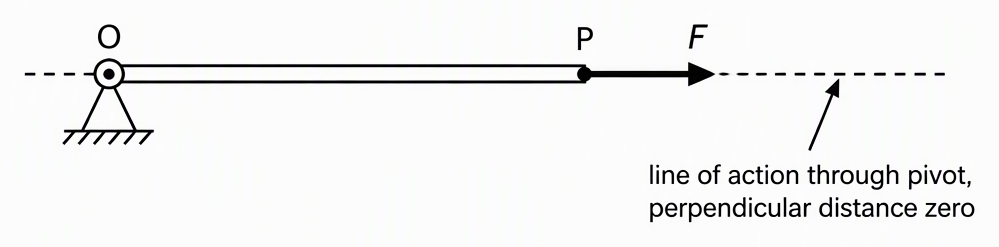
Option A uses the pivot-to-point distance instead of the perpendicular distance. Option C confuses force with torque, which are different physical quantities.
Why does the hoop have greater inertia in Question 2?
The hoop has twice the disc’s moment of inertia because all its mass lies at the outer radius. The disc’s mass is spread across smaller radii too. About each central axis perpendicular to its plane, the moments of inertia are:
Option B assumes equal mass and radius guarantee equal inertia. Mass distribution relative to the specified axis matters.
Why must we add the extra term in Question 3?
The parallel-axis theorem adds a positive contribution when moving away from the centre-of-mass axis. It applies here because the axes are parallel and the reference axis passes through the centre of mass.
Option B ignores the axis shift. Option C subtracts the correction, incorrectly making the displaced parallel axis have a smaller inertia.
Why does the angular speed halve in Question 4?
Zero external torque about the stated axis conserves angular momentum, not angular speed. Doubling the moment of inertia therefore halves the speed.
Option B treats angular speed as the conserved quantity. Internal rearrangement can change angular speed without external torque.
Why is the rolling-energy ratio four to three in Question 5?
Both bodies have equal translational energy, but the hoop has greater rotational energy at the same centre-of-mass speed. Total kinetic energy must include both contributions, with linear and angular speed connected by pure rolling:
Option A counts only translation. Option C compares only the rotational contributions and forgets that both bodies also translate.
Why does the disc arrive first in Question 6?
The disc has greater downhill acceleration under pure rolling. Combining the translational equation with torque due to static friction gives:
Both start from rest and cover the same distance, so the disc arrives first. Option B assumes equal descent acceleration despite different rotational inertia.
What should I practise next after checking my mistakes?
Repair the principle behind each wrong answer before adding more questions. Re-solve missed questions without viewing the solution, then attempt unfamiliar questions using the same principle. This is a study method, not a validated scoring rule or a promise of extra marks.
- Missed torque or inertia: Sketch and label the axis before calculating. For torque, mark the force’s line of action and perpendicular distance. For inertia, identify how mass is distributed around that axis.
- Missed angular momentum: Write “zero external torque about this axis” before using conservation. If you cannot justify that condition, do not use the equation automatically.
- Missed rolling: Separate translational and rotational kinetic energy. Check that rolling without slipping is actually stated before connecting linear and angular speed. If the error starts with work–energy basics, use the Work, Energy and Power practice plan.
Once chapter reasoning is stable, move to verified PYQs with written working, then mixed-paper practice. During mock review, use the official marking rule:
Distinguish a conceptual error from a guess or rushed execution because each needs a different repair. The 180 questions in 180 minutes give a whole-paper average, not a compulsory one-minute limit for every Physics question.
For that mixed-paper step, NEET JEEnius AI offers 30 free full-length mocks a month. After a mock, use the scored per-subject breakdown to locate the subject needing attention, then inspect your working and write the reason for each wrong Physics answer before attempting another paper.
Next step: full-length mock tests on NEET JEEnius AI and sit a full 180-question, 720-mark, 180-minute paper, 45 Physics, 45 Chemistry and 90 Biology, and get a scored per-subject breakdown (30 free a month).
Frequently asked questions
Should I practise Rotational Motion chapter questions or full mocks first?
Start with chapter drills if torque, moment of inertia or rolling still confuses you. Write down the governing principle before checking the options. Move to verified NEET PYQs once you can explain your reasoning, then use full mocks to practise whole-paper decisions.
Are these Rotational Motion questions NEET previous-year questions?
No. These are six free original single-correct MCQs with worked solutions, not past NEET questions. A verified PYQ needs an identifiable paper and year, checked against its final official answer key.
Why does a solid disc roll down an incline faster than a hoop?
For rolling without slipping, downhill acceleration is g sinθ divided by 1 + I/(MR²). A uniform solid disc accelerates at two-thirds of g sinθ, while a thin hoop accelerates at one-half of g sinθ. Starting from rest at the same height on the same straight incline, with sufficient static friction and no dissipative losses, the disc reaches the bottom first.
What should I do after getting Rotational Motion questions wrong?
Identify the failed principle before attempting more questions: axis selection, torque, angular momentum conservation or rolling energy. Re-solve missed questions without looking at the solutions, then attempt unfamiliar questions using the same principle. Move to verified PYQs and mixed-paper practice once your chapter reasoning is stable.