
Should I start with chapter MCQs, NCERT questions or NEET PYQs?
Start with these explained Sexual Reproduction in Flowering Plants practice questions for NEET if you have read the chapter. If you still confuse pollination with fertilisation, begin with NCERT reading and exercises. This page contains six original single-correct questions, with answers placed after the complete set.
After attempting the diagnostic and repairing concept gaps, use verified chapter-wise NEET previous-year questions to examine actual exam wording. They are not a substitute for understanding the chapter.
These are three practice routes, not a ranking of websites. The comparison makes no claims about unverified providers’ free access, features or question counts.
How do NCERT questions, explained chapter MCQs and NEET PYQs compare?
Use NCERT for concept repair, explained MCQs for conceptual contrasts, and verified PYQs for historical exam wording. NCERT’s mixed question formats help you build explanations, but they are not a ready-made NEET mock.
- Purpose
- NCERT in-text and end-of-chapter questions: Build concepts and recall.
- This page’s original explained MCQs: Expose confusion between related processes.
- Verified chapter-wise NEET PYQs: Examine actual exam wording.
- Question format
- NCERT: Mixed formats, including written explanations.
- This page: Six single-correct MCQs.
- PYQs: Questions as asked in their source papers.
- Feedback available
- NCERT: Check reasoning against the chapter.
- This page: Answer key and distractor explanations.
- PYQs: Verify keys; third-party explanations need checking.
- Best preparation stage
- NCERT: First learning or basic repair.
- This page: After a first reading.
- PYQs: After understanding the relevant concepts.
- Limitation
- NCERT: Not a timed NEET simulation.
- This page: Targets conceptual contrasts, but cannot establish what NEET previously asked.
- PYQs: Familiarity can hide weak reasoning; third-party chapter tagging needs checking.
- Access considerations
- NCERT: Use your textbook’s relevant questions.
- This page: All six questions and explanations are available directly in this article.
- PYQs: Check the source paper and official answer key; external access conditions vary.
Which route should Class 11 students, Class 12 students and droppers choose?
Choose by readiness, not class label. A dropper can need basic concept repair, while a Class 11 student studying ahead may already be ready for application questions. For parents, judge the next resource by the student’s error type, not its advertised question count.
- Class 11 students studying ahead: Begin with the relevant NCERT reading and exercises. Anyone who treats pollination and fertilisation as the same event should do this, regardless of class.
- Class 12 students after a first reading: Attempt the explained MCQs without checking the key. If related terms keep merging in your memory, write the difference before choosing an option.
- Droppers recognising familiar questions: Use verified PYQs to inspect wording. Explain why each rejected option is wrong instead of accepting recognition as mastery.
- Students accurate without time pressure: Move to mixed Biology practice if errors appear when chapters are combined. Then progress to full-length mocks for mixed-subject execution.
Before choosing a larger bank, check whether you can explain your last wrong answer. If you cannot, revise that concept before adding more questions.
Can I attempt free Sexual Reproduction in Flowering Plants practice questions for NEET here?
Attempt these six original single-correct questions before reading the answers. They are practice questions, not previous-year questions, and sample selected conceptual contrasts rather than the entire chapter. Record your option and a short reason, and mark any answer chosen by guessing.
1. During anther development, which wall layer primarily nourishes the developing pollen grains?
- A. Epidermis
- B. Endothecium
- C. Tapetum
- D. Middle layers
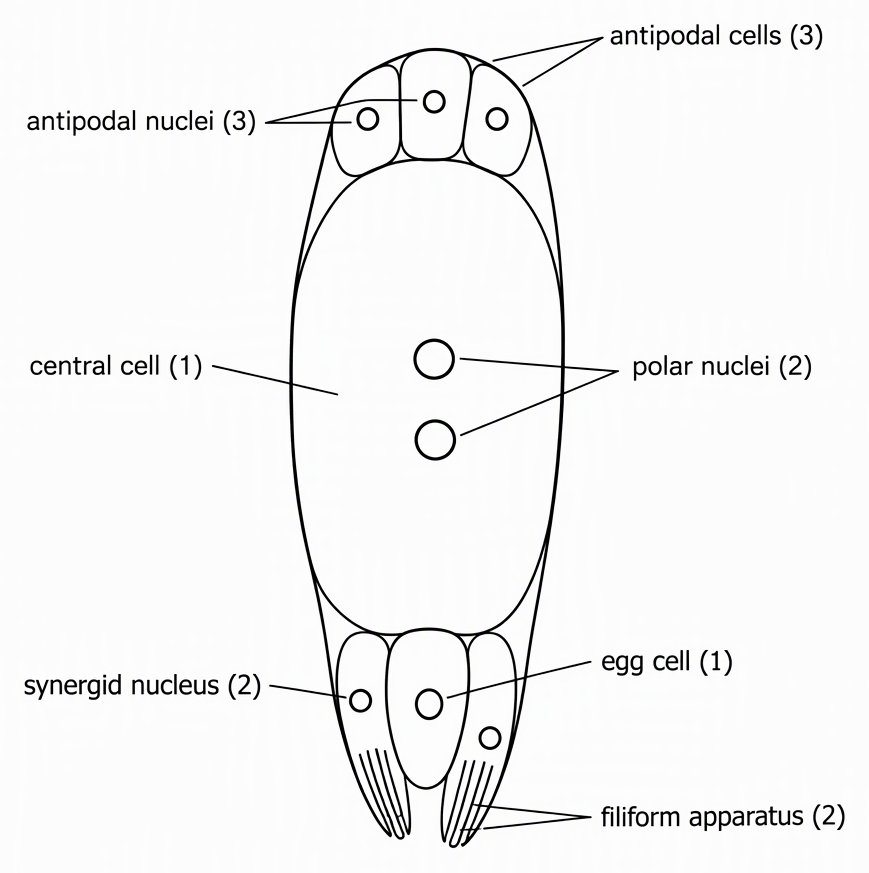
2. Which description matches a typical mature angiosperm embryo sac before fertilisation?
- A. Eight cells and eight nuclei, with each polar nucleus in a separate cell
- B. Seven cells and eight nuclei, with two polar nuclei in the central cell
- C. Seven cells and seven nuclei, with one polar nucleus in the central cell
- D. Eight cells and seven nuclei, with two egg cells at the micropylar end
3. Pollen moves from one flower to another flower on the same plant through an insect. Which statement correctly describes this event?
- A. It is autogamy because both flowers belong to one plant.
- B. It is xenogamy because pollen reaches a different flower.
- C. It is geitonogamy and introduces pollen from a genetically different plant.
- D. It is geitonogamy, requiring pollen transfer but genetically resembling autogamy.
4. In a typical angiosperm embryo sac, which pairing of fusion event and product is correct?
- A. Syngamy: a male gamete fuses with the egg to form the zygote; triple fusion: the other male gamete fuses with two polar nuclei to form the primary endosperm nucleus.
- B. Syngamy: a male gamete fuses with two polar nuclei to form the zygote; triple fusion: the other fuses with the egg to form the primary endosperm nucleus.
- C. Syngamy forms the primary endosperm nucleus; triple fusion forms the zygote.
- D. Syngamy involves both male gametes and the egg; triple fusion involves three antipodal nuclei.
5. A breeder selects an unopened, unisexual female flower as the female parent. It has no stamens. Which procedure supports controlled pollination using a chosen male parent?
- A. Emasculate, bag, then leave pollination to insects.
- B. Leave it uncovered because it cannot produce pollen.
- C. Bag without emasculation, apply chosen pollen when the stigma is receptive, then rebag.
- D. Remove the stigma, apply chosen pollen, then bag.
6. Which statement correctly distinguishes apomixis from polyembryony?
- A. Apomixis means several embryos per seed; polyembryony means seed formation without fertilisation.
- B. Apomixis means seed formation without fertilisation; polyembryony means multiple embryos in a seed, and both can occur together.
- C. Both terms mean seed formation without fertilisation.
- D. Polyembryony necessarily excludes apomixis.
What are the correct answers, and why are the tempting options wrong?
The answer key is: 1 C, 2 B, 3 D, 4 A, 5 C, 6 B. Check your reasoning as well as your letters. A correct choice based on a false rule still needs revision.
1. C, Tapetum
The tapetum is the innermost anther-wall layer and nourishes developing pollen grains. The strongest distractor is the endothecium: its characteristic thickenings help anther dehiscence, which releases pollen. Distinguish the layer supporting pollen development from the layer helping its release.
2. B, Seven cells and eight nuclei
The typical embryo sac contains an egg, two synergids, three antipodals and one central cell. The central cell contains two polar nuclei, giving eight nuclei across seven cells. Option A wrongly assumes that every nucleus must occupy a separate cell; the question describes the typical organisation, not every angiosperm.
3. D, Geitonogamy
Pollen moves between different flowers of the same plant. It is functionally cross-pollination because it requires a pollinating agent to transfer pollen between flowers, but genetically resembles autogamy because the pollen comes from the same plant. Option A confuses “same plant” with “same flower”: autogamy occurs within one flower.
4. A, Two different fusion products
Syngamy joins one male gamete with the egg, producing the zygote. Triple fusion joins the other male gamete with the two polar nuclei, producing the primary endosperm nucleus. Option B swaps the partners while retaining familiar product names. Track the participants first, then the product.
5. C, Bag without emasculation
A unisexual female flower has no anthers to remove, so emasculation is unnecessary. Bagging still prevents unwanted pollen from reaching its stigma; Option B confuses absence of pollen production with absence of pollen exposure. A bisexual female-parent flower would require anther removal before dehiscence, followed by protection and controlled pollination.
6. B, Different definitions that can overlap
Apomixis is seed formation without fertilisation; polyembryony is the presence of more than one embryo in a seed. Option D wrongly treats them as mutually exclusive. Embryos arising from maternal tissues can contribute to polyembryony, so one seed can illustrate both phenomena. One term concerns origin; the other concerns embryo number.
How should I use my mistakes to choose the next free practice route?
Sort errors before choosing more questions. Missing knowledge needs NCERT repair; confused terms need a direct comparison; wording mistakes need carefully reviewed PYQs. For each question, record your chosen option, your reason and the error type.
- Missing knowledge: Return to the relevant NCERT passage or diagram. For Question 2, count cells and nuclei separately.
- Confusing terms: Write an explicit contrast, such as same flower versus different flowers on the same plant.
- Misreading the stem: Underline the controlling word, such as “typical” or “unisexual”. Then inspect similar wording in verified PYQs.
- Guessing: Review even a correct answer. Guessing is not evidence of mastery.
Apply the official marking rule: award 4 marks for each correct answer, subtract 1 mark for each incorrect answer, and award zero for an unattempted question. Keep the error record beside the score: it tells you what to revise.
Do not convert this six-question result into a predicted NEET score, percentile or guaranteed chapter readiness. After revision, reattempt missed questions without the key and explain why every distractor is wrong.
When should I move to full-length mocks, and what is actually free?
Use full-length mocks when you need to test mixed-subject execution, not as a replacement for targeted chapter repair. If these concepts make sense in isolation but become difficult among unrelated questions, progress through mixed Biology practice before attempting a complete paper.
The current paper has 180 compulsory single-correct MCQs and no optional Section B. Your full-paper practice should match that structure rather than the discontinued optional-section format. After a mock, separate a forgotten fact from a rushed reading error before deciding what to revise.
As a next step, NEET JEEnius AI offers 30 free full-length mock tests a month. Each has 180 questions, 720 marks and 180 minutes, split into 45 Physics, 45 Chemistry and 90 Biology questions, with a scored per-subject breakdown. Use that breakdown to identify the subject needing attention, then repair the specific errors before your next full-length attempt.
Next step: full-length mock tests on NEET JEEnius AI and sit a full 180-question, 720-mark, 180-minute paper, 45 Physics, 45 Chemistry and 90 Biology, and get a scored per-subject breakdown (30 free a month).
Read next: Somatic Hybridisation NEET 2026: Correct Step Order.
Frequently asked questions
Should I solve NCERT questions or NEET PYQs first for this chapter?
Start with NCERT reading and exercises if basic concepts such as pollination and fertilisation are unclear. After a first reading, use explained chapter MCQs to identify conceptual confusion. Then attempt verified chapter-wise NEET PYQs to examine actual exam wording.
Are these flowering plant reproduction questions NEET PYQs?
No. These are six original single-correct practice MCQs, not previous-year questions. They cover selected conceptual contrasts rather than the entire chapter, with an answer key and distractor explanations available directly in the article.
How should I score these six NEET practice questions?
Award 4 marks for each correct answer, subtract 1 for each incorrect answer and give zero for an unattempted question. Record your reasoning and error type alongside the score, including correct answers reached by guessing. Do not use this six-question result to predict your NEET score, percentile or chapter readiness.
What should I revise after getting these chapter MCQs wrong?
Return to the relevant NCERT passage or diagram for missing knowledge, and write direct comparisons for confused terms. For stem-reading errors, underline controlling words such as “typical” or “unisexual” and review similar wording in verified PYQs. After revision, reattempt missed questions without the key and explain why each distractor is wrong.