
Should I start semiconductor practice with chapter MCQs or a full mock?
Start with explained semiconductor practice questions for NEET if you still confuse carriers, doping or diode polarity. Use the original MCQs on this page to check your reasoning before attempting a mixed paper.
Choose source-verified chapter PYQs to check how concepts have actually been examined. Choose full mocks to test performance across the paper, including reading and time management.
This page contains six original, free, single-correct practice questions, with answers below the complete set. No account is needed to attempt the drill or read the explanations.
How do explained MCQs, semiconductor PYQs and full mocks compare?
Explained MCQs diagnose chapter concepts; verified PYQs show past-paper wording; full mocks test mixed-subject performance. Choose the format that tests your current weakness. A whole-paper score cannot replace checking why you reversed a diode’s polarity.
- What question does it answer?
- This page’s MCQs: Can you reason through an unfamiliar semiconductor question?
- Verified semiconductor PYQs: How was this concept asked in an authentic past paper?
- NEET JEEnius AI full mocks: Can you apply your knowledge across a complete paper?
- How focused is the practice?
- This page’s MCQs: Six semiconductor concept checks.
- Verified PYQs: Semiconductor questions selected from past papers.
- Full mocks: Mixed subjects, with no guaranteed semiconductor coverage; 180 questions, 720 marks and 180 minutes.
- What feedback is available?
- This page’s MCQs: Answers, explanations and analysis of wrong options.
- Verified PYQs: Explanations depend on the source.
- Full mocks: A scored per-subject breakdown.
- Where do the questions come from?
- This page’s MCQs: Original practice, not past-paper claims.
- Verified PYQs: Check the stated year and paper against an authentic paper and answer key.
- Full mocks: Platform practice papers, not automatically PYQs.
- What is free?
- This page’s MCQs: The complete drill and explanations, with no account needed.
- Verified PYQs: Free access depends on the source.
- Full mocks: 30 free full-length mocks a month.
- What is the main limitation?
- This page’s MCQs: A small concept sample, not a whole-paper assessment.
- Verified PYQs: Remembering an answer can disguise weak understanding.
- Full mocks: A subject score alone does not explain a semiconductor misconception.
A memorised PYQ answer is weaker evidence than a correctly reasoned answer to an unfamiliar question. Before counting a correct response as progress, explain why the most tempting wrong option fails.
Which format should I choose in Class 11, Class 12 or a drop year?
Choose by your mistakes, not your school year or number of previous attempts. A dropper who reverses majority carriers needs focused questions, while a Class 12 student with secure chapter reasoning can move to verified PYQs.
- Class 11, studying ahead: Learn intrinsic material, doping, junction formation and biasing before attempting this drill. Do not let advance semiconductor work displace your current foundations.
- Class 12, chapter just completed: Attempt the six questions closed-book. Review every explanation, including correct answers, then move to source-verified PYQs.
- Any class, carriers or polarity still confused: Return to focused questions and check the rule behind each answer.
- Dropper, familiar answers but losses in mixed papers: Prioritise full mocks. Separate knowledge errors from misreading and time-management errors during review.
- PYQs already memorised: Use these unfamiliar original questions. Write the reasoning before treating the answer as evidence of understanding.
For parents: Paying for more questions is not the first remedy for a repeated conceptual error. Ask the student to explain one missed answer and reject one wrong option.
Can I try six free semiconductor practice questions for NEET now?
All six questions are below, with the key after the complete set. These are original single-correct questions, not NEET PYQs. Attempt them closed-book, recording an option and a short reason before scrolling to the key. Mark guessed answers for review.
Question 1: Intrinsic carriers
An intrinsic silicon sample is in thermal equilibrium. Which statement must be true about its electrons and holes?
- A. Their concentrations and mobilities are both equal.
- B. Their concentrations are equal, but their mobilities need not be equal.
- C. Their mobilities are equal, but their concentrations must differ.
- D. Their concentrations are equal, so their conductivity contributions must be equal.
Question 2: Pentavalent doping
Silicon is doped with a small amount of phosphorus, a pentavalent impurity. Under usual extrinsic conditions, which description is correct?
- A. Holes are majority carriers, and the sample is neutral overall.
- B. Electrons are majority carriers, so the sample has a net negative charge.
- C. Electrons are majority carriers, and the sample remains neutral overall.
- D. Electrons and holes remain equally numerous because the sample is neutral.
Question 3: Trivalent doping
Silicon is doped with boron, a trivalent impurity. Under usual extrinsic conditions, identify the majority and minority mobile carriers.
- A. Majority: holes; minority: electrons.
- B. Majority: electrons; minority: holes.
- C. Majority: holes; electrons are completely absent.
- D. Majority: electrons; minority: negatively charged acceptor ions.
Question 4: Depletion region
Which statement best describes the depletion region of an unbiased p–n junction at equilibrium?
- A. It contains neither mobile carriers nor any charged particles.
- B. It contains a high concentration of freely moving electrons and holes.
- C. It contains mobile donor and acceptor ions that carry current across the junction.
- D. It has very few mobile carriers but contains fixed ionised donors and acceptors.
Question 5: Battery connection
A battery is connected across a p–n junction diode. Which arrangement forward-biases the diode, and what happens to its junction barrier and depletion width?
- A. Positive terminal to p-side, negative to n-side; barrier and width increase.
- B. Positive terminal to p-side, negative to n-side; barrier and width decrease.
- C. Positive terminal to n-side, negative to p-side; barrier and width decrease.
- D. Positive terminal to n-side, negative to p-side; barrier and width remain unchanged.
Question 6: Half-wave rectification
An AC source is connected between input node S and reference node O. An ideal diode has its anode at S and cathode at L. A load resistor connects L to O, and output voltage is measured at L relative to O. Which statement is correct?
- A. It conducts when S is negative relative to O, giving negative output.
- B. It conducts during both half-cycles, giving alternating output.
- C. It conducts when S is positive relative to O, giving positive output; output is zero during the negative half-cycle.
- D. It blocks during the positive half-cycle and gives positive output during the negative half-cycle.
What are the answers, and which misconception does each question expose?
The answer key is: 1 B, 2 C, 3 A, 4 D, 5 B, 6 C. Compare your written reasons with the explanations, not just your letters. A correct guess does not establish that you can apply the concept to a changed question.
1. B: Equal concentrations do not mean equal mobilities.
In intrinsic material, electron and hole concentrations are equal. Mobility describes how carriers respond to an electric field, and electron and hole mobilities need not match. Their conductivity contributions therefore need not be equal: both concentration and mobility matter. Options A and D incorrectly extend one equality into another.
2. C: Carrier type is not net sample charge.
Pentavalent donors supply electrons that become majority carriers under usual extrinsic conditions. When a donor releases an electron, it leaves a positively charged, fixed donor ion. The charges balance overall, so n-type silicon is not a negatively charged sample, as option B claims. Option D confuses electrical neutrality with equal mobile-carrier concentrations.
3. A: Minority carriers do not disappear.
Trivalent doping produces p-type material, with holes as majority carriers and electrons as minority carriers. “Majority” means more numerous, not exclusively present. Option B reverses the carrier roles; option C wrongly removes electrons altogether. Fixed acceptor ions are not mobile minority carriers.
4. D: Depleted does not mean charge-free.
Carrier diffusion and recombination near the junction leave fixed positive donor ions on the n-side and fixed negative acceptor ions on the p-side. The region is depleted of mobile carriers, not of charge. These ions produce the junction electric field; they do not travel across the junction as option C suggests.
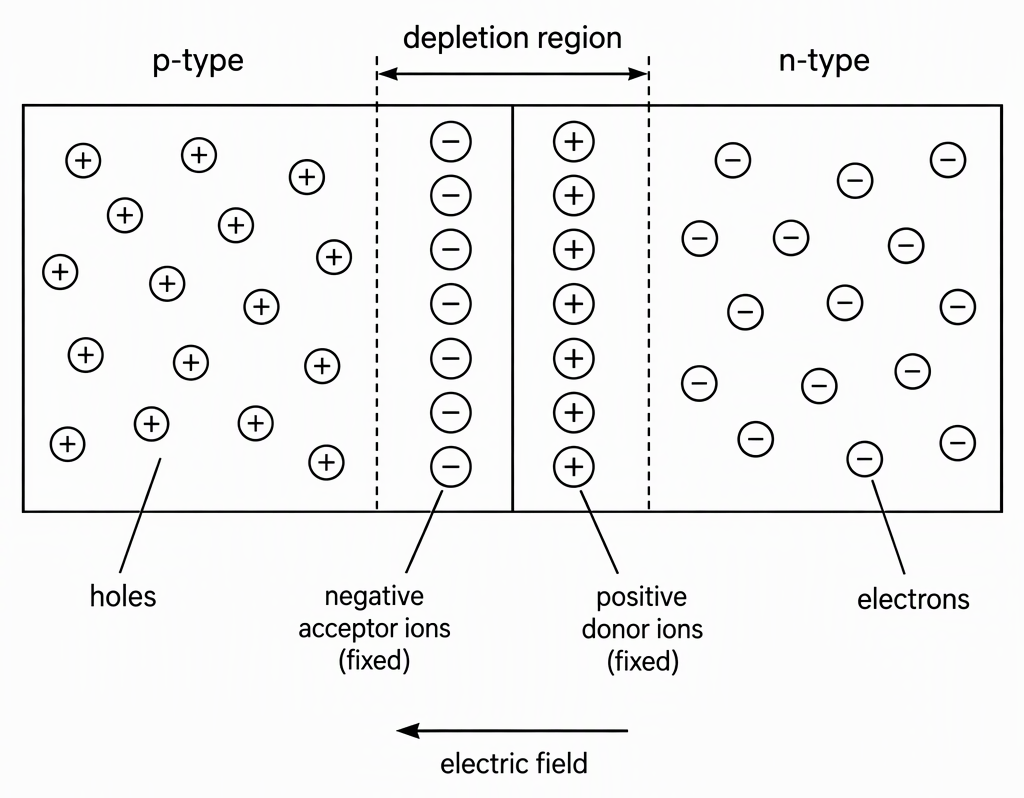
5. B: Forward bias opposes the junction barrier.
Connect the battery’s positive terminal to the p-side and negative terminal to the n-side. This forward bias reduces the junction barrier and narrows the depletion region. Option A gets the terminals right but the effect wrong; option C describes reverse-bias polarity.
6. C: Determine diode bias for each half-cycle.
When S is positive relative to O, the ideal diode is forward-biased and conducts, making L positive relative to O. During the negative half-cycle, it is reverse-biased and blocks; without load current, the resistor’s voltage is zero. Options A and D reverse the conducting polarity, while B ignores reverse-bias blocking.
Are these questions actual NEET PYQs?
No. They are original practice questions designed to test semiconductor concepts. For past-paper evidence, check a PYQ’s stated year and paper against an authentic paper and answer key.
Does a correct answer prove that I understand the concept?
Not if you guessed or remembered the option. Explain why your choice works and why the most tempting alternative fails before treating it as evidence of understanding.
How should I use my mistakes to choose the next practice session?
Use the drill to choose what to repair, not to predict your NEET result. Apply the official marking rule: four marks for a correct answer, minus one for a wrong answer and zero for an unattempted question. This is a learning check, not a validated predictor of marks, rank or chapter mastery.
Classify each mistake, and flag correct guesses for review:
- Carrier concepts: Questions 1 to 3, including concentration, mobility, doping and neutrality.
- Junction behaviour: Questions 4 and 5, including fixed charge, barrier and battery polarity.
- Circuit interpretation: Question 6, including diode orientation and output reference.
If the reasoning was wrong, revisit that concept before doing more questions. If reasoning was sound but wording caused the error, practise fresh questions with explicit polarity annotations.
Reattempt missed questions later without the key. Remembering “B” is not conceptual repair: explain what changes if the doping type or battery terminals are reversed.
Once chapter reasoning is secure, use verified PYQs to check authentic exam wording. For final-month planning, place that work within NEET Revision Strategy: A 30-Day Plan for the Last Month.
Then test mixed-paper performance: NEET JEEnius AI offers 30 free full-length mocks a month, each with 45 Physics, 45 Chemistry and 90 Biology questions, all compulsory, in 180 minutes, plus a scored per-subject breakdown. After the mock, classify each missed Physics question as knowledge, reading or time management before choosing your next session.
Frequently asked questions
Should I start semiconductor practice with chapter MCQs or full mocks?
Start with explained chapter MCQs if you still confuse carriers, doping or diode polarity. Once your reasoning is secure, use source-verified PYQs to check authentic exam wording. Use full mocks to test mixed-subject performance, reading accuracy and time management.
Are these semiconductor questions actual NEET PYQs?
No. These are six original, single-correct practice questions, not past-paper questions. To verify a PYQ, check its stated year and paper against an authentic paper and answer key.
Can I attempt these semiconductor MCQs for free without an account?
Yes, all six questions and their explanations are free, with no account needed. Attempt the complete set closed-book before checking the answer key. Record a short reason for each choice and flag guesses for review.
How should I review mistakes in semiconductor practice questions?
Group mistakes into carrier concepts, junction behaviour or circuit interpretation, and review correct guesses too. Revisit the concept if your reasoning was wrong; use fresh questions with explicit polarity annotations if wording caused the error. Reattempt missed questions later without the key and explain why the tempting wrong option fails.