
What is the best NEET revision strategy for the last month?
The best neet revision strategy for the last month is to repair recoverable mistakes, not force another complete syllabus pass. Prioritise active recall of studied material, timed questions, full-paper practice and correction of recurring errors. Biology needs daily attention because it accounts for 360 of 720 marks, but revision hours must also reflect your weaknesses.
This is a recommended plan for students with substantial syllabus coverage. It is not a promise to build preparation from scratch in 30 days.
Count backwards from your confirmed examination date, not an estimated calendar date. Check neet.nta.nic.in for the announcement for your sitting before attaching dates to this countdown.
What should an eight-hour NEET revision timetable look like?
Use six focused blocks on normal days and a separate test-and-repair schedule on mock days. Start with three hours of Biology and two and a half hours each of Physics and Chemistry, then adjust from your errors. These hours are recommendations, not official requirements or proven optimal targets.
Recommended normal-day timetable: time, task and required output
- 07:00–09:00 | Biology recall and NCERT checking | Produce a closed-book recall sheet, then check statements, labels and exceptions against NCERT.
- 09:30–11:00 | Physics formula recall and timed problems | Write formulas with their conditions, solve without notes and identify questions needing correction.
- 11:15–12:45 | Chemistry recall and application | Retrieve the chosen material, apply it to questions and correct incomplete answers.
- 14:00–15:00 | Biology questions and corrections | Finish a question set and record the distinction behind each error.
- 15:15–16:15 | Physics error repair | Redo selected wrong questions independently and list errors to retest.
- 16:30–17:30 | Chemistry error repair | Produce corrected solutions or recall notes and a short retest list.
Time audit: eight study hours, comprising Biology three hours, Physics two and a half hours, and Chemistry two and a half hours. Meals and breaks are excluded. Keep those gaps free rather than turning them into extra lectures.
Measure completed work by a checked recall sheet, corrected solutions and a short retest list. “Read 30 pages” does not tell you whether anything can be recalled.
Recommended mock-day timetable
- 09:00–12:00 | Full paper | Complete the paper and record answers in the examination mode announced for your sitting.
- 13:00–15:00 | Initial analysis | Review wrong, unattempted and guessed-correct questions; identify repair tasks.
- 15:15–16:45 | Targeted repair or continued analysis | Resolve priority errors instead of rushing through explanations.
- 17:00–18:30 | Biology maintenance or remaining error repair | Complete a recall check or finish unresolved corrections.
This also totals eight hours. It replaces the normal schedule, rather than being added to it. The clock times are illustrative, not official exam-session timings.
Protect eight hours of sleep. Move these blocks around school or household needs, but do not create a late-night second shift.
How should I divide revision time between Biology, Physics and Chemistry?
Give Biology daily retrieval practice, but do not automatically give it half your study time. Half the paper’s marks justify frequent attention, not a fixed hourly rule. A weak Physics method or Physical Chemistry calculation may need a longer correction session than a Biology fact you can already retrieve reliably.
Official current paper comparison
- Biology: 90 questions, 360 marks.
- Physics: 45 questions, 180 marks.
- Chemistry: 45 questions, 180 marks.
Use the starting allocation to establish a routine, then let error patterns change it. Judge a block by what you can answer independently after it, not by whether the subject received its usual hours.
Match the method to the subject
- Biology: Recall without looking. Verify NCERT statements and diagrams, then answer questions on exceptions and confusing distinctions. After checking, close the book and retrieve the corrected point again.
- Physics: Retrieve a formula with its conditions of use. Solve a timed problem, then redo wrong questions without copying the solution. If you cannot explain why the formula applies, the repair is unfinished.
- Chemistry: Use numerical practice for Physical Chemistry, reaction relationships and conditions for Organic Chemistry, and precise NCERT recall for Inorganic Chemistry. Keep all work within the current official syllabus.
Review the allocation after each mock. Move a 30-minute block towards a recurring, repairable weakness while retaining daily contact with all three subjects.
Suppose Biology recall is secure, but Physics errors repeatedly come from choosing the wrong equation. Move 30 minutes from Biology to Physics:
- Biology: 2.5 hours, reduced from three.
- Physics: three hours, increased from 2.5.
- Chemistry: 2.5 hours, unchanged.
- Total: eight hours, unchanged.
Name the extra block’s output: “Select and justify the correct equation, then redo the missed problems.” Do not label it simply “more Physics.”
One unusually difficult question is not enough reason to rebuild your week. Look for repeated errors rather than allocating hours through predicted chapter weightages or claims that a chapter is guaranteed to appear.
What mistakes make a last-month NEET revision plan fail?
Passive rereading, unanalysed mocks and an uncapped backlog leave errors unresolved while filling the timetable. Replace these habits with recall checks, correction blocks and a rule for dropping lower-priority work. When a task runs late, adjust the next block rather than adding hours to the day.
- Passive rereading: Replace “finished the chapter” with a closed-book recall check and questions answered without notes. Familiar-looking text is not evidence that you can retrieve it.
- Daily mocks without analysis: Do not schedule the next paper at the expense of correcting repeated errors. Move the test if the previous paper still has unresolved, repairable mistakes.
- A new book, question bank or long lecture series: Stay with familiar sources. Use a short explanation only for an identified gap, then return to solving or recall.
- Treating all unfinished chapters as urgent: Separate a small prerequisite gap from material needing extensive first-time learning. The first may fit a repair block; the second may displace several stronger tasks.
- Stacking missed work onto tomorrow: Carry forward only the highest-priority repair. Reschedule or drop lower-priority work rather than turning one missed block into a week of overload.
- Counting desk hours as progress: Preserve sleep and breaks. A longer session with no independent recall or corrected solution is not a better session.
- Practising the obsolete optional-section format: The current paper has 180 compulsory questions and no optional Section B. Use a paper that matches this structure, not an old choice-based mock.
“Compulsory” means there is no section-choice mechanism. It does not mean blind guesses are advisable under negative marking. Review uncertain attempts even when they were correct, so a lucky response does not hide a knowledge gap.
How should I organise the 30-day NEET countdown?
Divide the month into diagnosis, mixed revision, rehearsal and a short taper. Prioritise chapters you have studied but cannot yet recall or solve reliably. Maintain secure material with shorter checks, and start untouched material only after deciding what it would displace. Completion alone is not a reason to give a chapter revision time.
Here, D-1 means the day before the examination. D-30 means 30 days before it.
Recommended phase schedule
- D-30 to D-22 | Diagnose and repair familiar material: Use a full paper and closed-book checks to locate unstable knowledge. Repair the most repeated errors first.
- D-21 to D-11 | Broaden mixed revision: Mix topics, maintain secure chapters and retest recurring errors. Revisit work that seemed fixed but failed under time pressure.
- D-10 to D-4 | Rehearse and consolidate: Practise full-paper execution, answer recording and pacing. Keep corrections tied to familiar sources.
- D-3 to D-1 | Taper and prepare: Reduce study volume, use familiar notes and light recall, and complete practical checks.
Classify chapters before filling the slots
- Can recall and solve: Maintain with short recall checks and mixed questions.
- Studied but unstable: Give these chapters first claim on repair blocks. Identify the exact failed concept, distinction or method.
- Largely untouched: Check prerequisites, how much needs learning and which revision tasks would be displaced before starting.
For untouched material, assess whether usable understanding can fit inside an existing repair block. If it needs several new prerequisites or a long first-time course, postpone it rather than crowding out stronger revision.
Allow at most one contained backlog-repair block on a normal day. It replaces an existing slot; it never extends the day. For an unstable studied chapter such as Work, Energy and Power, use the Work, Energy and Power practice plan to narrow the repair task.
Use D-30, D-25, D-20, D-15, D-10 and D-6 as six sample full-paper checkpoints, not a universal prescription. A recent, properly analysed full-length mock can replace the D-30 diagnostic.
Keep a checkpoint only if there is time to analyse and repair it. Choose a corrected paper over an extra score showing the same mistakes.
In the final three days, this sample plan avoids full papers. Review familiar errors, taper the workload, check admit-card instructions and settle travel arrangements instead of opening another major backlog item.
How should I use each mock to plan the next day’s revision?
Give each reviewed error a specific next action and a retest date. Review wrong answers, unattempted questions and guessed-correct answers, not just the score report’s highlighted mistakes. The score records performance on that paper; the error log identifies what tomorrow’s first repair block should contain.
Use the current official format: 180 single-correct MCQs in 180 minutes, awarding 4 marks for correct answers, deducting 1 for wrong answers and awarding zero for unattempted responses.
Changing one previously wrong response to correct changes that response’s contribution by five marks. It does not guarantee a five-mark gain on a different paper.
Use a repeatable test–repair–retest cycle. Treat an error as repaired only after an independent answer, not after reading an explanation.
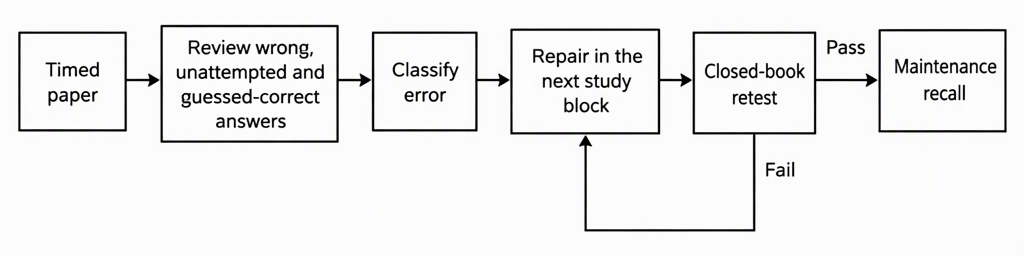
Compact error-log template
- Question or concept: Identify the exact item.
- Error type: Knowledge gap; failed recall; calculation or reading error; time or answer-recording error.
- Correction: Write the missing fact, rule or corrected step.
- Next action: State the independent task.
- Retest date: Schedule it inside an existing study block.
For a Physics sign error, recall the sign convention, re-solve the original question and attempt a different question testing the same convention. Copying the solution does not complete this sequence.
Treat two hours as initial analysis, not a deadline. Continue into the repair block if needed.
Start with paper-based retesting: keep question references on a dated sheet and cover solutions. Optionally, NEET JEEnius AI’s free mistake notebook automatically saves every question you get wrong and returns it at 1, 3, 7 and 14 days until marked mastered.
Keep retests within existing blocks and prioritise dates before the examination. Late-month mistakes cannot all complete a 14-day cycle.
Rehearse the mode announced for your sitting. Offline pen-and-paper OMR applied through 2026; do not assume a switch from 2027, which is not confirmed. Check neet.nta.nic.in before choosing the rehearsal mode.
What if I have only five hours or my syllabus is incomplete?
Use a five-hour version rather than treating eight hours as a minimum. Keep recall, questions and corrections inside the subject totals, and let mock days replace normal revision. If preparation is incomplete, concentrate on studied chapters and contained gaps instead of trying to fit an entire first pass into the final month.
Recommended five-hour normal day
- Biology: Two hours, including recall, NCERT checking, questions and corrections.
- Physics: One and a half hours, including formula retrieval, timed problems and error repair.
- Chemistry: One and a half hours, including recall, application and corrections.
On a five-hour mock day, allocate three hours to the paper and two hours to initial analysis. Put unresolved repairs into the next day’s first block. Normal subject revision does not also fit into those five hours.
Class 12 students with remaining commitments can use this shorter version. Droppers should not fill available time merely to imitate someone else’s hours; use extra time only for a defined task.
A final-month revision plan cannot substitute for a full first pass through a largely untouched syllabus. Prioritise studied chapters and contained gaps; postpone material needing extensive first-time learning.
Before tomorrow, complete this checklist:
- Choose your available focused hours.
- Inspect your latest mock, including guessed-correct answers.
- Classify the studied chapters that remain unstable.
- Select tomorrow’s highest-priority repair task and its required output.
- Set the first full-paper checkpoint, with analysis time reserved.
Next step: the mistake notebook on NEET JEEnius AI and every question you get wrong is saved automatically and returned to you at 1, 3, 7 and 14 days until it is marked mastered (free).
Frequently asked questions
What is the best NEET revision strategy for the last month?
Prioritise active recall, timed questions and correction of recurring errors in chapters you have already studied. Give Biology daily attention, but adjust subject hours according to repeated, repairable weaknesses. Use full-paper mocks only when you have time to analyse and repair them.
Is five hours a day enough for NEET revision?
Five focused hours can support a final-month revision plan if you already have substantial syllabus coverage; eight hours is not a minimum. Start with two hours of Biology and one and a half hours each of Physics and Chemistry, including corrections within those totals. On mock days, use three hours for the paper and two for initial analysis, carrying unresolved repairs into the next day's first block.
How many NEET mock tests should I take in the last month?
The article suggests six sample checkpoints: 30, 25, 20, 15, 10 and 6 days before the examination. This is not a compulsory target: move or skip a test if the previous paper still has unresolved, repairable errors. The sample plan avoids full papers in the final three days.
How should I analyse a NEET mock test?
Review wrong, unattempted and guessed-correct answers, then classify each error and record its correction, next action and retest date. Use the next repair block for an independent task, such as re-solving a missed problem without notes. Treat two hours as initial analysis, not a deadline, and consider an error repaired only after an independent answer.
What should I do if my NEET syllabus is incomplete in the last month?
Prioritise studied but unstable chapters and small, contained gaps rather than attempting an entire first pass. Start untouched material only after checking its prerequisites and deciding which revision task it would replace. Allow at most one contained backlog-repair block on a normal day, replacing an existing slot rather than extending study hours.