
Which NEET Physics chapters should you do first?
Start revision of NEET Physics important chapters with Physics and Measurement, then Dual Nature and Atoms and Nuclei, Electronic Devices, Electrostatics and Current Electricity. Electronic Devices needs a short basic-circuit refresher; Electrostatics needs comfort with vectors.
True beginners should put basic mathematics, vectors and foundational mechanics before the Class 12 sequence. The highest PYQ count does not automatically identify the best first chapter. Priority is not permission to skip the remaining syllabus.
How should you study Physics for two hours a day over 14 days?
Use this 28-hour starter plan if you are a Class 12 student or dropper who has encountered these chapters before. Each allocation is a proposed starting budget, not an evidence-based chapter completion time or a promise of mastery. Judge progress by the required output, not by finishing a video.
Days • Chapter or task • Total hours • Required output
- Day 1 • Physics and Measurement plus basic-maths diagnostic • 2 hours. Revise units, dimensions and measurement skills within the syllabus. Attempt a short diagnostic covering algebra, powers, graphs and vector components; list the gaps.
- Days 2–4 • Dual Nature and Atoms and Nuclei • 6 hours. Begin with energy, electron-volts and unit conversion. Produce a closed-book formula sheet, attempt numerical questions independently and identify relations you confuse.
- Days 5–6 • Electronic Devices • 4 hours. Start with current direction, potential difference and simple-circuit reading. Restrict study to the applicable official syllabus at neet.nta.nic.in; finish with independent questions on the included content.
- Day 7 • Mixed retrieval, short test and error repair • 2 hours. Recall earlier concepts without notes, take a short mixed test and repair the most common error.
- Days 8–10 • Electrostatics • 6 hours. Check vector addition and components before beginning. Practise distinguishing field from potential and solving syllabus-relevant force, field, potential and capacitance questions.
- Days 11–13 • Current Electricity • 6 hours. Practise resistance combinations and circuit equations within the syllabus. Show current directions, equations and units on paper before choosing an option.
- Day 14 • Mixed test and error repair • 2 hours. Test all starter blocks, classify errors and schedule the next repair or review session.
Use this example daily slot of 6:00–8:00 pm:
- 6:00–6:20 pm: 20 minutes of closed-book recall.
- 6:20–7:00 pm: 40 minutes of concept work.
- 7:00–7:45 pm: 45 minutes of questions.
- 7:45–8:00 pm: 15 minutes of error analysis.
On test days, replace the concept block with testing and correction. Keep retrieval and error analysis rather than spending the entire evening generating another score.
If a prerequisite check fails, use the next concept block to repair it. A student learning these chapters from zero should extend the schedule, not rush to keep the dates. Record completed questions and unresolved errors, not just hours spent.
How should you split Physics, Chemistry and Biology study time?
For a revision day with 6 net self-study hours, start with Physics 2 hours, Chemistry 1.5 hours and Biology 2.5 hours. Net study time excludes school, coaching and breaks. Protect a daily slot for all three subjects rather than letting the Physics plan consume your entire preparation.
Subject • Six-hour revision day • Three-hour school day • Official paper share
- Physics • 2 hours • 1 hour • 45 questions, 180 marks.
- Chemistry • 1 hour 30 minutes • 45 minutes • 45 questions, 180 marks.
- Biology • 2 hours 30 minutes • 1 hour 15 minutes • 90 questions, 360 marks.
On a school day with only 3 net hours, use the smaller allocation and extend the 14-day Physics plan to 28 days. Divide each two-hour block across two days, but keep some recall and independent solving on both.
Biology accounts for half the official questions and marks. That is a strong reason to protect its time, especially when Physics feels uncomfortable and demands attention.
Marks share is an anchor, not an inflexible study-time formula. Physics may need extra problem-solving time because knowing a formula and choosing how to use it are different skills. Still, anxiety is not a reason to abandon daily Biology.
Change these budgets after reviewing actual subject-wise errors in a test. Identify where marks were lost through forgotten content, weak concepts or avoidable mistakes, then shift time deliberately. One frustrating Electrostatics session is not enough evidence to rewrite the entire week.
What mistakes can make this Physics plan fail?
The main risk is mistaking scheduled activity for learning. Keep the two-hour boundary, but judge progress through independent answers and corrected errors. When a block goes badly, repair the specific cause rather than taking time from every other subject or automatically restarting a long lecture.
- Starting with the highest count: EMI and AC before basic electricity and magnetism can turn revision into repeated relearning. Build the relevant foundations first, even when another chapter has a larger PYQ count.
- Calling two hours “chapter complete”: Require independent question solving before moving on; use the checkpoint at the end of this guide. Finishing a study slot is not evidence of understanding.
- Watching instead of solving: Attempt each question on paper before opening its explanation. Record why the answer failed, such as a wrong sign, an unsuitable formula or a missed condition.
- Letting one chapter absorb the day: Return to the scheduled mixed review. Put unresolved work into the next planned repair block instead of silently cancelling Chemistry and Biology.
- Turning priorities into exclusions: The current official pattern has 180 compulsory questions and no optional Section B. Your starting shortlist is not a safe list of chapters to study exclusively.
- Chasing attempts despite weak accuracy: The official marking rule awards 4 marks for a correct answer, deducts 1 for a wrong answer and gives 0 for an unattempted question. Check reasoning, signs and units; attempt totals alone do not measure progress.
For fresh practice after repair, NEET JEEnius AI’s practice mode uses topic sets that skip previously seen questions and includes 60 free sets a month.
What does the PYQ bank tell us about NEET Physics chapter priorities?
The bank identifies frequently tagged chapter groups, not what the next paper will contain. These NEET Physics important chapters figures are tagged-question counts and corpus shares from a reported 365-question pool. They are not official chapter weightage, expected questions or guaranteed marks, and they do not determine the best starting order.
Chapter group • Tagged questions • Share of the reported pool
- Electrostatics • 32 • 8.8%.
- EMI and AC • 30 • 8.2%.
- Current Electricity • 27 • 7.4%.
- Optics • 27 • 7.4%.
- Atoms and Nuclei • 23 • 6.3%.
- Magnetic Effects of Current and Magnetism • 22 • 6.0%.
- Properties of Solids and Liquids • 22 • 6.0%.
- Electronic Devices • 21 • 5.8%.
- Physics and Measurement • 19 • 5.2%.
- Oscillations and Waves • 19 • 5.2%.
- Thermodynamics • 18 • 4.9%.
- Kinematics • 17 • 4.7%.
The overall platform corpus contains 1,342 tagged Physics questions across 2000–2026. That larger collection should not be confused with the 365-question pool used for the supplied chapter shares.
There is a source inconsistency: the aggregate is labelled “last 5 years”, but the supplied chapter breakdown spans 2021–2026, six calendar years. The figures above retain the reported counts and shares without silently changing that period label.
Annual representation is also uneven: 2025 has 35 tagged questions, while 2026 has 136. These are platform records, not the number of Physics questions in a single official paper. The supplied data does not explain the difference, so it cannot justify a ranking adjusted for annual coverage.
A missing year entry is not proof of zero appearances. The difficulty labels 1–4 are undefined, so they cannot support claims that a chapter contains easy, moderate or difficult questions.
Electrostatics illustrates the distinction between frequency and starting order. Its 32 tagged questions exceed Physics and Measurement’s 19, but Measurement lets you check units, dimensions and calculation habits before taking on vector-heavy work. For a returning student, that makes it a useful first block without making it the higher-frequency chapter.
Which starting route fits your current level, and what comes next?
Choose by what you can already do without help, not by your class label alone. A beginner needs foundations before the Class 12 sequence; a current Class 12 student should protect the live course. A dropper should use a diagnostic to identify gaps rather than repeat every foundation lesson.
- Beginner or Class 11: Study basic algebra, trigonometry and vectors alongside Physics and Measurement. Then work through Kinematics, Laws of Motion, and Work, Energy and Power. This is a prerequisite route, not a ranking derived from the supplied counts.
- Current Class 12: Keep your current school or coaching chapter active. Use a separate backlog slot for the starter sequence, extending its calendar when necessary. Do not create a new backlog by abandoning the live course for a generic list.
- Dropper or revision student: Use a short diagnostic to check formula rearrangement, vector components, energy conversion and basic circuits. Refresh only the foundations that fail before following the 14-day plan.
After Current Electricity, continue through Magnetic Effects of Current and Magnetism, then EMI and AC. Refresh circular motion before charged-particle motion where needed, and sinusoidal or oscillation basics before alternating-current work.
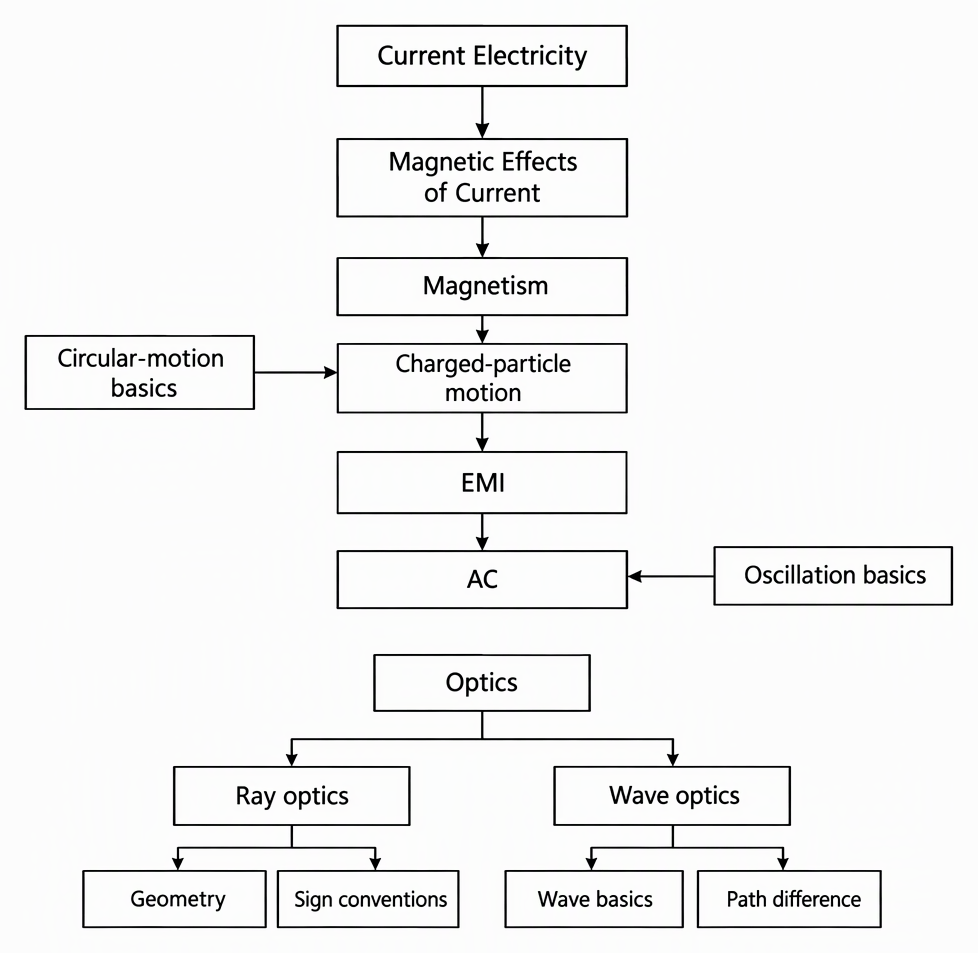
Treat Optics as another priority block, not as a chapter that must wait for the entire electricity sequence. Ray optics needs geometry, trigonometry and sign conventions; wave optics needs wave basics, phase and path difference.
Keep Thermodynamics, Properties of Solids and Liquids, Oscillations and Waves, and the remaining syllabus on the subsequent coverage list. Chapters absent from the supplied top 12 are not proven unimportant.
Broad groups such as Optics and EMI and AC contain different amounts of work, so do not assign identical hours just because each occupies one row. For final-month revision, use NEET Revision Strategy: A 30-Day Plan for the Last Month to place these repair blocks inside a shorter revision calendar.
When should you move on from a Physics chapter?
Move on after a closed-book set of 20 syllabus-relevant mixed questions shows independent understanding, not after finishing the lecture. Use 16 correct out of 20 as a suggested checkpoint only when errors do not reveal a repeated prerequisite gap. This is a faculty planning tool, not a validated predictor of NEET performance.
Mix concepts and question types within the chapter instead of selecting near-copies of one worked example. Keep solutions hidden until the set is finished.
- At least 16 correct, solved independently: Start the next scheduled block and book a later retest. Do not declare mastery.
- Below 16 correct: Classify the misses as conceptual, algebra or calculation, and reading or unit errors. Repair the dominant issue, then attempt fresh questions.
- Repeated prerequisite error at any score: Repair that foundation first. Several correct answers do not cancel a recurring failure with vectors, signs or circuit reasoning.
A conceptual gap may need a short explanation and a worked example. Calculation errors need written steps and checking; reading errors need attention to the condition or quantity requested. Replaying the entire lecture is not the default repair.
Even after meeting the checkpoint, keep the chapter in mixed revision. Check retention after a gap between study sessions.
The free NEET JEEnius AI mistake notebook automatically saves wrong answers and returns them at 1, 3, 7 and 14 days until marked mastered. Use those returns as repair opportunities, not as proof that a chapter is finished.
Today, choose your route, book the first study slot and prepare the diagnostic set before opening a lecture.
Next step: the mistake notebook on NEET JEEnius AI and every question you get wrong is saved automatically and returned to you at 1, 3, 7 and 14 days until it is marked mastered (free).
Frequently asked questions
Which NEET Physics chapters should I study first?
For revision, start with Physics and Measurement, followed by Dual Nature and Atoms and Nuclei, Electronic Devices, Electrostatics and Current Electricity. Refresh basic circuits before Electronic Devices and vectors before Electrostatics. Beginners should build basic mathematics, vectors and foundational mechanics before following the Class 12 sequence.
Can I finish the important NEET Physics chapters in 14 days?
The 14-day schedule is a 28-hour starter plan for Class 12 students and droppers who have studied these chapters before, not a promise of completion or mastery. It allocates two hours daily to recall, concepts, independent questions and error analysis. Extend the schedule if prerequisites are weak or you are learning from zero.
How should I divide study time between Physics, Chemistry and Biology?
For six net self-study hours, start with two hours for Physics, 1.5 hours for Chemistry and 2.5 hours for Biology. On a three-hour school day, use one hour, 45 minutes and 75 minutes respectively, extending the Physics starter plan to 28 days. Adjust these budgets using subject-wise test errors rather than one frustrating study session.
Do NEET Physics PYQ counts show official chapter weightage?
No: the article's chapter counts and shares come from a reported 365-question platform pool, not official chapter weightage or predictions. The data has a period-label inconsistency and uneven annual representation, so the counts cannot establish a reliable year-adjusted ranking. Use them as frequency signals, not as permission to skip other chapters.
How do I know when to move on from a NEET Physics chapter?
Attempt 20 syllabus-relevant mixed questions closed-book, keeping solutions hidden until you finish. A suggested checkpoint is at least 16 correct independently, provided errors do not show a repeated prerequisite gap. Below that score, repair the dominant error type and attempt fresh questions; repair recurring foundation gaps at any score. This is a planning tool, not proof of mastery or a validated NEET performance predictor, so schedule a later retest.