
How should I start studying Sexual Reproduction in Flowering Plants for NEET?
- Divide Sexual Reproduction in Flowering Plants into three NCERT blocks before memorising terms for NEET. Follow developmental order rather than repeatedly reading the chapter:
- Pre-fertilisation structures and events.
- Double fertilisation.
- Post-fertilisation events, including apomixis and polyembryony.
- Build parallel male and female timelines. Mark meiosis, mitosis and fusion beside the relevant transitions so you can distinguish spore formation, gametophyte development and fertilisation.
The male sequence is:
The typical female sequence is:
Connect the timelines at double fertilisation, marking both fusions. Locate pollen mother cells and microspores inside the anther’s microsporangia, and female development within the ovule’s nucellus.
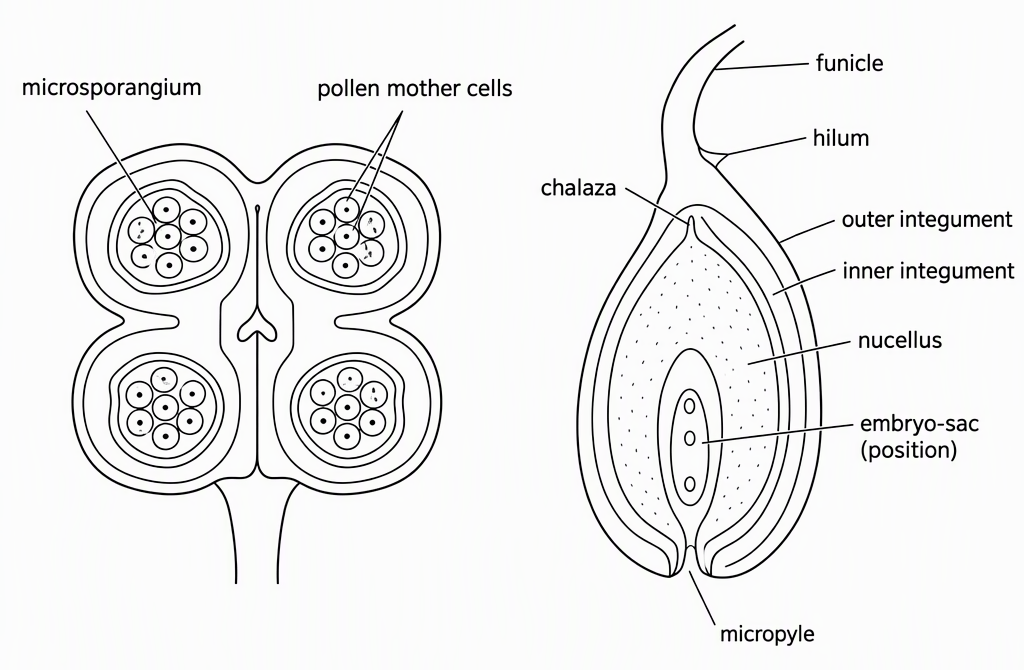
Read your current NCERT edition’s text, diagrams, captions and named examples together. The location often decides which developmental stage an MCQ describes.
After each block, close NCERT and reconstruct its sequence. Reread only where recall breaks. This is a study order, not a claim about chapter weightage or guaranteed NEET questions.
How do I stop confusing cells, nuclei and ploidy?
Count cells, nuclei and chromosome sets separately. Cell count describes compartments, nuclear count describes nuclei, and ploidy describes chromosome sets within a nucleus. None substitutes for another.
Step 3: Make a ledger, your second revision tool, with columns for structure or cell, origin, division or fusion, ploidy and fate. Assume a normal diploid sexual life cycle unless the question says otherwise.
Use these core records:
- Pollen and megaspore mother cells: arise from sporogenous tissue; undergo meiosis; produce spores.
- Microspores and megaspores: meiotic products; develop into gametophytes through mitosis.
- Gametes: develop within gametophytes without further meiosis; participate in fertilisation. Spores and gametes are haploid.
- Zygote: formed by syngamy; develops into the embryo.
- Primary endosperm nucleus: formed by typical triple fusion; initiates endosperm development.
In typical monosporic development, meiosis produces four megaspores. Usually one remains functional, and three mitotic divisions produce eight nuclei. Eight nuclei do not mean eight cells.
Step 4: Redraw from memory the anther wall, anatropous ovule and mature embryo sac, then check NCERT. Learn the anther-wall order from outside inward:
Place the egg apparatus at the micropylar end, antipodals at the chalazal end, and two polar nuclei within the central cell in the standard eight-nucleate representation.
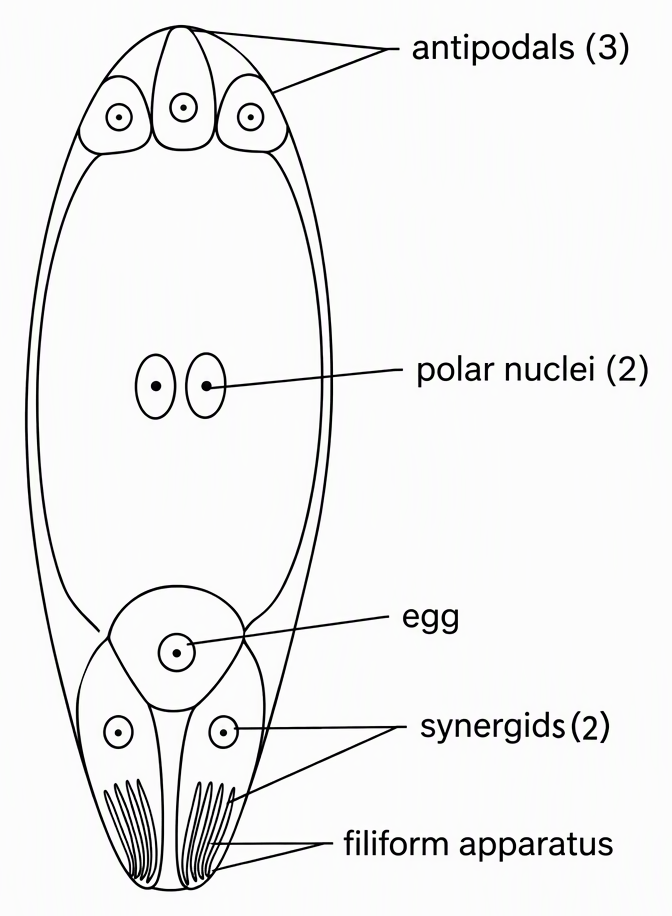
Explain one function per label. For example, the filiform apparatus guides pollen-tube entry into a synergid; tapetum nourishes developing pollen.
How do I use comparisons to eliminate MCQ options?
Check the criterion named in the option. Pollination questions may test flower and plant identity; developmental questions may test division; post-fertilisation questions may test tissue origin.
Step 5: Build a comparison sheet, your third revision tool. Use consistent fields: source flower, source plant, pollinating agent and genetic source.
- Autogamy: same flower; same plant; an external agent is not necessarily required; genetically self.
- Geitonogamy: different flower; same plant; requires a pollinating agent; genetically self.
- Xenogamy: different flower on another plant of the same species; requires a pollinating agent; genetically from another plant.
Add compact process contrasts:
- Microsporogenesis: meiotic production of microspores. Microgametogenesis: development of the male gametophyte from a microspore.
- Syngamy: male gamete fuses with egg. Triple fusion: the other male gamete fuses with two polar nuclei or their fused secondary nucleus.
- Apomixis: seed formation without fertilisation.
- Parthenocarpy: fruit development without fertilisation.
- Polyembryony: more than one embryo in a seed.
The last three terms are not interchangeable. Keep a separate NCERT example list for pollination adaptations, outbreeding devices, pollen–pistil interaction and artificial hybridisation; ploidy cannot explain these facts.
Step 6: Check each claim in order.
- Circle qualifiers such as NOT, incorrect, always and only.
- Identify the stage or structure.
- Check origin and location.
- Test division, fusion or genetic source.
An absolute word is a prompt to verify, not automatically reject. Judge statements independently before reading option combinations. Log the wrong rule used and its corrected version, not just the answer letter.
Why does the typical embryo sac have seven cells but eight nuclei?
The central cell contains two polar nuclei, so counting nuclei as cells gives the wrong answer. First identify the developmental stage, then count cells and nuclei separately. “Typical” matters because embryo-sac development is not identical across all flowering plants.
Original NCERT-aligned practice example, not a previous-year NEET question:
In the typical mature angiosperm embryo sac, with the two polar nuclei shown separately, which description is correct?
- A: Eight cells and eight nuclei.
- B: Seven cells and eight nuclei.
- C: Seven cells and seven nuclei.
- D: Eight cells and seven nuclei.
The stage is the mature embryo sac, before fertilisation. Count cells:
Now count nuclei:
Answer: B.
- A treats each polar nucleus as a separate cell.
- C overlooks the second polar nucleus.
- D matches neither the cell boundaries nor the nuclear count.
The functional megaspore undergoes three rounds of mitosis, producing eight nuclei before cellular organisation gives the typical seven-celled structure. Calling these divisions meiosis confuses embryo-sac development with megaspore formation.
Why is geitonogamy genetically self-pollination?
Both flowers belong to the same plant, so an outside pollen carrier does not make the transfer genetically cross-pollination. Flower identity, plant identity and the transfer agent are separate criteria. Check them in that order.
Original practice MCQ: A bee transfers pollen between two different flowers on the same plant. Which description is correct?
- A: Autogamy because the plant is the same.
- B: Geitonogamy, functionally cross-pollination but genetically self-pollination.
- C: Xenogamy because two flowers are involved.
- D: Xenogamy because an insect carries the pollen.
Answer: B. Apply the comparison sheet:
- Reject A: autogamy requires transfer within the same flower, not merely the same plant.
- Reject C: different flowers are insufficient for xenogamy; they must belong to different plants of the same species.
- Reject D: an insect identifies the agent, not the genetic source.
Geitonogamy resembles cross-pollination functionally because it needs an agent to move pollen between flowers. Genetically, the pollen still comes from the same plant.
Retrieval check: change the destination to a flower on another plant of the same species. The classification becomes xenogamy.
How do I determine the ploidy of seed tissues?
Trace each tissue to its origin. The embryo comes from the zygote, typical endosperm follows triple fusion, and the seed coat comes from maternal integuments. The seed coat is not a fertilisation product.
Original practice MCQ: In a normal diploid angiosperm undergoing typical sexual reproduction, what are the ploidies of embryo, endosperm and seed coat, respectively?
Derive the embryo through syngamy:
Derive typical endosperm through triple fusion:
Trace the seed coat without adding any gametes:
Answer: C.
- A ignores syngamy, misses a contribution to triple fusion and makes maternal tissue haploid.
- B assigns the wrong fusion outcome to endosperm and incorrectly makes seed coat triploid.
- D swaps the embryo and endosperm fusion outcomes.
Attach the fate map:
Other floral parts contribute to false fruits. The sexual-reproduction assumption matters because apomictic embryos develop without fertilisation. Identify their actual origin rather than automatically applying syngamy.
What should I practise before attempting mixed chapter MCQs?
Start with developmental sequences and ploidy, then diagrams, then pollination and special cases. Finish with mixed single-correct chapter questions; use each error to select a specific NCERT passage rather than restarting the chapter.
- Solve developmental-sequence and ploidy sets.
- Identify diagram labels, including dicot and monocot embryos.
- Compare pollination and special cases.
- Attempt mixed single-correct chapter questions.
Include counting problems. Original numerical: compare microspore production from twelve pollen mother cells with embryo-sac formation from twelve megaspore mother cells. Assume normal meiosis, monosporic development, one functional megaspore per female meiotic tetrad and no losses beyond normal megaspore degeneration.
State assumptions before calculating. Four meiotic products do not imply four functional embryo sacs.
Cover NCERT examples, pollen viability and storage, outbreeding devices, emasculation and bagging, seed development, apomixis and polyembryony. Use genuine chapter PYQs where available, retaining source and year; never relabel original questions as PYQs or infer frequency from an unverified collection.
Classify errors as sequence, location, ploidy, terminology or missed NCERT fact. Revisit only the relevant passage or diagram, then retry. Readiness means reconstructing all three revision tools unaided and explaining why mixed-set distractors are wrong.
NEET JEEnius AI practice mode offers topic sets that skip questions already seen, with 60 free sets a month. Use these for fresh-question practice; deliberately retry logged mistakes separately.
Next step: daily practice problems on NEET JEEnius AI and get a fresh set on a topic every day (20 free attempts a month).
If that step was the hard part, work through Ray Optics Practice Questions NEET: 6 MCQs With Explanations.
Frequently asked questions
How should I start studying Sexual Reproduction in Flowering Plants for NEET?
Divide NCERT into three blocks: pre-fertilisation structures and events, double fertilisation, and post-fertilisation events including apomixis and polyembryony. Build parallel male and female developmental timelines, marking meiosis, mitosis and fusion. After each block, close NCERT and reconstruct the sequence before checking gaps.
Why does the embryo sac have seven cells but eight nuclei?
In the typical mature embryo sac with separate polar nuclei, the central cell contains two nuclei. The egg apparatus contributes three cells and three nuclei, while the antipodals contribute another three cells and three nuclei. Adding the central cell gives seven cells but eight nuclei.
Why is geitonogamy genetically self-pollination?
Geitonogamy transfers pollen between different flowers on the same plant, so the genetic source remains the same plant. It is functionally cross-pollination because a pollinating agent is required. Transfer between flowers on different plants of the same species is xenogamy.
What is the ploidy of the embryo, endosperm and seed coat?
In a normal diploid angiosperm undergoing typical sexual reproduction, the embryo is 2n, the endosperm is 3n and the seed coat is 2n. The embryo develops from the zygote after syngamy, while typical endosperm follows triple fusion. The seed coat develops from maternal integuments, not from fertilisation.