
What order should I study Wave Optics in for NEET?
Draw the setup and name the phenomenon before choosing an equation. Study Wave Optics for NEET in the order below so each model builds on the previous one.
Step 1: Study in dependency order.
- Wavefronts and Huygens’ principle.
- Coherent superposition and Young’s double-slit experiment, or YDSE.
- Single-slit diffraction.
- Polarisation.
Your minimum prerequisites are wavelength, phase, superposition, refractive index, basic trigonometry and conversions between nanometres, millimetres and metres. Repair gaps in these before attempting intensity questions.
For Huygens’ principle, reconstruct the reflection and refraction wavefronts. Follow how secondary wavelets form the new wavefront, then connect its orientation to the laws of reflection and refraction. Do not memorise the final laws without understanding the construction.
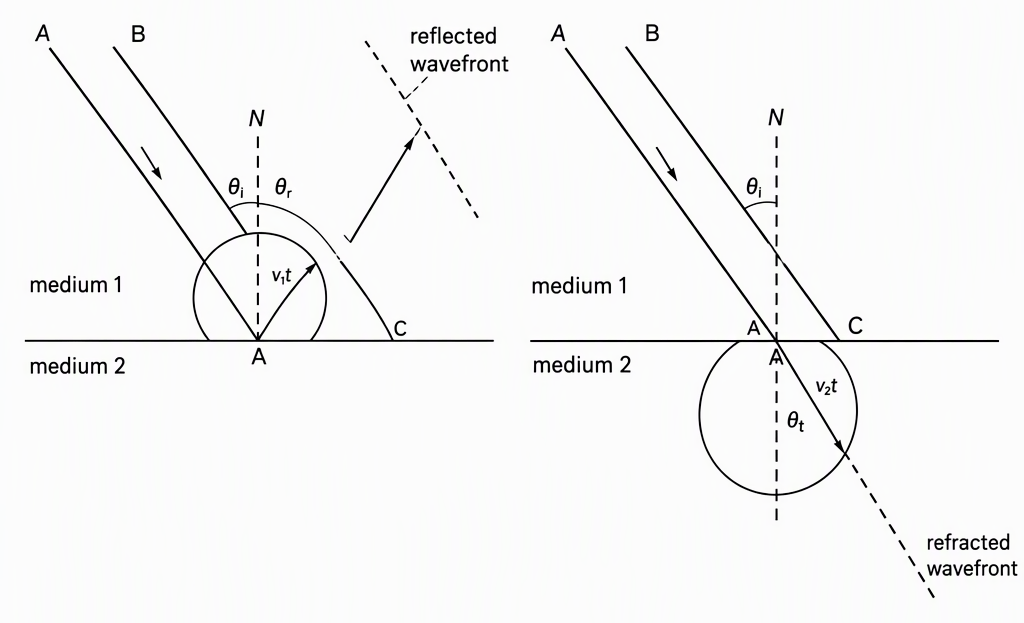
Read the relevant NCERT explanation and figure, close the book, redraw or explain it, then attempt a matching question. Use this cycle for each new model.
Before YDSE, settle coherence: equal frequency alone is insufficient. The phase difference between the sources must remain constant.
How do I choose the right Wave Optics formula?
Identify the arrangement, translate the wording into quantities, calculate symbolically, then check units, width definitions and intensity assumptions. Choose the model before the formula: two slits, one finite slit and polarising elements require different equations.
Step 2: Classify and sketch.
- Two coherent slits suggest interference.
- A finite single slit suggests diffraction.
- Polariser or analyser axes suggest polarisation.
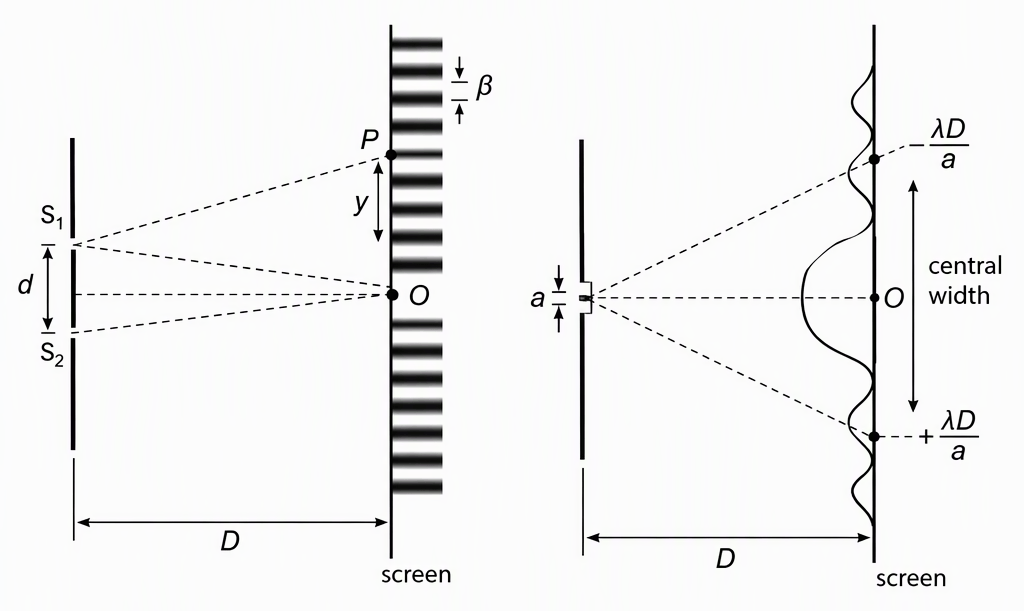
YDSE uses the separation between two slits; diffraction uses the width of one slit. Their screen widths also measure different things: adjacent-fringe spacing versus the distance between the first minima.
Step 3: Translate the quantities and assumptions.
For YDSE, the distant-screen, small-angle approximation gives path difference, phase difference and fringe width:
Use the wavelength in the propagation medium. For coherent sources initially in phase:
Include any initial phase difference before applying the bright or dark conditions:
For equal individual slit intensities:
For single-slit diffraction, minima occur at nonzero integer orders. The full central width uses the distant-screen, small-angle approximation:
For ideal polarising elements, halve unpolarised intensity at the first polariser. Then apply Malus’ law, measuring the analyser angle from the incoming light’s polarisation direction:
Brewster’s law for incidence from medium 1 into medium 2 uses their respective refractive indices:
Step 4: Calculate symbolically before inserting SI values. For changed-parameter YDSE questions, use:
Step 5: Check dimensions, full versus half-width, and whether the intensity entering the analyser has already been reduced.
How do I find YDSE intensity at a given screen position?
Convert screen position into path difference, then phase, then intensity. Fringe width provides the bridge: a displacement of one fringe width corresponds to one full phase cycle.
Original illustrative problem, not a previous-year NEET question: Two coherent, initially in-phase slits have equal individual intensities. Find the intensity at the stated displacement:
Apply the five-step routine:
- Study foundation: recall that superposition links phase to intensity.
- Classify and sketch: identify YDSE and mark the slit separation, screen distance and observation point.
- Translate: the sources start in phase, so only path-generated phase is needed.
- Calculate: convert lengths and obtain fringe width before phase.
- Check: compare with the central maximum and verify that the cosine argument is dimensionless.
The conversions and calculation are:
The answer is half the central intensity, not half either slit’s individual intensity. The tempting error is inserting path difference directly into a cosine instead of converting it to phase.
For a scaling check, consider uniform immersion of the entire arrangement, initially in air approximated as vacuum. With geometry unchanged, frequency remains constant; the wavelength relation therefore gives a smaller fringe width:
Practise direct YDSE questions, then unseen phase-and-intensity variants. For that unseen-question stage, NEET JEEnius AI practice mode offers topic sets that skip questions already seen, with 60 free sets a month.
Why is the diffraction width twice the interference spacing here?
The central diffraction maximum extends between the first minima on opposite sides. YDSE fringe width measures adjacent bright-fringe spacing. When slit width and slit separation have equal numerical values, with wavelength and screen distance unchanged, the full diffraction width is twice the interference spacing.
Original illustrative problem: Find the full central-maximum width for a single slit with:
Classify this as diffraction. The given small length is the width of one slit, not a separation between two slits.
The first minima lie at:
Their separation is the requested full width:
Compare the answers:
- Previous YDSE problem: adjacent bright-fringe spacing is 2.4 millimetres.
- This diffraction problem: full central-maximum width is 4.8 millimetres.
The numerical slit width equals the earlier slit separation, but the geometry and width definitions differ. The diffraction centre is a maximum, not a zeroth-order minimum:
Check the trend: narrowing the slit broadens the central maximum. Diffraction side maxima do not have equal intensities; those peaks decrease away from the centre.
How do I track intensity through a polariser and analyser?
Handle each element separately: unpolarised light loses half its intensity at an ideal first polariser, and the resulting plane-polarised light follows Malus’ law at the analyser. Applying the analyser angle directly to the original unpolarised intensity skips the first reduction.
Original illustrative problem: Unpolarised light passes through an ideal polariser and an ideal analyser. The angle is between their transmission axes:
The intensity chain is:
For already plane-polarised light aligned with the first polariser, there is no initial halving. With the same original intensity:
Applying Malus’ law directly to the original unpolarised beam answers a different problem. Unpolarised light has no single fixed polarisation direction from which to measure that angle.
Check the original setup at the limits: parallel axes transmit the intensity leaving the first polariser, while crossed ideal axes transmit zero.
Polarisation demonstrates light’s transverse nature. The polariser selects an electric-field vibration direction perpendicular to propagation.
What should I practise next to improve Wave Optics accuracy?
Practise by model first, then mix the models so you must choose the equation yourself. Judge readiness by whether you can explain the choice and solve an unseen variant, not by formula recognition.
Use this progression:
- Huygens diagram and concept questions.
- Direct YDSE questions.
- Phase and intensity.
- Changed-parameter ratios.
- Diffraction-width comparisons.
- Polariser chains and Brewster-angle questions.
- Mixed questions, including genuine PYQs.
For every attempt, write a phenomenon label, a sketch where useful, the governing equation and one final check before selecting the answer. Log the cause of each error and apply its matching repair:
- Wrong model: identify which physical detail distinguishes two similar-looking questions.
- Wrong geometry or angle: relabel slit width, slit separation or the reference polarisation axis.
- Wrong units: rewrite every length in metres before substitution.
- Wrong intensity assumption: write the intensity entering each element, or define each slit’s individual intensity.
You are ready when you can explain why the equation applies, solve an unseen variant and distinguish diffraction width from interference spacing without notes. After correcting an error, test that skill on another question rather than merely recording the right option.
For broader optics practice, try Ray Optics Practice Questions NEET: 6 MCQs With Explanations. It is optional, not a prerequisite.
Choose your weakest error category for the next set. NEET JEEnius AI daily practice problems provide a fresh set on a topic every day, with 20 free attempts a month.
Frequently asked questions
What order should I study Wave Optics in for NEET?
Start with wavefronts and Huygens’ principle, then study coherent superposition and YDSE, single-slit diffraction, and polarisation. Before intensity questions, revise wavelength, phase, superposition, refractive index, basic trigonometry and unit conversions. For each model, read the NCERT explanation, redraw or explain it without notes, and attempt a matching question.
How do I calculate YDSE intensity at a given screen position?
Under the distant-screen, small-angle approximation, convert displacement y into path difference using Δ ≈ dy/D, then calculate total phase as φ = φ_initial + 2πΔ/λ. For coherent slits with equal individual intensity I₀, use I = 4I₀ cos²(φ/2). Do not put path difference directly into the cosine or confuse I₀ with the central maximum intensity.
Is diffraction width always twice the YDSE fringe width?
No: under the distant-screen, small-angle approximation, the full central diffraction width is 2λD/a, while YDSE fringe spacing is λD/d. The diffraction width is twice the interference spacing only when the single-slit width a equals the slit separation d, with wavelength and screen distance unchanged. Diffraction width spans the first minima on opposite sides; YDSE fringe spacing measures adjacent bright fringes.
When should I halve intensity in polarisation questions?
Halve the intensity when unpolarised light passes through an ideal first polariser. Apply Malus’ law to the intensity entering the analyser, measuring its axis angle from the incoming light’s polarisation direction. Already plane-polarised light aligned with the first polariser does not undergo this initial halving.