
How should I start studying Work, Energy and Power for NEET?
- Start Work, Energy and Power for NEET by identifying which forces do work. Repair only the necessary prerequisites: force diagrams, resolving components, displacement and elementary graph areas. Do not restart all of mechanics.
Follow this study order: work and its sign → work–energy theorem → potential energy and conservation → power → applications involving springs, collisions and vertical circles. Use each stage to practise a decision: what work occurs, what changes, whether mechanical energy is conserved and how quickly energy transfers.
- Mark the initial and final states before choosing an equation. Record the displacement, the unknown and every force that could do work between those states. A force being present does not mean it transfers energy.
- Choose one accounting route. For net work on a particle, use the work–energy theorem:
For a system that includes conservative interactions, use:
Here, “other work” means work not already represented by a potential-energy term. If gravitational potential energy is included, do not also add gravitational work. That would count the same transfer twice.
Mechanical energy is conserved only when the net other work is zero. Individual contributions can cancel, so examine their sum rather than checking only whether a non-conservative force exists.
Keep this compact equation bank, with its conditions:
- Constant force: use the angle between force and displacement.
- Kinetic energy: for a particle or the translational motion of a block.
- Gravitational potential energy: near Earth’s surface, with height measured from a chosen reference.
- Ideal spring energy: extension or compression is measured from natural length.
- One-dimensional variable force: integrate the force component along displacement, or calculate signed graph area.
How do I write and check the energy balance?
- Assign signs from force relative to displacement. A force component along displacement does positive work; one against it does negative work. Do not assign signs from labels such as “helpful” or “opposing”.
For a block sliding on a stationary rough surface, frictional work is negative. Friction does not always do negative work, for example when a moving belt speeds up a block.
The normal force does zero work in the fixed-surface examples here because it is perpendicular to displacement. Do not extend that rule to every moving constraint.
- Write one symbolic balance before substituting or simplifying. For power, identify whose work is being measured and whether the question asks for an interval average or an instantaneous value.
- Check dimensions, the sign of the kinetic-energy change and one limiting case. Energy terms must have units of joules; power must have units of watts. Removing friction should recover the smooth-surface result.
Energy alone may not determine time or force. Use Newton’s laws or kinematics when needed.
For collisions, use momentum reasoning when the external impulse on the chosen system is negligible; kinetic energy is conserved only in elastic collisions. For vertical circles, pair energy with the radial force equation and the appropriate contact or taut-string condition.
How do I find speed after sliding down a rough incline?
Use gravitational potential energy and include negative frictional work. Do not conserve mechanical energy across this rough slide. In this original symbolic example, a block is already moving down a fixed incline and continues sliding throughout the stated distance.
The setup is:
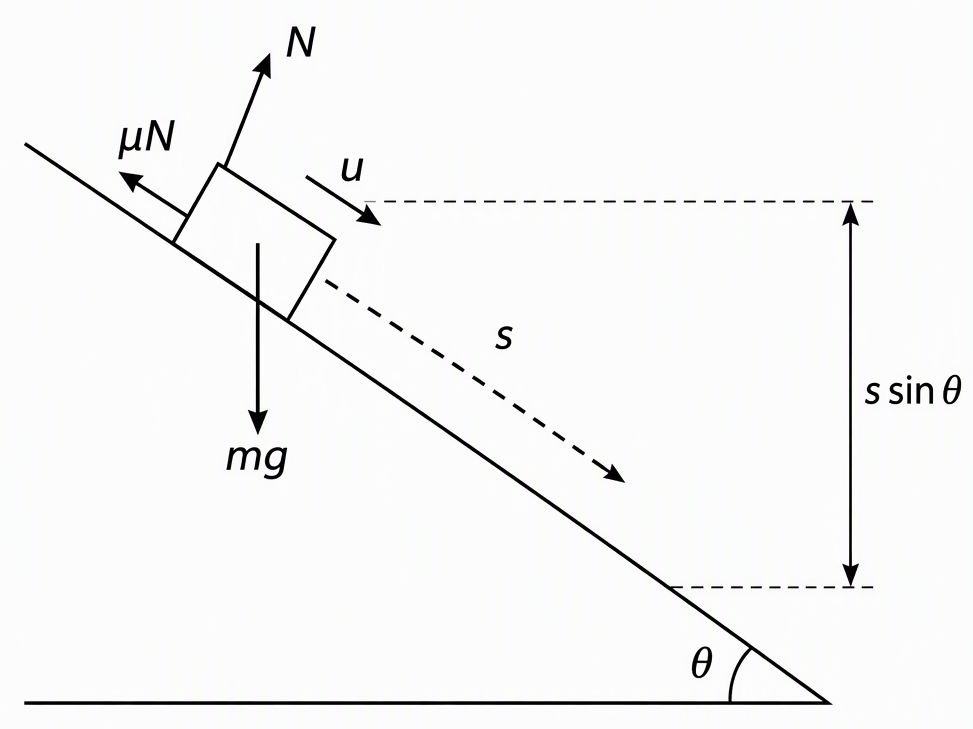
The vertical drop and normal reaction are:
Choose the final height as zero potential energy. Use the block–Earth gravitational energy account, with sliding friction entered as other work:
Solving gives:
Mass cancels because every energy term is proportional to it. Multiplying weight by the full slope distance would give the wrong gravitational energy change: gravity acts vertically, so use the vertical drop.
The tempting mechanical-energy conservation equation omits negative frictional work and overestimates the final kinetic energy. Check the correct balance by removing friction:
A negative calculated squared speed means the assumed interval cannot be completed under the stated sliding motion. It does not mean the speed is negative.
How do I solve a force–displacement graph with negative areas?
Calculate signed area under the net-force graph, then equate it to the change in kinetic energy. Positive and negative areas can cancel over the full displacement even though the particle speeds up and slows down along the way.
Consider this original one-dimensional example:
The particle starts at the origin, moving in the positive direction:
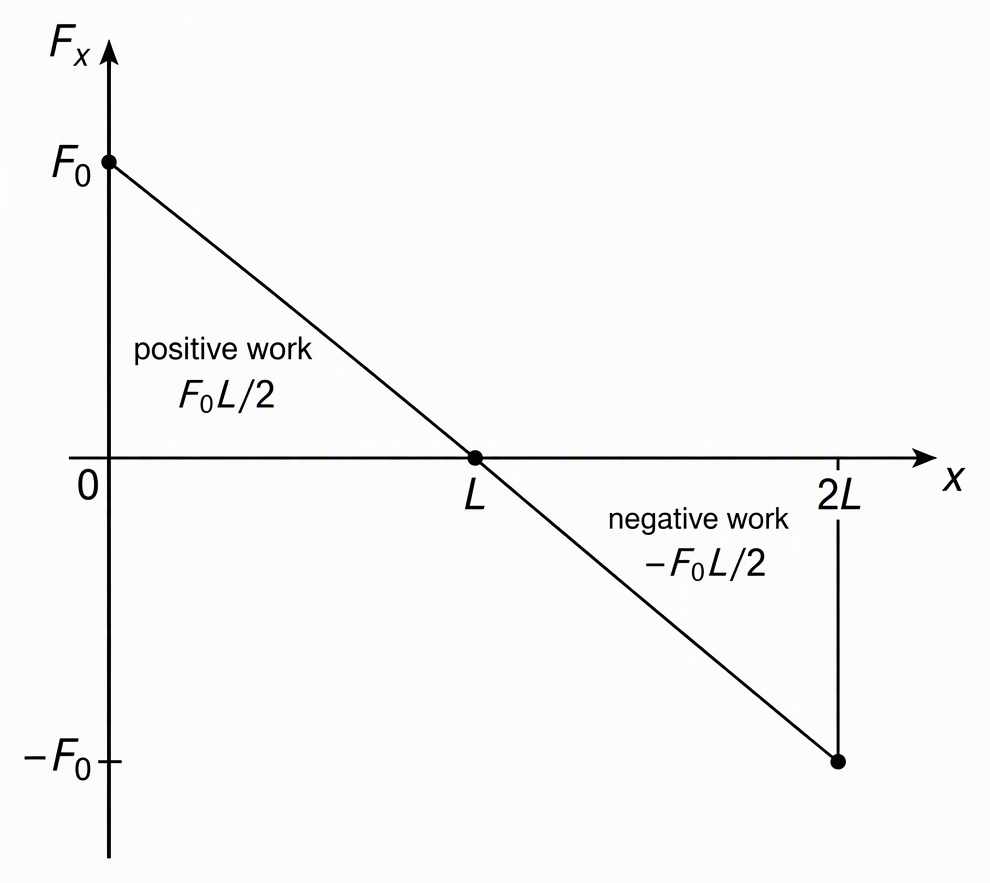
The force changes from positive to zero, then becomes negative:
The signed triangular areas give:
Over the full displacement:
Kinetic energy increases until the force changes sign, then decreases. The maximum speed occurs at the zero crossing:
For an original numerical illustration, take:
Adding absolute areas confuses total geometric area with net work. Zero net work over the full displacement does not mean constant speed.
How much power is needed to pull a block uphill at constant speed?
The pulling power is positive even though kinetic energy stays unchanged. Constant speed means zero net power, not zero power from each force. The pull supplies gravitational potential energy and compensates for sliding friction.
In this original symbolic example, a block is pulled parallel to a fixed rough incline at constant speed:
The pull has no perpendicular component, and acceleration along the slope is zero. The force equations are:
Force and velocity point in the same direction, so the pulling power is:
Gravity and friction have negative power; the normal force has zero power. The total is:
Cross-check by dividing pulling work by travel time:
The pulling force and speed are constant, so average and instantaneous pulling power agree. The work raises the block and supplies frictional loss; it does not increase speed.
What should I practise next if I keep choosing the wrong equation?
Begin with NCERT theory and worked examples in the study order above. Then solve chapter exercises and chapter-wise NEET previous-year questions from a source that identifies the paper and year. Use your errors to choose the next question type, rather than restarting the chapter.
Follow this practice progression:
- Constant-force work and signs.
- Signed force–displacement graph areas.
- Gravity and spring energy balances.
- Friction in energy accounts.
- Average versus instantaneous power.
- Collisions and vertical-circle constraints.
For a spring-transfer task, take a block arriving at an initially uncompressed ideal spring on a smooth horizontal surface. At maximum compression, its speed is zero, so first establish:
Only then add rough-surface variants. Identify exactly where friction acts before inserting its work.
Match each error to a specific repair:
- Wrong sign: draw displacement and force directions.
- Wrong conservation assumption: list work not already represented by potential energy.
- Wrong graph result: mark positive and negative regions before calculating areas.
- Wrong power equation: distinguish interval averages from instantaneous quantities.
For every wrong answer, record the setup error and redo the question without looking at the solution. Later, test the same idea on an unseen question.
Use this readiness check: justify the equation before calculating, then explain why the tempting alternative is invalid. A correct answer reached through double-counting is not a reliable method.
For that unseen-question check, NEET JEEnius AI’s practice mode offers topic sets that skip questions already seen, with 60 free sets a month. Choose the next set from your recorded setup error.
Next step: daily practice problems on NEET JEEnius AI and get a fresh set on a topic every day (20 free attempts a month).
If that step was the hard part, work through Respiration in Plants Practice Questions NEET: 8 MCQs.
Frequently asked questions
In what order should I study Work, Energy and Power for NEET?
Study work and its sign first, followed by the work–energy theorem, potential energy and conservation, then power. Finish with applications involving springs, collisions and vertical circles. Begin with NCERT theory and worked examples, then solve chapter exercises and chapter-wise NEET previous-year questions.
When can I use conservation of mechanical energy?
Mechanical energy is conserved when the net work not already represented by potential-energy terms is zero. List those work contributions and check their sum, since individual contributions can cancel. If gravitational potential energy is included in your balance, do not also add gravitational work.
How do I calculate work from a force–displacement graph?
Calculate the signed area under the force–displacement graph: regions above the axis contribute positive work, and regions below contribute negative work. If the graph shows net force, equate the total signed area to the change in kinetic energy. Zero net work over an interval means equal initial and final kinetic energies, not necessarily constant speed throughout.
Why is power needed to pull a block uphill at constant speed?
Constant speed means zero net power, not zero pulling power. On a fixed rough incline, the pull supplies gravitational potential energy and compensates for sliding friction. For a pull parallel to the slope, pulling power is P = mgv(sin θ + μ cos θ), where μ is the kinetic friction coefficient.