What is the correct order in the somatic hybridisation question?
Cell-wall digestion must precede protoplast isolation in this somatic hybridisation NEET 2026 question. Check what each operation produces before deciding which step can follow it.
This NEET 2026 Biology single-correct question is listed under Biotechnology and Its Applications. The question bank tags it medium and sets an expected solving time of 45 seconds.
Arrange these steps into a valid procedure:
- Step A: Remove plant cell walls by digestion.
- Step B: Collect the resulting wall-free protoplasts.
- Step C: Merge protoplasts to produce a hybrid protoplast.
- Step D: Separate individual cells from two plant varieties.
- Step E: Regenerate a plant from the hybrid protoplast.
Choose one answer:
Option labels name answers; step letters name operations. Choosing option A does not mean starting with step A.
Why does wall digestion come before protoplast isolation?
The first three operations are D, then A, then B: obtain individual cells, digest their walls, and collect the resulting protoplasts. Cell isolation provides wall-bearing starting material; wall digestion produces the wall-free cells needed for protoplast isolation.
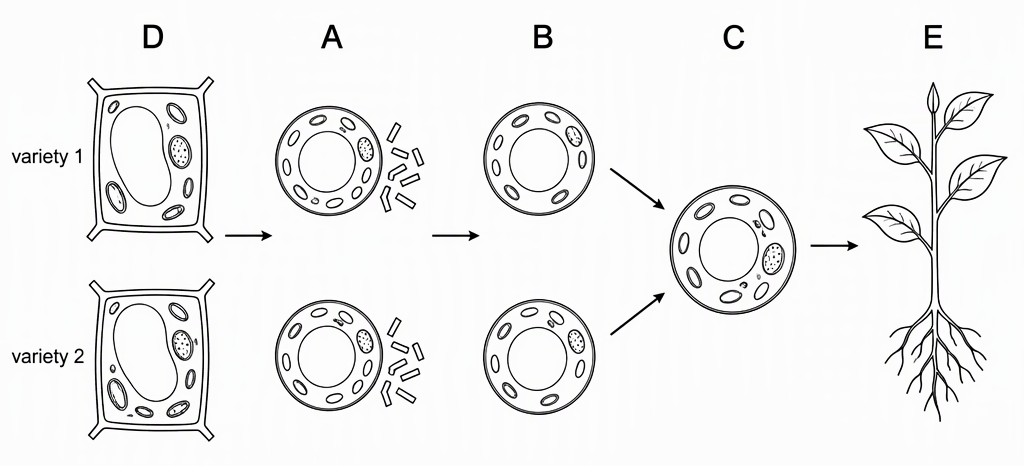
Step 1 is D: Isolate individual cells from each of the two plant varieties. These cells are the starting materials, and they still possess cell walls.
Step 2 is A: Digest the walls of those isolated cells. A protoplast is a plant cell without its cell wall, with its plasma membrane retained. “Naked” therefore means wall-free, not membrane-free.
Step 3 is B: Isolate the naked protoplasts obtained after wall digestion. This collects the material produced by A; it does not remove the walls itself.
The intermediate sequence and the material available after each step are:
B cannot precede A in the supplied procedure. Before wall digestion, the isolated cells are not yet naked protoplasts.
Why must fusion happen before regeneration, and which option is correct?
Option A is correct: fusion must produce the hybrid protoplast before it can be regenerated into a new plant. The final two steps therefore require C before E.
Step 4 is C: Fuse the isolated protoplasts from the two varieties to obtain a hybrid protoplast. The input is separate protoplasts; the product is the hybrid protoplast.
Step 5 is E: Grow and regenerate that hybrid protoplast into a new plant. E requires the product of C.
The full sequence is:
Check it in plain language:
Use this reconstruction to check the biology, not replace it. The bank’s 45 seconds is its expected solving time, not a measured student average or guarantee.
Under a marking scheme awarding 4 marks for a correct response and negative 1 for a wrong response, the difference is:
Why does option C fail at two different steps?
Option C uses biological products before the operations that create them. It contains two dependency errors, so fixing only the protoplast-isolation error would still leave an invalid procedure.
Option C proposes:
- First violation, B before A: After D, the isolated cells still have walls. Collecting them as naked protoplasts treats intact cells as though wall digestion has already occurred.
- Second violation, E before C: Regenerating the hybrid plant requires a hybrid protoplast. That product does not yet exist because fusion is placed last.
The method mistake is ordering familiar terms without checking the input required for each operation. At each arrow, ask: “What must already exist for this step to happen?” If the required material has not been produced, reject the sequence.
How can I practise somatic hybridisation sequence questions?
Test what remains after wall digestion and what must exist before regeneration. These are original related practice questions, not additional verified PYQs. Both cover somatic hybridisation, listed in the supplied bank under Biotechnology and Its Applications.
Practice question 1: After cell-wall digestion, which structure still encloses the protoplast?
- Cell wall
- Plasma membrane
- Nuclear envelope alone
- No enclosing structure
Answer: Plasma membrane. Removing the wall does not mean removing the cell membrane. The nuclear envelope encloses the nucleus, not the whole protoplast.
This explains A before B: wall digestion produces the wall-free, membrane-bound cells that are then isolated as protoplasts. Collecting intact cells alone does not make them protoplasts.
Practice question 2: Protoplasts from two plant varieties have been isolated but have not yet fused. Can the next step be regeneration of the hybrid plant?
Answer: No. Separate protoplasts are available, but the hybrid protoplast does not yet exist. Fusion must first produce it; that product can then be grown into a plant.
This explains C before E: regeneration needs the product of fusion. Cover the worked answer and rebuild the sequence by naming the material available after each step.
Next step: photograph a doubt on NEET JEEnius AI and photograph any question you are stuck on and get a step-by-step solution across Physics, Chemistry and Biology (20 free a month).
Related on NEET JEEnius AI: Free Expansion of Ideal Gas NEET 2026: Entropy Changes.
Frequently asked questions
What is the correct sequence of somatic hybridisation steps?
The sequence is cell isolation, cell-wall digestion, protoplast isolation, protoplast fusion, and plant regeneration. In the supplied question, this is D-A-B-C-E, which corresponds to option A.
Why does cell-wall digestion come before protoplast isolation?
The isolated plant cells initially retain their cell walls. Digestion removes those walls to produce protoplasts, which are then collected. Protoplast isolation cannot precede the operation that produces the protoplasts.
Does a protoplast still have a plasma membrane?
Yes, a protoplast retains its plasma membrane after cell-wall digestion. A naked protoplast is wall-free, not membrane-free.
Why is option C wrong in the somatic hybridisation sequence question?
Option C proposes D-B-A-E-C and contains two errors. It places protoplast isolation before wall digestion and hybrid plant regeneration before protoplast fusion. Both steps require products that have not yet been formed.