What is the correct answer to the conductors in electrostatics NEET 2026 question?
Option C (3), statements A, C and D, is correct. The conductors in electrostatics NEET 2026 question concerns a charged conductor after its charges have settled into electrostatic equilibrium. The figure is illustrative, not an additional condition in the question.
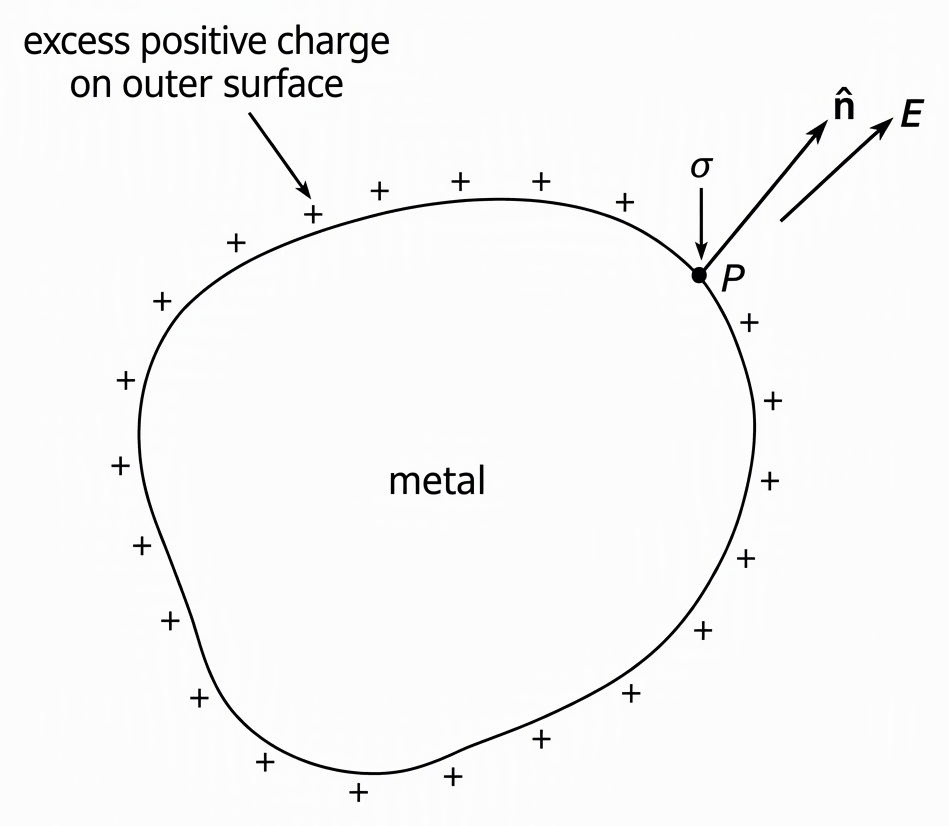
Decide which claims are correct:
- Statement A: The electric field vanishes within the conducting material.
- Statement B: The field immediately outside the surface is independent of local surface charge density.
- Statement C: The conducting bulk contains no excess charge at equilibrium.
- Statement D: The field immediately outside must be perpendicular to the surface.
- Statement E: Potential is zero throughout the interior.
Select one combination:
- Option A (1): Statements A, B and D only.
- Option B (2): Statements A, C and E only.
- Option C (3): Statements A, C and D only.
- Option D (4): Statements C, D and E only.
The bank rates this medium, with an expected solving time of 60 seconds, not a measured student average. Its “Multiple Correct Choice” tag refers to several true statements, not multiple OMR responses: select one answer combination.
Why is statement A true but statement B false?
A is true because the interior field is zero; B is false because the immediately external field depends on local surface charge density. These claims concern different locations, not conflicting rules for the same point.
Step 1, check A. A persistent electric field within conducting material would drive its free charges. At electrostatic equilibrium, that interior field must vanish.
Step 2, check B. Immediately outside the conductor’s surface in vacuum, the official relation is:
Here, sigma is the local surface charge density, epsilon-zero is vacuum permittivity, and n-hat is the outward unit normal. The equation directly shows dependence on local surface charge density, so B is false.
Zero field inside the metal and a nonzero field immediately outside do not contradict each other. The surface charge separates those two regions.
Why are statements C and D both true?
C correctly places excess charge on the conductor’s surfaces, while D correctly fixes the immediately external field’s direction. At equilibrium, excess charge cannot remain in the conducting bulk, and a tangential field cannot persist at its surface.
Step 3, check C. The conducting bulk contains no excess charge at electrostatic equilibrium. Excess charge resides on its surfaces.
This does not mean “no charged particles”: the material still contains positive constituents and electrons. Here, “interior” means the conducting material, not a claim about charges that might be placed in a cavity. C is true.
Step 4, check D. Resolve the immediately external field into a normal component, perpendicular to the surface, and a tangential component, along it. A nonzero tangential component would move surface charges and violate equilibrium.
The tangential component therefore vanishes. D is true, matching the normal direction represented by n-hat in the official expression.
Why is statement E false, and why does option C follow?
Zero interior field means constant potential, not necessarily zero potential. Statement E wrongly fixes the value of that constant. Take two points P and Q within the same conductor and connect them by a path through the conducting material.
Step 5, check E. Potential difference is:
Substitute the zero field along the interior path:
Therefore:
Potential is constant throughout the conductor, but that constant need not be zero. An absolute potential value requires a chosen reference and boundary conditions, such as grounding or a specified applied potential. Zero field alone does not fix that value, so E is false.
Verdict: A true, B false, C true, D true, E false.
The official result is statements A, C and D only: choose option C, equivalent to numbered option (3).
How can the zero-field shortcut lead to wrong option B?
The mistake is replacing “constant potential” with “zero potential”, then matching an option before checking every statement. The flawed route is to accept A and C, incorrectly accept E, and select option B (A, C and E) without completing D.
This inference is invalid:
A zero spatial derivative fixes constancy, not the constant’s value. The correct relation is:
That option-B route has two defects: E is false, and D, which the combination omits, is true. The potential mistake provides no reason to reject D.
Record a true-or-false verdict for all five statements before matching any answer combination. This keeps the potential check separate from the field-direction check.
Which three related questions check the same equilibrium rules?
Use the questions below to check field magnitude, interior potential and surface-field direction separately. These are original related practice questions, not additional verified NEET PYQs.
What happens if local surface charge density doubles?
Question 1: At one smooth point on a conductor in vacuum, local surface charge density changes from sigma to twice sigma between two equilibrium states. How does the immediately external field change?
Solution: Its magnitude doubles. Substitute the new density into the surface relation:
For a numerical check, take an initial magnitude of 30 newtons per coulomb:
Can the interior have zero field but nonzero potential?
Question 2: A conductor is maintained at a nonzero potential relative to earth. What are the field and potential inside its conducting material at equilibrium?
Solution: The field is zero, while potential equals the maintained value everywhere inside:
For any two interior points:
The difference vanishes without requiring the maintained potential itself to vanish.
Can a tangential surface field exist at equilibrium?
Question 3: A proposed field immediately outside a conductor has a nonzero tangential component. Can this describe equilibrium?
Solution: No. That component would drive surface charges until redistribution removes it. Before accepting any proposed equilibrium field, check that its component along the surface is zero.
Next step: the past-paper archive on NEET JEEnius AI and search past NEET papers by year, subject or chapter, each with a worked solution (100 free searches a month).
For a worked example of the same idea, see NEET Time Management: A 180-Minute Plan With OMR Checks.
Frequently asked questions
What is the correct answer to the conductors in electrostatics NEET 2026 question?
Option C (3), containing statements A, C and D only, is correct. At electrostatic equilibrium, the conducting material has zero electric field and no excess bulk charge, while the immediately external field has no tangential component. Statements B and E are false.
Does zero electric field inside a conductor mean zero potential?
No. Zero electric field means the potential is constant throughout the conductor, not necessarily zero. Its value depends on the chosen reference and boundary conditions, such as grounding or a maintained potential.
How does surface charge density affect the field just outside a conductor?
Immediately outside a conductor in vacuum, the electric field is E = (σ/ε₀)n̂, where σ is the local surface charge density and n̂ is the outward unit normal. Doubling the local surface charge density at the same smooth point between equilibrium states doubles the field magnitude.
Why is the electric field perpendicular to a conductor's surface?
At electrostatic equilibrium, a tangential electric field would move free charges along the surface. Charges redistribute until that tangential component vanishes. Any nonzero field immediately outside is therefore perpendicular to the surface.