How do you arrange the five operations in DNA fingerprinting NEET 2026?
Membrane transfer comes before labelled-probe hybridisation in the DNA fingerprinting NEET 2026 question. Identify the correct laboratory sequence for the procedure below.
This is a single-correct Biology question from Genetics and Evolution, rated medium on this question bank’s scale, not an official exam-wide difficulty rating. Use 45 seconds as your attempt target, not as a measured student average.
Arrange these five operations:
- A: Extract DNA and cut it using restriction endonucleases.
- B: Allow a labelled VNTR probe to bind complementary sequences.
- C: Move the separated DNA fragments onto a synthetic membrane.
- D: Visualise probe-bound fragments through autoradiography.
- E: Resolve the DNA fragments by electrophoresis.
Choose one sequence before reading the solution:
What is the correct sequence, and why does each step follow the previous one?
The answer is option C: A → E → C → B → D. The sequence is prepare, separate, transfer, probe, detect. Reconstruct it from what each operation produces and what the next operation needs.
The described procedure uses restriction fragments and Southern blotting. The separated DNA must reach the membrane before probing, and the probe must bind before its label can reveal matching fragments.
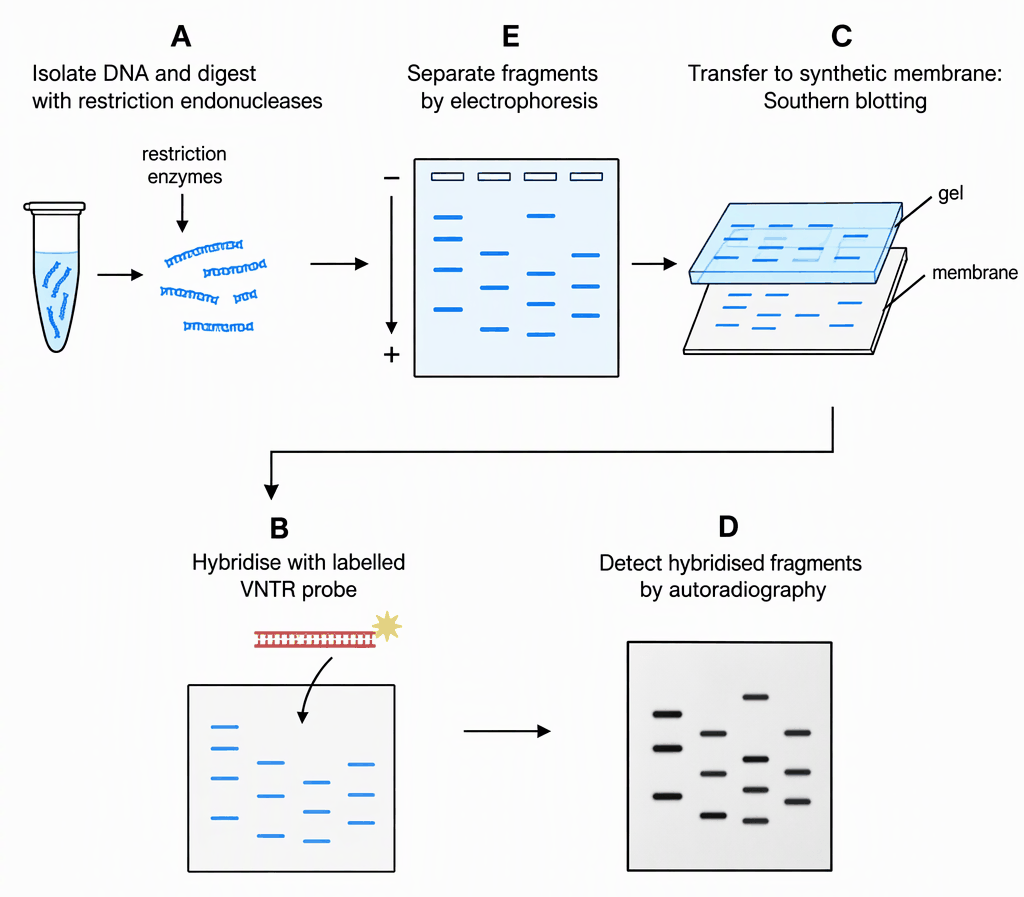
- A: Isolate DNA, then digest it. Isolation makes DNA available from the biological sample. Restriction endonucleases then cut that DNA at their recognition sites. Although grouped under one letter, these are two operations. End material: a mixture of DNA fragments, ready for separation.
- E: Separate fragments by electrophoresis. The fragments move through a gel and separate according to size; smaller DNA fragments generally travel farther under the same conditions. End material: a size-separated pattern in the gel. Transfer now has a pattern to preserve.
- C: Transfer fragments to a synthetic membrane. This operation is Southern blotting. It preserves the separation pattern while placing the DNA on a support suitable for probing. End material: membrane-bound, separated DNA fragments, available for hybridisation.
- B: Hybridise with the labelled VNTR probe. The probe recognises complementary target sequences. It does not indiscriminately label every DNA fragment. End material: probe-bound target fragments on the membrane. Their bound label makes detection possible.
- D: Detect through autoradiography. In the procedure described, autoradiography reveals the labelled, hybridised fragments. End material: a visible band pattern representing detected targets. This is the readout, so no further listed operation follows it.
A → E → C → B → D; correct answer: option C, the third listed choice. Keep the two uses of C separate: step C means membrane transfer; option C means the complete correct sequence.
Why is option D wrong even though it starts and ends correctly?
Option D puts labelled-probe hybridisation before membrane transfer. It correctly opens with A → E and ends with detection, but a correct beginning and ending cannot rescue an incorrect intermediate order.
- Option D: A → E → B → C → D
- Correct sequence: A → E → C → B → D
The mistake is treating the membrane as a final display sheet added after probing. In this Southern-blot workflow, it is the support on which the separated DNA is probed. Check the dependencies: separated fragments must first be transferred, then hybridised, then detected.
Marking calculation: under a scheme awarding 4 marks for a correct answer and minus 1 for an incorrect answer, choosing option C rather than option D gives this score difference:
What variation at a VNTR locus makes DNA fingerprinting possible?
Variation in the number of tandem repeat units is the answer. VNTR means variable number of tandem repeats. The three related questions here are original practice, not additional verified NEET PYQs.
Practice question 1: Which variation at a VNTR locus supports DNA fingerprinting?
- Number of tandem repeat units.
- Direction of DNA replication.
- Identity of the genetic code.
- Number of chromosomes in every cell.
Different repeat counts produce different lengths of the repeat-containing region. In the restriction-fragment method, these differences can produce distinguishable fragment patterns after separation and probing. One VNTR locus alone does not guarantee unique identification of every individual.
Which way do DNA fragments move during agarose gel electrophoresis?
DNA moves towards the positive electrode, and smaller fragments generally travel farther under the same conditions. This explains how step E establishes a separation pattern before membrane transfer.
Original practice question 2: Which statement correctly describes DNA migration during agarose gel electrophoresis?
- Towards the positive electrode; smaller fragments travel farther.
- Towards the positive electrode; larger fragments travel farther.
- Towards the negative electrode; smaller fragments travel farther.
- Towards the negative electrode; larger fragments travel farther.
The first choice is correct. DNA’s phosphate backbone gives it a net negative charge. The gel impedes larger fragments more strongly, allowing smaller fragments to travel farther during the same run.
Which fragments does a labelled VNTR probe identify after Southern transfer?
It identifies fragments containing sequences complementary to the probe. Complementary base pairing gives hybridisation its sequence specificity; fragment size alone does not determine probe binding.
Original practice question 3: Which fragments are identified by a labelled VNTR probe after Southern transfer?
- All DNA fragments.
- Fragments containing complementary target sequences.
- Only the shortest fragments.
- Only protein-coding fragments.
The second choice is correct. Hybridisation locates matching sequences, while autoradiography reveals the labelled, hybridised fragments. These are separate jobs, not interchangeable names for detection.
Cover the solution and reconstruct the sequence. Retrieval check: prepare, separate, transfer, probe, detect equals A → E → C → B → D.
Next step: the past-paper archive on NEET JEEnius AI and search past NEET papers by year, subject or chapter, each with a worked solution (100 free searches a month).
Related on NEET JEEnius AI: Spectrochemical Series NEET 2026: Ligand Field Order.
Frequently asked questions
What is the correct sequence of DNA fingerprinting steps?
The correct order is DNA isolation and restriction digestion, electrophoresis, Southern transfer, labelled VNTR probe hybridisation, and autoradiography. For the operations listed in the article, this is A → E → C → B → D, option C.
Why does Southern blotting come before probe hybridisation?
Southern blotting transfers separated DNA fragments from the gel onto a synthetic membrane while preserving their separation pattern. In this workflow, the membrane supports the DNA during labelled-probe hybridisation, so transfer must precede probing.
What variation in VNTRs makes DNA fingerprinting possible?
VNTR loci vary in the number of tandem repeat units, producing differences in the lengths of repeat-containing regions. In the restriction-fragment method, these differences can produce distinguishable band patterns after separation and probing. One VNTR locus alone does not guarantee unique identification of every individual.
Which electrode does DNA move towards in gel electrophoresis?
DNA moves towards the positive electrode because its phosphate backbone gives it a net negative charge. Smaller DNA fragments generally travel farther than larger fragments under the same gel electrophoresis conditions.
Does a labelled VNTR probe bind to all DNA fragments?
No, a labelled VNTR probe binds to fragments containing sequences complementary to the probe. Hybridisation provides sequence specificity, while autoradiography reveals the labelled, hybridised fragments in the procedure described.