What is the correct answer to the free expansion entropy question?
Option D is correct in the free expansion of ideal gas NEET 2026 question: the gas gains entropy, while the surroundings have no entropy change. Zero heat exchange does not mean zero entropy change in an irreversible process.
This question is from NEET UG 2026, held on 21 June 2026, Code-50, Chemistry. “Medium” is the question bank’s difficulty classification, not an official exam rating.
A 2 mol ideal-gas sample initially occupies 10 L at 300 K and gains access to 100 L. The official solution assumes expansion into vacuum inside a rigid, thermally insulated container. “Free expansion” establishes zero external pressure, not thermal insulation by itself.
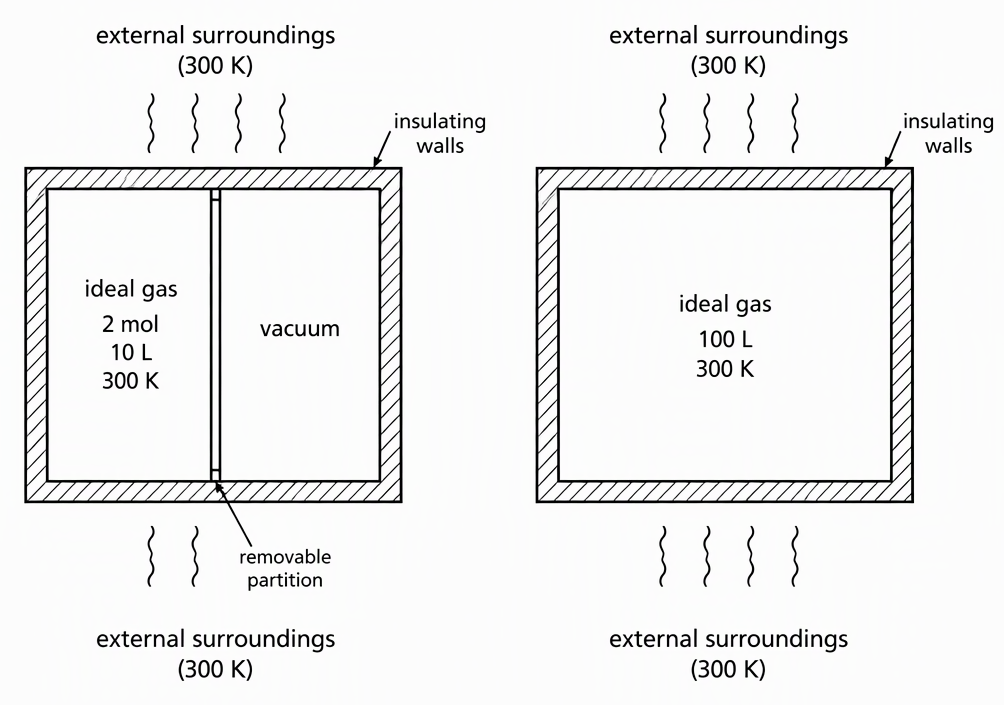
The requested quantities are entropy changes, not absolute entropies. Each option lists system first, surroundings second:
- A:
- B:
- C:
- D, correct:
Why does the gas remain at 300 K?
The gas exchanges neither heat nor work, so its internal energy stays unchanged. For an ideal gas, internal energy depends only on temperature, which therefore remains at 300 K. Establish this energy balance before choosing an entropy formula.
Thermal insulation gives zero heat transfer during the actual expansion:
Expansion into vacuum means zero external pressure. Using the chemistry sign convention, pressure–volume work is:
The first law therefore gives:
For this ideal gas:
This establishes equal initial and final temperatures. It does not make the actual expansion reversible: the gas spreads into vacuum rather than passing through a controlled sequence of equilibrium states.
How do you calculate the gas, surroundings and total entropy changes?
Use a hypothetical reversible isothermal path between the same equilibrium endpoints for the gas, but use the actual process for the surroundings. Entropy is a state function, so the reference path gives the gas’s correct entropy change. This follows the treatment of entropy in NCERT Class 11 Chemical Thermodynamics.
For the reversible reference path, heat entering the gas balances the work it does:
Hence:
Substitute the given volumes:
The ratio is dimensionless. No litre-to-cubic-metre conversion is needed, since matching units cancel.
The final approximation retains the value reported in the supplied solution and options; the multiplication shows the small numerical difference. Using reversible-path heat here does not mean heat entered during the actual expansion.
Return to the actual insulated process for the surroundings:
The second-law check is:
Positive total entropy change agrees with spontaneous, irreversible expansion and confirms D. The paper’s notation is retained; with the amount in moles and the gas constant in the units below, entropy changes have units of joules per kelvin:
Why does option B describe the wrong process?
Option B gives the correct gas entropy change but imports the surroundings’ heat loss from a different process, reversible isothermal expansion. It is a method error, not an error in calculating the gas’s entropy.
For the actual insulated free expansion:
Along the reversible isothermal reference path, the gas absorbs heat from a reservoir at the same temperature. That reservoir loses entropy:
The gas has the same endpoints along both paths, so its entropy change is identical. The surroundings do not undergo the same changes: they remain unchanged in the actual process but supply heat in the reversible comparison.
Use the reference path only for the gas’s state-function change. Then return to the actual process to evaluate its surroundings.
The following is not a general formula for an irreversible process:
What changes if the same gas expands reversibly and isothermally?
The gas gains the same entropy, but the reservoir loses an equal amount, making the total change zero. This is author-created related practice, not another verified NEET PYQ, testing the distinction behind option B.
Question: The same 2 mol ideal gas expands reversibly and isothermally from 10 L to 100 L at 300 K, exchanging heat with a reservoir at 300 K. What are the system, surroundings and total entropy changes?
The gas endpoints are unchanged:
The reversible heat absorbed is:
The reservoir’s entropy change is:
The changed process, not changed gas endpoints, produces the different surroundings result. The equal and opposite entropy changes give:
Does every adiabatic process have zero entropy change?
No. Adiabatic means no heat exchange; isentropic means no entropy change. An irreversible adiabatic process can generate entropy inside the system even though no entropy enters through heat transfer.
Author-created conceptual practice: A student says every adiabatic process has zero system entropy change because heat transfer is zero. Is that statement correct?
For a closed system, the entropy balance is:
The heat-transfer term vanishes in an adiabatic process, but entropy generation need not. Compare these two cases:
- Reversible adiabatic expansion:
- The supplied irreversible insulated free expansion:
Establish the actual heat and work first, then calculate entropy from the endpoints using a valid reversible reference path.
Next step: the past-paper archive on NEET JEEnius AI and search past NEET papers by year, subject or chapter, each with a worked solution (100 free searches a month).
Keep going with Pressure in Fluids NEET 2026: The 100 atm Depth Limit.
Frequently asked questions
What is the correct answer to the NEET 2026 free expansion entropy question?
Option D is correct: the gas gains approximately 4.606R of entropy, while the surroundings have zero entropy change. For 2 mol expanding from 10 L to 100 L at unchanged temperature, the gas entropy change is nR ln(V2/V1) = 2R ln(10). The actual container is thermally insulated, so no heat is exchanged with the surroundings.
Why does the temperature stay constant during insulated free expansion of an ideal gas?
Thermal insulation makes heat transfer zero, and expansion into vacuum makes pressure–volume work zero. The first law therefore gives zero change in internal energy. Since an ideal gas's internal energy depends only on temperature, its final temperature equals its initial temperature.
Why is option B wrong in the free expansion entropy question?
Option B assigns the surroundings the entropy loss associated with reversible isothermal expansion, not the actual insulated free expansion. A reversible reference path gives the correct gas entropy change because entropy is a state function. The surroundings must be evaluated using the actual process, in which their entropy change is zero.
Does every adiabatic process have zero entropy change?
No: adiabatic means no heat exchange, whereas isentropic means no entropy change. An irreversible adiabatic process can generate entropy within the system. Reversible adiabatic expansion has zero system entropy change, but the insulated free expansion in this question has a positive system entropy change.