What is the answer to the submarine’s 100 atm pressure-limit question?
The maximum depth is 990 m, option A, because the 100 atm absolute-pressure limit includes atmospheric pressure. In this pressure in fluids NEET 2026 question, the water column can therefore contribute only 99 atm.
A submarine lies beneath a water surface exposed to the atmosphere. Find the greatest depth at which the surrounding water’s absolute pressure stays within its 100 atm design limit.
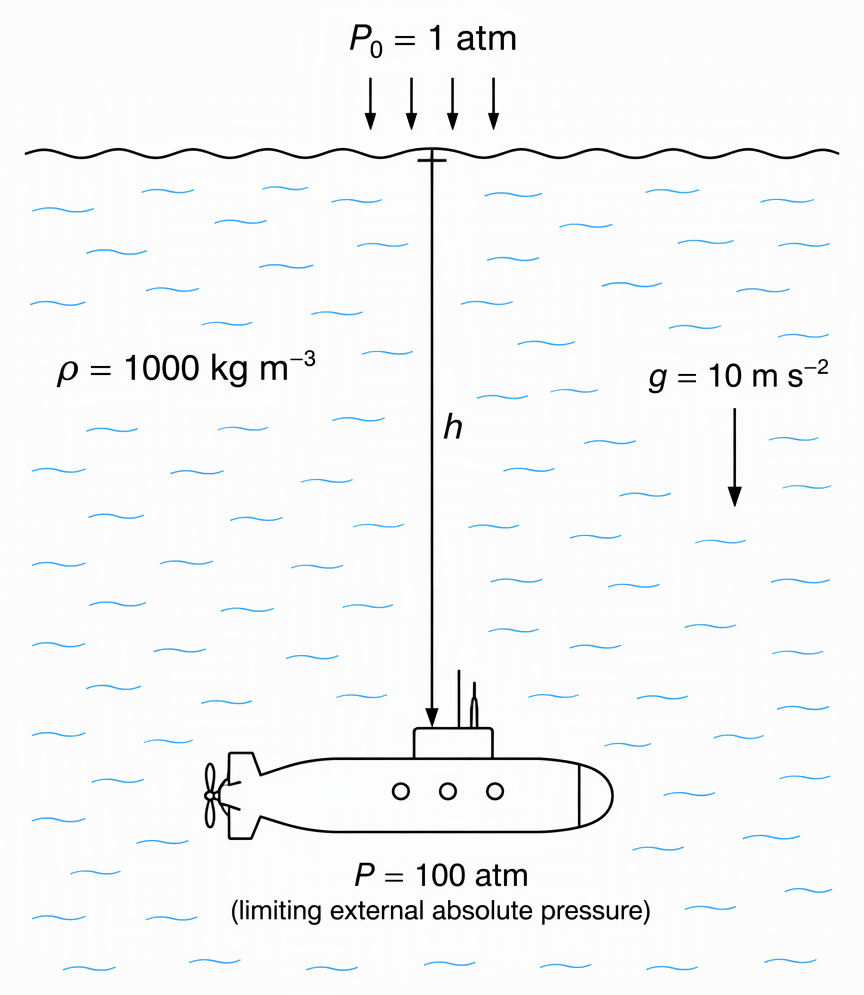
The supplied values are:
The original choices are:
The chapter is Properties of Solids and Liquids. The question bank rates this question medium and gives an expected solving time of 60 seconds. These are question-bank classifications, not official NTA difficulty or timing labels.
How does the full solution give a maximum depth of 990 m?
Include atmospheric pressure first: the 100 atm limit is the total external pressure, not an allowance above the atmosphere. Subtract the surface contribution before calculating depth. Use the full hydrostatic equation rather than a depth shortcut:
The symbols mean:
At the greatest permitted depth, the external pressure reaches the design limit. Convert that limit and the surface pressure to pascals:
Following the supplied official solution, substitute the values in SI units:
Multiply density by gravitational acceleration:
Now divide every term by the same factor:
Therefore:
Option A is correct. The surface-pressure term becomes 10 after division, not 1 or 100.
Check the result by substituting the depth back into the water-column pressure. This must give the remaining pressure allowance:
Adding the surface atmosphere gives:
As a separate check, a 10 m increase in depth adds:
Under the supplied values and constant-density model, 990 m therefore adds 99 atm. Use this as verification, not as a replacement for the official algebra.
How does leaving out gravity produce option B, 9900 m?
The correct pressure difference is 99 atm. Dividing it by density alone, instead of density times gravitational acceleration, produces option B numerically.
The required depth expression is:
The faulty calculation omits gravitational acceleration from the denominator:
This matches option B numerically, but it is not a depth. The correct denominator is:
Using density alone gives:
Omitting the factor of 10 makes the numerical result ten times too large. Units expose the mistake: pressure divided by density does not have units of metres.
Dividing by density times gravitational acceleration gives the correct units:
Forgetting atmospheric pressure is a separate error. It gives 1000 m, which is not among the listed options:
What depth would correspond to a gauge pressure of 100 atm?
The depth would be 1000 m, because gauge pressure already excludes atmospheric pressure. This is an original practice question from Properties of Solids and Liquids, not another verified NEET PYQ: find the depth corresponding to 100 atm gauge pressure, retaining the original water density, gravitational acceleration and atmosphere-to-pascal conversion.
Gauge pressure means pressure above atmospheric pressure:
Hence:
The gauge-pressure variant gives 1000 m, compared with 990 m for the original absolute-pressure question. The 10 m difference corresponds to 1 atm under these assumptions.
Do not subtract another atmosphere here. Gauge pressure already excludes surface atmospheric pressure, so subtracting it again would count the correction twice.
What is the absolute pressure at a depth of 99 m?
The absolute pressure is 10.9 atm; the gauge pressure is 9.9 atm. This is a second original practice question from Properties of Solids and Liquids, not a sourced past-paper question: find the absolute pressure at 99 m in the same water, with the same atmospheric pressure and gravitational acceleration.
First calculate the water-column contribution:
Then add atmospheric pressure:
Stopping after the first calculation gives gauge pressure, not the requested absolute pressure. Before selecting an option, identify the pressure type, retain density times gravitational acceleration in full, and verify the final units.
Next step: photograph a doubt on NEET JEEnius AI and photograph any question you are stuck on and get a step-by-step solution across Physics, Chemistry and Biology (20 free a month).
For a worked example of the same idea, see Semiconductor Practice Questions NEET: 6 Explained MCQs.
Frequently asked questions
Why is the submarine’s maximum depth 990 m at 100 atm?
The 100 atm limit is absolute pressure, so it includes the 1 atm acting at the water surface. The water column can contribute only 99 atm. Using h = (P − P₀)/(ρg), with ρ = 1000 kg/m³, g = 10 m/s² and 1 atm = 10⁵ Pa, gives h = 990 m, option A.
What depth corresponds to 100 atm gauge pressure?
The depth is 1000 m for water of density 1000 kg/m³, with g = 10 m/s² and 1 atm = 10⁵ Pa. Gauge pressure already excludes atmospheric pressure, so use h = P_gauge/(ρg). Do not subtract another atmosphere.
Why do I get 9900 m instead of 990 m?
Dividing the 99 atm pressure difference by density alone gives 9900 numerically, but this omits gravitational acceleration. The correct denominator is ρg = 1000 × 10 = 10⁴, giving 990 m. Pressure divided by density has units of m²/s², not metres.
What is the absolute pressure at 99 m underwater?
Using ρ = 1000 kg/m³, g = 10 m/s² and 1 atm = 10⁵ Pa, the water-column pressure at 99 m is 9.9 atm. Adding the 1 atm surface pressure gives an absolute pressure of 10.9 atm. The value 9.9 atm alone is the gauge pressure.