
Should I start Wave Optics with solved MCQs, PYQs or mocks?
Start with solved chapter MCQs if your concepts are unstable, chapter-wise PYQs for exam-style application, and full mocks for whole-paper performance. These wave optics practice questions for NEET include six original, free, single-correct MCQs with worked explanations below. Attempt them without signing up or leaving this article.
None of these formats replaces the other two. Choose by your mistakes: misunderstanding fringe width needs targeted practice; losing a familiar question during subject switching needs mixed-paper practice.
How do solved chapter MCQs, NEET PYQs and full-length mocks compare?
Chapter MCQs isolate misconceptions, PYQs show actual past question styles, and mocks test subject switching and time allocation. Choose by the problem you need to fix, not by which resource offers the longest question list.
- Purpose
- Original solved chapter MCQs: Learn or repair a specific idea.
- Chapter-wise NEET PYQs: Check application against actual past questions.
- Full-length mocks: Test subject switching, question selection and time allocation.
- Wave Optics targeting
- Original solved chapter MCQs: Can isolate one misconception.
- Chapter-wise NEET PYQs: Target the chapter through its past questions.
- Full-length mocks: Do not guarantee useful coverage of this chapter.
- Solution feedback
- Original solved chapter MCQs: Worked explanations can expose a wrong assumption.
- Chapter-wise NEET PYQs: Need a checked key; explanations depend on the source.
- Full-length mocks: Scoring shows performance; detailed feedback depends on the provider.
- Exam-style calibration
- Original solved chapter MCQs: Practice, not evidence of what NEET has asked.
- Chapter-wise NEET PYQs: Direct evidence of past wording and application.
- Full-length mocks: Simulate whole-paper demands, not a guaranteed future difficulty.
- Whole-paper time management
- Original solved chapter MCQs: Cannot test it.
- Chapter-wise NEET PYQs: Chapter-only attempts cannot test it.
- Full-length mocks: Test time allocation across subjects.
- Main limitation
- Original solved chapter MCQs: Quality depends on correct assumptions, options and explanations.
- Chapter-wise NEET PYQs: Finite; remembered answers can conceal weak reasoning.
- Full-length mocks: A total score can hide the cause of a chapter error.
Targeted original questions can change one condition at a time to expose a misconception. They must never be presented as actual NEET questions.
For whole-paper practice, the documented NEET JEEnius AI offer is 30 free full-length mocks a month, each with 180 questions, 720 marks and 180 minutes: 45 Physics, 45 Chemistry and 90 Biology questions, plus a scored per-subject breakdown. That breakdown is not chapter-level diagnosis, and this offer does not establish a dedicated Wave Optics question bank.
What should a first-time learner, Class 12 reviser or dropper choose?
Choose from observable errors, not your class label. Remembering a PYQ answer is different from explaining it, and solving a chapter question alone is different from solving it inside a complete paper.
- First-time learner: If you cannot explain why fringe width changes, begin with solved chapter MCQs. Reconstruct the concept before attempting a large set.
- Class 12 reviser: If textbook examples feel easy but unfamiliar wording causes errors, use chapter-wise PYQs. Explain why each rejected option is wrong.
- Dropper: If PYQ answers arrive from memory, use fresh original MCQs with changed conditions. Justify your answer before checking the key.
- Any student losing chapter questions in mixed tests: Prioritise full-length mocks if you solve those questions correctly in isolation. Review time allocation and question selection.
- Any student repeating concept errors in mocks: Return to targeted chapter practice. More mocks alone do not repair a misconception.
Free access is not a quality check. A question with an unchecked key can reinforce a mistake rather than fix it.
Can I attempt six free Wave Optics practice questions for NEET here?
Yes. These are original practice questions, not PYQs or predicted exam questions, and each has exactly one correct option. Attempt all six before reading the answer explanations. Beside each answer, write your reason and mark any guess as uncertain.
Question 1: Huygens’ principle
In a homogeneous, isotropic medium, which statement correctly relates a wavefront to the direction of propagation?
- A. A wavefront joins points of equal phase; propagation is normal to it.
- B. A wavefront joins points of equal phase; propagation is tangential to it.
- C. A wavefront is the path followed by an individual ray.
- D. A wavefront necessarily joins points of equal intensity.
Question 2: Young’s double-slit experiment
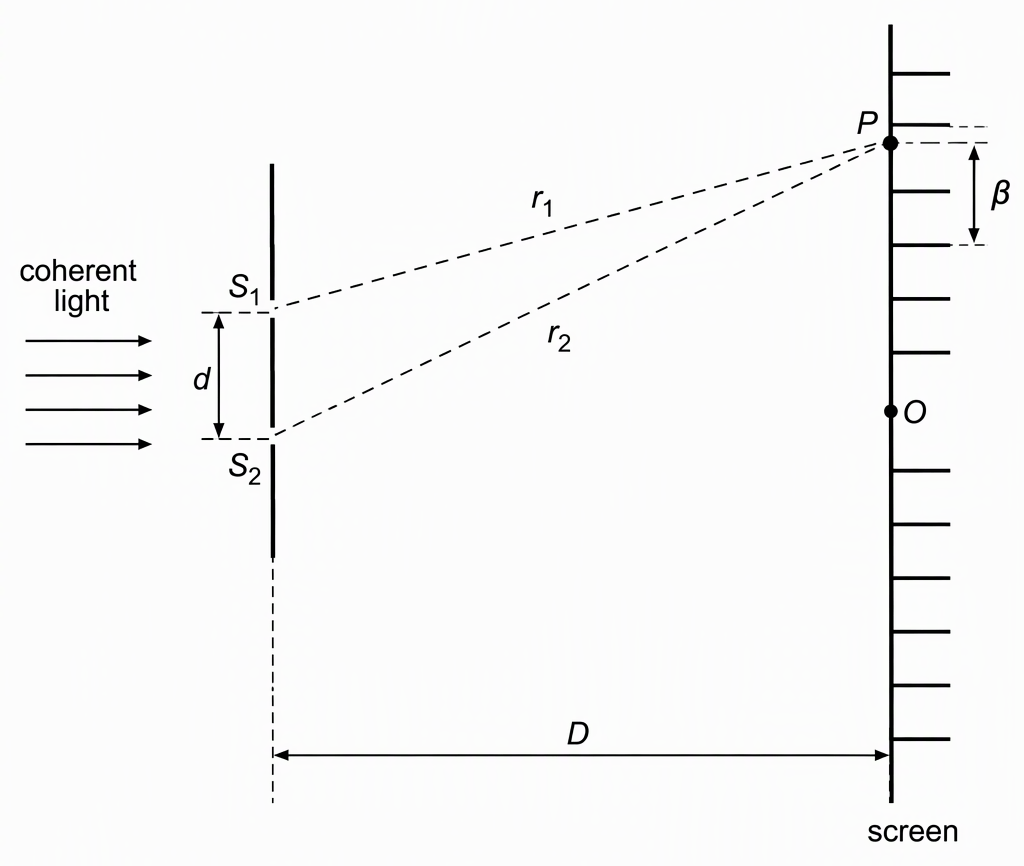
In an ideal double-slit experiment, the screen distance is much larger than the slit separation, and the observed fringes make small angles with the central axis. The wavelength doubles, the screen distance halves and the slit separation doubles, with these assumptions still valid. What happens to fringe width?
- A. It remains unchanged.
- B. It doubles.
- C. It halves.
- D. It becomes one-quarter of its original value.
Question 3: Interference conditions
Two coherent sources are initially in phase and produce overlapping waves of equal amplitude and the same polarisation. At a point, the optical path difference is three halves of the vacuum wavelength. What occurs there?
- A. An intensity maximum.
- B. An intensity minimum, ideally zero.
- C. An intensity halfway between maximum and minimum.
- D. No stable interference because the path difference is nonzero.
Question 4: Uniform immersion
An ideal Young’s double-slit arrangement is uniformly immersed in a transparent medium whose refractive index is greater than one. The source frequency, slit separation and screen distance remain fixed. Compared with vacuum, what changes?
- A. Frequency decreases; wavelength and fringe width stay unchanged.
- B. Frequency stays unchanged; wavelength and fringe width increase.
- C. Frequency and wavelength stay unchanged; fringe width decreases.
- D. Frequency stays unchanged; wavelength and fringe width both decrease by the refractive-index factor.
Question 5: Single-slit diffraction
A uniformly illuminated single slit produces a Fraunhofer diffraction pattern under small-angle conditions. Its width is halved while wavelength and screen distance remain fixed. What happens to the linear width of the central maximum, measured between its first minima?
- A. It halves.
- B. It remains unchanged.
- C. It doubles.
- D. It becomes four times as large.
Question 6: Polarisation
Which statement explains why light can show polarisation?
- A. Its electric field oscillates only along the propagation direction.
- B. Its electric field oscillates perpendicular to propagation, and a polariser can select a transverse orientation.
- C. Every light wave has the same phase.
- D. Polarisation changes light from transverse to longitudinal.
What are the correct answers and the reasoning behind them?
The answer key is 1-A, 2-C, 3-B, 4-D, 5-C and 6-B. Check the assumption behind each result, not just the option. Keep a correct answer marked uncertain if your reasoning used the wrong relationship.
1. A: Equal phase defines a wavefront.
Huygens’ principle treats each wavefront point as a source of secondary wavelets; their forward envelope gives the next wavefront. In a homogeneous, isotropic medium, rays indicate propagation normal to the wavefront. B confuses movement along a wavefront with wave propagation.
2. C: Fringe width halves.
Fringe width is proportional to wavelength in the medium and screen distance, and inversely proportional to slit separation. For ideal narrow slits, a distant screen and small observation angles:
Apply all the stated changes:
A accounts for the wavelength and screen-distance changes, which cancel. It ignores the doubled slit separation.
3. B: An odd half-wavelength gives destructive interference.
For initially in-phase coherent sources, optical path difference determines phase difference through the vacuum wavelength. Here:
Constructive and destructive conditions are, respectively:
Equal amplitudes and matching polarisation allow zero intensity at the minimum. A wrongly treats every wavelength-related path difference as constructive; integer and half-integer multiples give different results.
4. D: Frequency stays fixed while wavelength and fringe width decrease.
Uniform immersion reduces wave speed, not the source’s oscillation frequency. Using the vacuum wavelength and the medium’s refractive index:
With geometry unchanged and the same small-angle approximation, the fringe width becomes:
A assumes lower speed must mean lower frequency. Uniform immersion matters: placing material in only one path is a different problem.
5. C: The central maximum doubles in width.
For single-slit Fraunhofer diffraction, the central maximum extends between the first minima. Under small-angle conditions, its linear width is inversely proportional to slit width:
Halving the slit width therefore doubles the central maximum’s width. A assumes a narrower opening makes a narrower diffraction pattern; single-slit width is not double-slit separation.
6. B: Polarisation demonstrates transverse oscillation.
For light propagating in the usual homogeneous, isotropic setting, the electric field oscillates perpendicular to propagation. An ideal linear polariser selects a transverse field component. D mistakes selecting an orientation for changing light into a longitudinal wave.
How should I use wrong answers to choose my next practice set?
Use the missed idea, not the total score, to choose your next resource. This short diagnostic cannot establish chapter mastery or predict NEET marks. Record a correct guess as unresolved until you can defend it.
- Questions 1 or 6: Revise wavefronts, rays and transverse oscillation, then attempt fresh conceptual MCQs.
- Questions 2 or 4: Rebuild fringe-width relationships. Separate wavelength from frequency explicitly before substituting changes.
- Question 3: Write the optical path difference and initial phase condition before selecting an option.
- Question 5: Identify whether the aperture quantity is single-slit width or double-slit separation. Do not apply one remembered formula to both.
Reattempt the idea with changed conditions, not the identical question immediately. Keep the wavelength fixed but reduce slit separation, or start the interfering sources out of phase.
If you can explain the changed versions but mixed-paper performance remains weak, move to a full mock. Use How to Score 600 in NEET: Targets and Mock Analysis to structure the whole-paper review, not to convert this chapter score into a promised result.
How can I use free Wave Optics practice without wasting attempts?
Judge practice by whether you can explain the assumptions and solve a changed version, not by a daily question quota. Check the source and answer key before treating a familiar answer as evidence of understanding.
Are PYQs enough if I already remember the answers?
No. PYQs show actual past question styles, but memorised answers can bypass reasoning. Repair weak concepts with solved chapter MCQs, then return to PYQs and justify every rejected option.
Are these six questions actual NEET PYQs?
No. They are original practice questions. Any question labelled a PYQ needs a checked source and answer key. Similarity to an exam-style problem does not make it a past NEET question.
How should I score the set and time a full mock?
Use the official marking rule: +4 for a correct answer, -1 for a wrong answer and 0 for an unattempted question. Do not translate a chapter-set score into a rank or percentile.
The current paper has 180 compulsory questions in 180 minutes, with no optional Section B. The whole-paper average of one minute per question is not a mandatory limit for every Physics question.
Attempt the six questions now and review every uncertain answer. Choose targeted practice, PYQs or a full mock according to the error pattern.
Next step: full-length mock tests on NEET JEEnius AI and sit a full 180-question, 720-mark, 180-minute paper, 45 Physics, 45 Chemistry and 90 Biology, and get a scored per-subject breakdown (30 free a month).
Frequently asked questions
Should I start Wave Optics with solved MCQs, PYQs or mocks?
Start with solved chapter MCQs if your concepts are unstable, and use chapter-wise PYQs to check exam-style application. Choose full-length mocks when you can solve chapter questions alone but lose them during mixed-paper practice. Repeated concept errors need targeted practice, not just more mocks.
Are these six Wave Optics questions actual NEET PYQs?
No. These are original, single-correct practice MCQs with worked explanations, not actual NEET PYQs or predicted exam questions. You can attempt all six in the article without signing up.
Are Wave Optics PYQs enough if I remember the answers?
No. Remembering an answer can conceal weak reasoning, even when the option is correct. Use fresh MCQs with changed conditions to test your understanding, then return to PYQs and explain why each rejected option is wrong.
How should I score the six Wave Optics practice questions?
Award +4 for each correct answer, subtract 1 for each wrong answer, and give 0 for an unattempted question. Keep correct guesses marked as unresolved until you can justify them. This short set cannot establish chapter mastery or predict NEET marks, rank or percentile.