
Should I start Solutions practice with NCERT, PYQs or MCQs?
Use MCQs to diagnose, NCERT to repair and PYQs to calibrate. For free Solutions practice questions for NEET, start with the diagnostic below if you have studied the chapter; start with NCERT if its definitions and laws are still unclear. This page covers Solutions, the Chemistry chapter, not generic solved NEET questions.
The three choices are NCERT worked examples and exercises, verified NEET chapter PYQs, and original targeted single-correct MCQs. They serve different jobs, so none is universally best.
The six original questions below include answers, explanations and common traps. No download or registration is needed: attempt them first, then use your mistakes to choose textbook repair, exam calibration or targeted practice.
How do NCERT exercises, NEET PYQs and targeted MCQs compare?
NCERT repairs concepts; verified PYQs show actual exam wording; targeted MCQs isolate recurring mistakes. Choose by the gap you need to fix, not the size of a question collection. In each comparison below, the order is NCERT worked examples and exercises; verified NEET PYQs; original targeted MCQs.
- Conceptual repair: Worked examples demonstrate reasoning; PYQs reveal gaps but may need supporting explanations; targeted MCQs isolate a particular misconception.
- Single-correct format: NCERT exercises are not uniformly NEET-style MCQs; select verified single-correct exam questions; this diagnostic uses four-option, single-correct questions.
- Exam calibration: NCERT builds the base; verified PYQs demonstrate what was actually asked; original questions are not evidence of past NEET questions.
- Targeted repetition: NCERT offers chapter practice; PYQs provide a finite historical set, not unlimited fresh practice; original MCQs can vary one condition repeatedly.
- Answer verification: Consult official NCERT materials, distinguishing worked examples from unsolved exercises; match original exam papers with official answer keys; check original MCQ reasoning against the relevant law and assumptions.
- Limitations: Not every NCERT exercise supplies a worked explanation; PYQs cannot guarantee future topic frequency; targeted MCQ quality depends on accurate wording and solutions.
A free question is not necessarily a free worked solution. An official answer key verifies the selected option, not every explanation attached to it elsewhere. Check question access and explanation access separately, without assuming a third-party page is free or login-free.
Which resource should Class 11 students, Class 12 students and droppers choose?
Choose NCERT when you cannot explain a definition or a law’s conditions; choose verified PYQs after a first chapter pass; choose targeted MCQs when familiar formulas still produce repeated errors. Your class matters less than the reason for the mistake. Remembering an option from an old paper is not the same as deriving it.
- Class 11 students studying ahead: Establish mole-concept and concentration foundations first. Distinguish moles of solute, mass of solvent and volume of solution before treating PYQs as a performance judgement.
- Class 12 students: Match practice to the part currently being taught. After concentration terms, solve questions that contrast their denominators; after vapour pressure, practise identifying the solvent and deciding whether the solute is volatile.
- Droppers: Use error patterns rather than another round of remembered PYQs. Change a condition, explain the result and check whether your reasoning survives.
If you cannot explain why molarity changes with temperature, return to NCERT worked examples and then attempt exercises independently. If you understand the laws but struggle to recognise them in exam wording, use verified PYQs.
Choose targeted MCQs for repeated concentration-unit, vapour-pressure, dissociation or association errors. Prefer questions that force you to state an assumption, not merely substitute numbers.
Which free Solutions practice questions should I try for NEET?
Attempt all six questions before reading the key, and write one sentence explaining each choice. These are original practice MCQs, not NEET PYQs. Each has one correct answer and four options.
Do not use notes on the first attempt. If two options seem possible, record the condition you think separates them.
1. Which quantity remains unchanged?
A closed solution is warmed and expands. Its composition stays unchanged, with no reaction or loss of material. Which quantity remains unchanged?
- A. Molarity
- B. Molality
- C. Mass of solute per unit volume of solution
- D. Total volume of solution
2. What happens when gas pressure increases?
A dilute gas solution obeys Henry’s law. At constant temperature, the gas’s partial pressure above it doubles. What happens to its equilibrium dissolved mole fraction?
- A. It halves.
- B. It remains unchanged.
- C. It doubles.
- D. It becomes zero.
3. Which mole fraction belongs in Raoult’s law?
An ideal solution contains a non-volatile solute. The solvent mole fraction is 0.80, and the pure solvent’s vapour pressure at that temperature is 100 kPa. What is the solution’s vapour pressure?
- A. 20 kPa
- B. 80 kPa
- C. 100 kPa
- D. 125 kPa
4. What explains positive deviation?
A mixture of two volatile liquids shows positive deviation from Raoult’s law. Compared with like interactions and the ideal vapour-pressure prediction, which description fits?
- A. Stronger unlike interactions and higher vapour pressure than ideal
- B. Weaker unlike interactions and lower vapour pressure than ideal
- C. Unchanged interactions and exactly ideal vapour pressure
- D. Weaker unlike interactions and higher vapour pressure than ideal
5. Which solution has the greatest freezing-point depression?
Dilute aqueous solutions of glucose, sodium chloride and calcium chloride have equal molality. Assume ideal dilute behaviour, complete salt dissociation and no glucose association or dissociation. Which has the greatest freezing-point depression?
- A. Glucose solution
- B. Sodium chloride solution
- C. Calcium chloride solution
- D. All three equally
6. Which way does the solvent move?
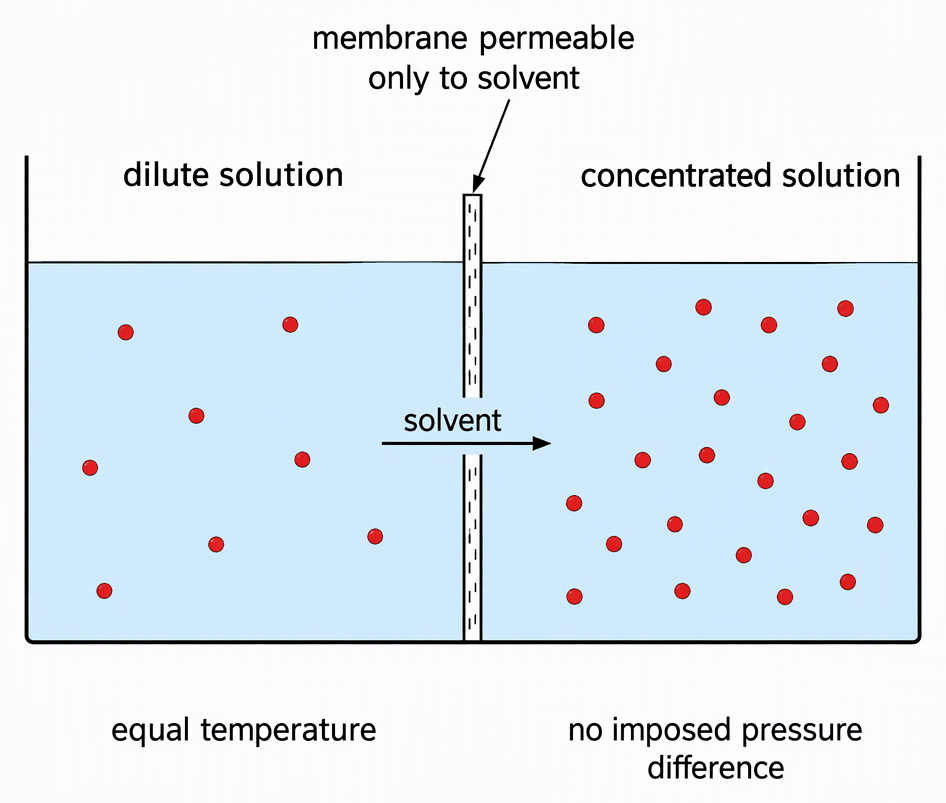
Two ideal dilute solutions contain the same solvent and a solute that cannot cross their separating membrane. The membrane passes only solvent. At equal temperature, initially equal pressure and no imposed pressure difference, what is the initial net solvent movement?
- A. From the more dilute side to the more concentrated side
- B. From the more concentrated side to the more dilute side
- C. No net movement
- D. Solute crosses until concentrations become equal
What are the correct answers and the traps?
The answer key is 1 B, 2 C, 3 B, 4 D, 5 C and 6 A. Check your written reason as well as your selected option. A correct guess does not show that you can identify a law’s conditions or count dissolved particles.
1. B, molality. Solute moles and solvent mass remain unchanged; solution volume increases. The trap is choosing molarity because solute amount stays fixed while ignoring its volume denominator.
2. C, it doubles. At fixed temperature, Henry’s constant stays fixed under the stated conditions. The trap is assuming extra pressure reduces dissolution rather than increasing the equilibrium dissolved mole fraction.
3. B, 80 kPa. Multiply pure-solvent vapour pressure by the solvent mole fraction. The tempting 20 kPa is the lowering in vapour pressure, not the remaining pressure.
4. D. Weaker unlike attractions let molecules escape more readily, raising vapour pressure above the ideal prediction. The trap is linking higher pressure with stronger attractions, which instead tend to hinder escape.
5. C, calcium chloride. Equal molality does not mean equal dissolved-particle concentration. Under the stated assumptions, the particle counts per formula unit are:
- Glucose: one.
- Sodium chloride: two.
- Calcium chloride: three.
6. A. Solvent initially moves towards the more concentrated solution under the stated conditions. The trap is applying solute-diffusion reasoning: the membrane blocks solute, and an opposing pressure could alter solvent flow.
How should I use my mistakes to choose the next practice source?
Choose your next resource by the cause of each error. A definition error needs textbook repair; a missed condition needs assumption-checking; a repeated particle-count error needs targeted practice. This small diagnostic cannot predict your NEET score, percentile or overall readiness.
- Concentration or Henry’s-law error: Review the NCERT definition or law, including what stays constant. Then attempt a fresh question without notes and explain the denominator or pressure relationship.
- Vapour-pressure or deviation error: Write the assumptions first: ideal or non-ideal, volatile or non-volatile solute, and fixed temperature. Only then select the equation or option.
- Colligative-property error: Identify the concentration basis, particle count and whether association or dissociation occurs. Dissociation increases particle count; association reduces it.
- Osmosis error: State what crosses the membrane. Check for an external pressure difference before deciding the direction.
Keep a short error log using these fields:
- Concept: The law or definition tested.
- Wrong assumption: What you incorrectly treated as true.
- Correction: The condition or reasoning that fixes it.
- Fresh-question result: Your new answer and its reason.
Move to verified PYQs when you can explain both the correct answer and why the tempting alternative fails. Select a fresh variation rather than an item whose answer you remember.
When should I move from Solutions questions to a full NEET mock?
Move to a full mock when you need to test paper management, not just chapter understanding. A Solutions set cannot test switching between subjects or managing a complete paper. Use chapter repair and full-paper practice alongside each other.
The current full-paper structure is 180 compulsory single-correct questions in 180 minutes for 720 marks, with no optional section:
- Physics: 45 questions.
- Chemistry: 45 questions across the subject, not 45 from Solutions.
- Biology: 90 questions.
Marking is +4 for correct, -1 for wrong and 0 for unattempted. Nothing in this diagnostic predicts how many Solutions questions a future paper will contain.
Before attempting a complete paper, use NEET Time Management: A 180-Minute Plan With OMR Checks to set your timing and checking routine.
For that next step, NEET JEEnius AI offers 30 free full-length mock tests a month using this 180-question, 720-mark, 180-minute structure, with a scored per-subject breakdown. After one paper, separate Chemistry concept errors from timing errors before choosing what to practise next.
Frequently asked questions
Should I start Solutions practice with NCERT, PYQs or MCQs?
Start with NCERT if definitions and the conditions behind laws are unclear. If you have studied the chapter, use targeted MCQs to diagnose errors and NCERT to repair them. Move to verified NEET PYQs to practise actual exam wording once you can explain your answers.
Are these Solutions questions NEET PYQs?
No. These are six original, four-option, single-correct MCQs, not past NEET questions. They include answers, explanations and common traps, with no download or registration required.
Why does molarity change with temperature but molality does not?
Molarity uses solution volume as its denominator, so it changes when the solution expands on warming. Molality uses solvent mass instead. If composition remains unchanged and there is no reaction or material loss, solute moles and solvent mass stay fixed, so molality remains unchanged.
How should I revise Solutions after getting MCQs wrong?
Classify each error by its cause rather than simply recording the wrong option. Review NCERT for definition errors, write the conditions before applying laws, and use targeted questions for repeated particle-count mistakes. Then attempt a fresh variation without notes and explain why the tempting alternative fails.