What is the answer to the Some Basic Principles NEET 2026 carbocation question?
Option A is correct in the Some Basic Principles NEET 2026 question: occupied sigma and occupied pi orbitals supply the stabilising electron density. The source is NEET UG 2026, held on 2026-06-21 (21 June 2026), Code-50, Chemistry. Its medium difficulty rating belongs to the question bank, not to an official NTA classification.
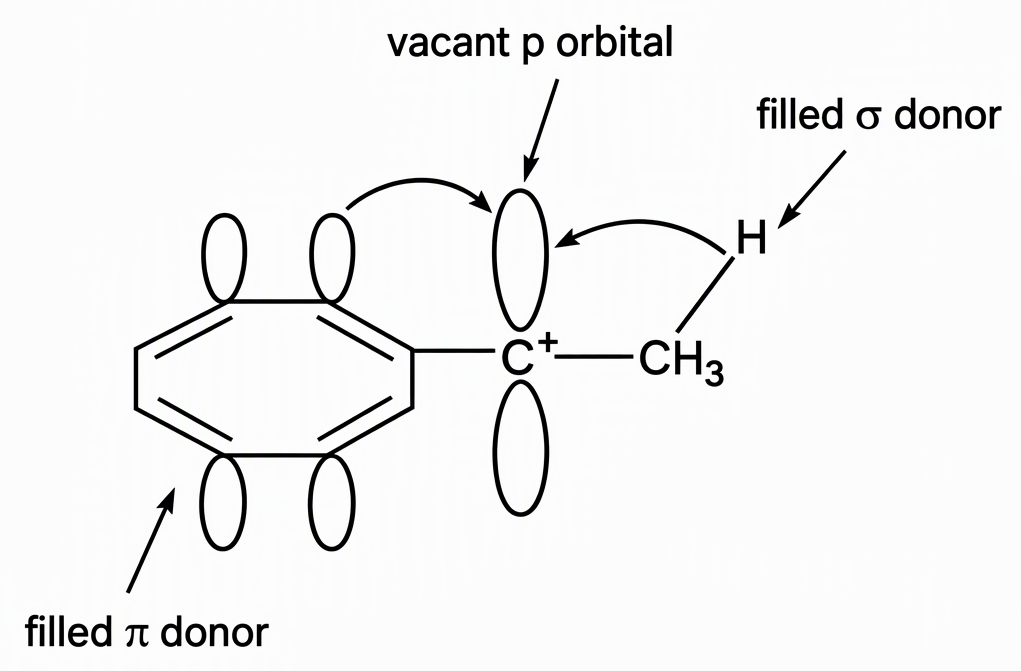
The task is to identify which pair of orbital types supplies electrons to the positively charged carbon in the structure below. Ph denotes a phenyl group, and the charged CH carbon is directly bonded to both the benzene ring and a methyl group.
The paraphrased choices are:
Identify the acceptor first, then check the donors on each side. A memorised carbocation stability order does not distinguish these options.
Which orbital accepts electrons at the positively charged carbon?
The vacant p orbital on the benzylic carbon is the electron acceptor. This carbon is electron-deficient, so it receives electron density from neighbouring occupied orbitals rather than supplying the electrons responsible for its own stabilisation.
The decision rule is:
Keep orbital type separate from orbital occupancy. Sigma and pi identify bonding orbital types; filled or empty tells you whether an orbital contains electrons it can donate in this interaction.
First check whether the proposed donor contains electrons. Then check whether its position allows suitable overlap with the vacant p orbital.
How does the benzene ring stabilise the carbocation?
The benzene ring supplies electron density from its occupied pi orbitals through resonance. The positively charged carbon is benzylic because it lies immediately next to the ring. It is not one of the ring carbons.
Its vacant p orbital can align with the ring p orbitals, allowing overlap with the benzene pi system. The donation direction is:
The arrow starts at the occupied ring orbital because that is where the donating electrons are. It ends at the electron-deficient carbon’s vacant p orbital, the acceptor.
This interaction delocalises the positive charge across the conjugated framework. Resonance structures represent contributions to one delocalised species, not separate molecules rapidly changing into one another.
The first required component is therefore filled pi orbitals. That keeps A and C under consideration; the methyl group supplies the evidence needed to distinguish them.
How does the methyl group identify option A?
The adjacent methyl C–H bonds supply occupied sigma orbitals through hyperconjugation. These are the sigma-bond donors identified in the supplied official solution. With suitable alignment, an occupied C–H bonding orbital overlaps with the benzylic carbon’s vacant p orbital.
This interaction is hyperconjugation. Its donor is a sigma bond, unlike the pi donor in resonance. Both interactions supply electron density to the same vacant p acceptor:
- Resonance: Donor location, benzene ring; donor orbital, filled pi; acceptor, vacant p.
- Hyperconjugation: Donor location, adjacent methyl C–H bonds; donor orbital, filled sigma; acceptor, vacant p.
One adjacent methyl group contains three candidate C–H donor bonds:
This counts available bonds, not three equally strong donations at every conformation. Effective donation depends on overlap.
Combining the two mechanisms gives filled sigma and filled pi orbitals, therefore option A:
Use this orbital argument, not an inductive-effect explanation. The question asks which orbitals supply electrons, not simply whether methyl groups stabilise carbocations.
Why is option C wrong despite including filled pi orbitals?
C gets the ring donor right but replaces the methyl donor with the wrong orbital. Its occupied pi orbitals account for resonance donation. Its empty sigma-star orbital cannot supply the C–H bonding electrons required for this hyperconjugation interaction.
The star denotes an antibonding orbital, so substituting sigma-star for sigma changes the orbital, not merely its notation. The methyl donor here is the occupied C–H bonding orbital:
The method mistake is selecting an orbital because it participates in donor–acceptor chemistry elsewhere, without checking its occupancy and role here. Sigma-star can act as an acceptor in other contexts, but this question’s acceptor is already the carbocation’s vacant p orbital.
B and D also fail because their listed empty orbitals cannot provide the stabilising electron donation required here. Check where the electrons come from before naming the interaction.
Can you apply the same method to two related carbocations?
The acceptor-first method still works, but changing the neighbouring group changes the available donors. These are original practice questions, not additional verified PYQs. Answer from each structure rather than carrying both mechanisms over automatically.
Practice question 1: For the ethyl carbocation below, identify the occupied orbitals responsible for C–H hyperconjugative stabilisation. Is benzene-ring resonance available?
Worked answer: The adjacent methyl group’s filled C–H sigma orbitals donate into the vacant p orbital on the positively charged carbon. There is no benzene ring or adjoining pi system, so benzene-ring resonance is unavailable.
Practice question 2: For the benzyl carbocation below, identify the resonance donor. Does the original question’s adjacent methyl C–H donation remain available?
Worked answer: The ring’s filled pi orbitals still donate into the benzylic vacant p orbital. The adjacent methyl group has been removed, so that specific methyl C–H hyperconjugation pathway is absent.
The hydrogens attached directly to the positively charged carbon are not the adjacent methyl C–H donors identified in the original question. Donor location matters as much as orbital occupancy.
For your next question, use this check:
- Locate the positively charged carbon.
- Inspect its directly neighbouring groups.
- Identify occupied donor orbitals with suitable overlap.
- Name the interaction: resonance or hyperconjugation.
Next step: photograph a doubt on NEET JEEnius AI and photograph any question you are stuck on and get a step-by-step solution across Physics, Chemistry and Biology (20 free a month).
For a worked example of the same idea, see Nuclear Size and Mass Defect NEET 2026: Option D Explained.
Frequently asked questions
What is the answer to the Some Basic Principles NEET 2026 carbocation question?
Option A is correct: occupied sigma and occupied pi orbitals supply the stabilising electron density in Ph–CH⁺–CH₃. The benzene ring supplies pi electrons through resonance, while adjacent methyl C–H bonds supply sigma electrons through hyperconjugation.
Which orbital accepts electrons in a benzylic carbocation?
The vacant p orbital on the positively charged benzylic carbon accepts electron density. Neighbouring occupied orbitals can donate when they have suitable overlap with this vacant p orbital.
Why is option C wrong in the carbocation question?
Option C correctly includes occupied pi orbitals but incorrectly identifies an empty sigma-star orbital as the other donor. An empty orbital cannot supply the required electrons. The methyl donors are occupied C–H sigma bonding orbitals, not sigma-star antibonding orbitals.
What is the difference between resonance and hyperconjugation in Ph–CH⁺–CH₃?
Resonance involves donation from the benzene ring’s filled pi orbitals into the benzylic carbon’s vacant p orbital. Hyperconjugation involves donation from adjacent methyl C–H sigma bonds into that same acceptor. The methyl group has three candidate C–H donor bonds, but effective donation depends on alignment.