What does the Packaging of DNA Helix NEET 2026 question ask?
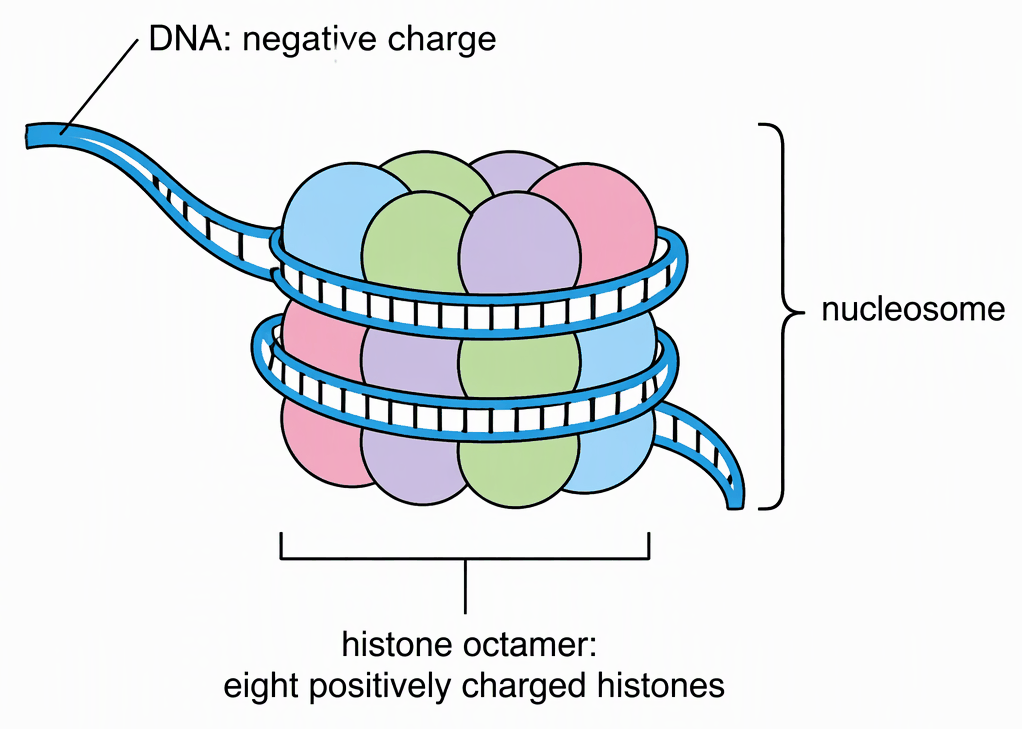
DNA is negatively charged; histones are positively charged. This distinction drives the Packaging of DNA Helix NEET 2026 question, which concerns DNA winding around a histone core and the proteins involved in further chromatin packaging.
This is a medium-difficulty Biology question from Genetics and Evolution. The question bank gives an expected solving time of 60 seconds, not a guaranteed target for every student.
Select the combination containing all the correct claims:
- A: Eight histone molecules assemble into a unit called a histone octamer.
- B: Histones are basic proteins that carry negative charge.
- C: Lysine and arginine are abundant amino acid residues in histones.
- D: Positively charged DNA winds around the histone octamer, forming a nucleosome.
- E: Further chromatin compaction needs additional proteins called non-histone chromosomal proteins.
The answer choices are:
- A, C and E only.
- B, D and E only.
- C, D and E only.
- A, B and D only.
Letters A–E identify statements; numbers 1–4 identify answer choices. Option (1) corresponds to answer A in the supplied question-bank labels, not to statement A alone.
Why are statements A and C true but B false?
A and C correctly describe histone composition; B assigns histones the wrong charge. Follow the official solution by checking each complete claim before selecting an option.
Step 1: Check the octamer claim. An octamer contains eight histone molecules. Statement A is true because it correctly identifies both the assembly and its molecule count.
Step 2: Check the charge claim. Histones are basic proteins with positive charge in this biological context. Statement B is false because it calls them negatively charged.
Its two fragments have different verdicts:
- “Basic proteins” is true.
- “Negatively charged” is false.
One correct fragment cannot make the whole statement correct. The charge error is enough to reject B.
Step 3: Check the amino acid claim. Histones are rich in lysine and arginine, the basic amino acid residues named in the question. Statement C is true.
The running result is A true, B false, C true. Leave option selection until D and E have also been checked.
How do statements D and E lead to the final answer?
D is false because DNA is negatively charged; E correctly identifies proteins needed for higher packaging. Check the wrapping process separately from the charge, then distinguish the nucleosome’s core from proteins involved in further compaction.
Step 4: Check DNA wrapping. Negatively charged DNA wraps around the positively charged histone octamer to form a nucleosome. Statement D gets the wrapping process right but calls DNA positively charged, making the complete statement false.
Step 5: Check higher packaging. Higher-level chromatin packaging requires an additional set of non-histone chromosomal proteins, abbreviated NHC proteins, so E is true. Histones form the nucleosome’s protein core; NHC proteins contribute to higher-level packaging without replacing the octamer.
Step 6: Match the complete truth pattern to an option. The verified statements give option (1), A, C and E only, corresponding to question-bank answer A.
- A: true
- B: false
- C: true
- D: false
- E: true
Check each combination against that pattern:
How can accepting a half-correct statement lead to option (3)?
Accepting the wrapping phrase while ignoring DNA’s charge makes false statement D appear true. That error can lead to option (3), C, D and E only. This combination admits false D and also leaves out true A.
Recognising “DNA wraps around a histone octamer” is not enough. The charge descriptor belongs to the claim and must be checked too.
Use this repair procedure:
- Check the entity: Which molecule or protein is being described?
- Check its stated property: Is its charge or composition correct?
- Check the process: Is the claimed packaging step correct?
Mark the whole statement false if any essential part is wrong. Use the memory aid only after that reasoning: DNA negative; histones positive; octamer eight.
Can you apply the same checks to three related questions?
Check charge, core identity and packaging level separately. These are three original related practice questions, not additional verified NEET PYQs. Each answer follows its question.
Original related practice question 1: Which charge pairing supports DNA association with histones?
Answer: (1), the first pairing. DNA carries negative charge; histones carry positive charge, supporting attraction. Option (3) gives opposite charges but assigns both to the wrong entities.
Original related practice question 2: An eight-histone core is present, but DNA has not yet wrapped around it. What is this core called?
Answer: (1), histone octamer. This names the eight-protein core. A nucleosome includes DNA wrapped around that core.
Worked numerical check: Suppose there are three such cores. The total number of core histone molecules is:
Original related practice question 3: Beyond nucleosome formation, which additional protein group is required for higher-level chromatin packaging?
Answer: (1), non-histone chromosomal proteins. NHC proteins contribute to higher-level packaging without replacing the histone octamer.
Next, practise checking a biological sequence rather than a charge claim: DNA Fingerprinting NEET 2026: Correct Step Sequence.
Frequently asked questions
What are the charges on DNA and histones?
DNA is negatively charged, while histones are positively charged in this biological context. Histones are basic proteins rich in lysine and arginine, and their positive charge supports association with DNA.
What is the difference between a histone octamer and a nucleosome?
A histone octamer is a core made of eight histone molecules. A nucleosome includes negatively charged DNA wrapped around that positively charged core.
Which statements are correct in the Packaging of DNA Helix NEET 2026 question?
Statements A, C and E are correct, giving option (1). Statement B wrongly assigns negative charge to histones, while statement D wrongly assigns positive charge to DNA. A correct fragment does not make either complete statement true.
Which proteins help in higher-level chromatin packaging?
Non-histone chromosomal proteins, abbreviated NHC proteins, contribute to higher-level chromatin packaging. They assist further compaction without replacing the histone octamer that forms the nucleosome’s protein core.