What is the answer to the Lassaigne’s test NEET 2026 amino-acid question?
C, methionine, is correct because it is the only listed amino acid containing sulphur. The Lassaigne's test NEET 2026 question contains a colour mismatch: sodium nitroprusside gives violet/purple with sulphide, not blood-red.
This question is from NEET 2026, 21 June, Code-50, and is single correct. “Medium difficulty” is the question bank’s classification, not an official exam rating.
The task is to identify which amino acid gives the colour described in the paper as “blood-red” when its sodium-fusion extract is treated with sodium nitroprusside:
Use the named reagent to solve it. The worked solution below separates its standard observation from the paper’s wording.
Which amino acid contains the sulphur needed for this test?
Methionine alone supplies sulphur. Following the official solution, compare the structures before applying a memorised colour test. All four options share the amino-acid framework below, so their side chains decide the answer.
The group shown as R is the side chain. Inspect the element symbols in each option:
- A, leucine: a hydrocarbon side chain, with no sulphur.
- B, threonine: a hydroxyl-containing side chain, with oxygen but no sulphur.
- C, methionine: a sulphur atom bonded between two carbon groups.
- D, serine: a hydroxyl-containing side chain, with oxygen but no sulphur.
The hydroxyl groups in threonine and serine contain oxygen, not sulphur. Neither can supply sulphur for this test.
All four amino acids contain nitrogen in their common framework. Nitrogen’s presence alone therefore eliminates none of the options. Methionine’s sulphur atom is the deciding structural difference, even though the question’s colour description is inconsistent.
How does sodium fusion lead to the answer despite the blood-red wording?
The named reagent detects sulphide, so methionine remains correct despite the faulty colour description. Track sulphur from its side chain into the sodium-fusion extract and then into the coloured complex. Keep this pathway separate from the blood-red thiocyanate test, which uses ferric ions rather than sodium nitroprusside.
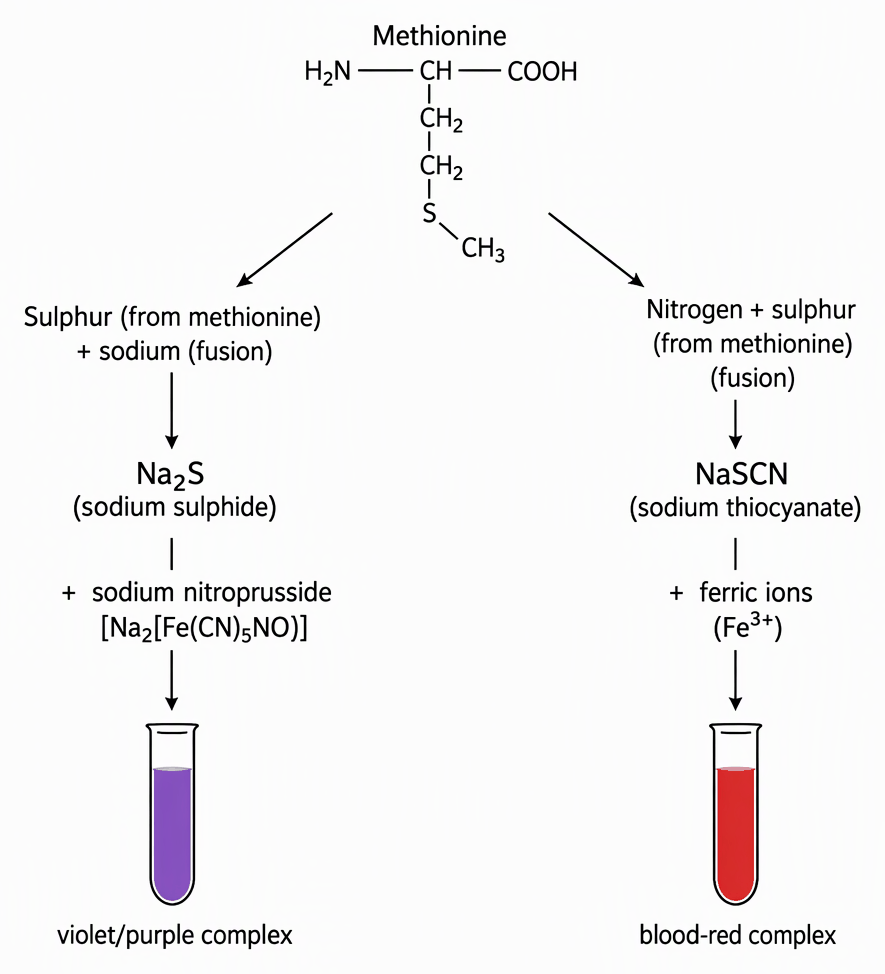
Step 2: sodium fusion makes sulphur detectable. Fusion converts covalently bound organic sulphur into sodium sulphide in the extract. This is a conversion schematic, not a balanced equation for the whole amino acid:
The dissolved salt supplies the detected sulphide ion:
Step 3: add sodium nitroprusside. Its formula and the ionic reaction are:
Check the total charge on each side:
Charge is conserved. The standard NCERT observation is violet/purple, not blood-red.
Step 4: separate the other test. When nitrogen and sulphur occur together, fusion can produce thiocyanate:
This gives a blood-red ferric thiocyanate complex with ferric ions:
The paper’s colour description is inconsistent with its named reagent. Blood-red is not an alternative standard observation for the sodium nitroprusside sulphur test.
The official answer remains C, methionine, the only option supplying sulphur. Leucine, threonine and serine lack sulphur and do not give the sulphur-specific violet/purple result. Use this reasoning sequence:
Named reagent → detected ion → element required → option containing that element.
How could a method mistake lead to B, threonine?
Selecting B because of its hydroxyl group would mean mistaking oxygen for sulphur, perhaps by silently reading a hydroxyl group as a thiol group. The error is failing to inspect the actual element symbols before applying a functional-group test.
Compare the side chains directly:
A hydroxyl group is not a thiol group:
Methionine does not need a free thiol group. Sodium fusion detects its sulphur even though that atom is bonded between carbon groups.
Separately, matching blood-red to the ferric chloride–thiocyanate test explains the colour confusion. It cannot justify choosing threonine: an amino acid without sulphur cannot supply sulphur for thiocyanate formation.
Can you distinguish the reagents in two related practice questions?
Ferric chloride gives blood-red with thiocyanate; silver nitrate identifies chloride through its precipitate. These are original related practice questions, not additional verified NEET PYQs. Use the reagent, detected ion and observation together.
Which reagent gives blood-red with a thiocyanate-containing extract?
Answer: A, ferric chloride. In Question 1, an extract from a compound containing both nitrogen and sulphur forms thiocyanate. Which reagent gives the blood-red result?
Nitrogen and sulphur can form thiocyanate during sodium fusion. Ferric chloride supplies ferric ions, which form the blood-red complex, represented by this simplified equation:
Sodium nitroprusside instead gives violet/purple with sulphide. Do not transfer the observation between these tests.
Which halogen gives a white silver precipitate that dissolves in ammonia?
Answer: B, chlorine. In Question 2, an appropriately nitric-acid-treated sodium-fusion extract gives a white precipitate with silver nitrate that dissolves in aqueous ammonia. Identify the halogen.
Chloride ions form white silver chloride. Its dissolution in aqueous ammonia supports the identification:
Proper nitric-acid treatment removes interfering cyanide and sulphide before silver nitrate testing. Otherwise, these ions could also react with silver ions.
Before selecting an option, write reagent, detected ion, observation beside the question. If they disagree, inspect the wording rather than changing the chemistry.
Next step: the past-paper archive on NEET JEEnius AI and search past NEET papers by year, subject or chapter, each with a worked solution (100 free searches a month).
Keep going with AC Fundamentals NEET 2026: Time to First Current Peak.
Frequently asked questions
What is the answer to the Lassaigne's test NEET 2026 amino-acid question?
The answer is C, methionine, because it is the only listed amino acid containing sulphur. Leucine, threonine and serine lack sulphur. The named reagent, sodium nitroprusside, detects sulphide and normally gives violet/purple, not the blood-red colour stated in the question.
Does sodium nitroprusside give a blood-red colour in Lassaigne's test?
No. Sodium nitroprusside gives a violet/purple complex with sulphide ions in the sodium-fusion extract. Blood-red belongs to the reaction of thiocyanate with ferric ions, supplied by a reagent such as ferric chloride.
Why is threonine wrong if it has an OH group?
Threonine's hydroxyl group contains oxygen, not sulphur, so it cannot supply sulphur for this test. Methionine contains sulphur bonded between carbon groups and does not need a free thiol group to give a positive sulphur test after sodium fusion.
Why is the sodium-fusion extract treated with nitric acid before adding silver nitrate?
Proper nitric-acid treatment removes interfering cyanide and sulphide ions before silver nitrate testing. Without this treatment, those ions could also react with silver ions. A white silver chloride precipitate that dissolves in aqueous ammonia supports the identification of chloride.