What is the answer to the Simple Pendulum NEET 2026 question?
The effective length in this simple pendulum NEET 2026 question is 1 m, option D. A Class 11 student determines this length by timing repeated swings of a simple pendulum.
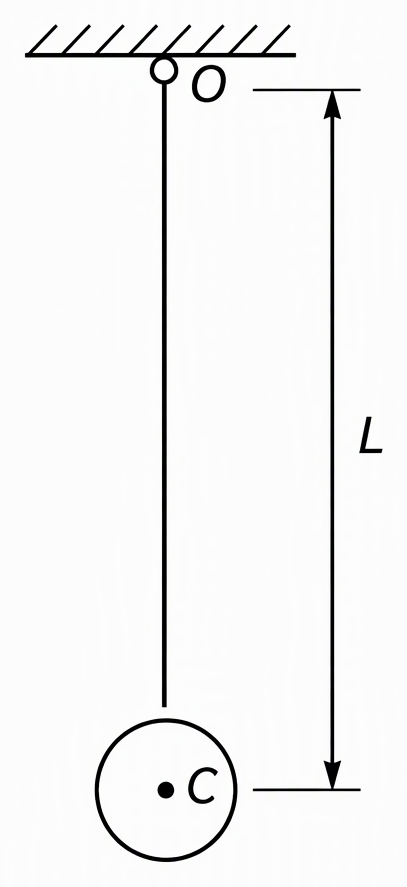
The student records 30 complete oscillations in 60 seconds. Calculate the effective length using the supplied values:
Effective length is the distance from the suspension point to the bob’s centre, not merely the exposed string length. Choose from:
The question bank classifies this as medium difficulty. Its listed target time is 60 seconds, not a measured student average.
How do you turn 30 oscillations in 60 seconds into the time period?
Divide the total observation time by the number of complete oscillations. The result is 2 seconds per oscillation, the time period needed in the pendulum formula. The stopwatch’s 60 seconds covers the whole set, not one cycle.
Keep these three quantities separate:
One complete oscillation returns the bob to the same position and the same direction of motion. Simply passing through the lowest point again does not necessarily complete a cycle.
The question already counts complete oscillations, so do not double or halve 30. Carry this period into the next step:
How do you rearrange the pendulum formula to get 1 m?
Use the small-angle simple-pendulum relation, then square the entire coefficient, not just pi. This gives a denominator of four times pi squared when you isolate effective length. In this simple pendulum NEET 2026 question, that step separates the correct answer from option C.
Use capital L consistently for effective length:
Square both sides, including the full coefficient outside the square root:
Multiply both sides by gravitational acceleration:
Then divide by the full coefficient of effective length:
Substitute the period calculated above and the question’s supplied values:
The supplied numerical values make the cancellation short. They do not mean gravitational acceleration and pi squared have identical units: pi squared is dimensionless.
Check that the result has the dimensions of length:
Using a more precise value of pi is unnecessary. The question explicitly supplies:
Answer: D) 1 m.
How does an incorrect square produce option C, 2 m?
Squaring pi but failing to square the coefficient two leaves the denominator half as large as it should be. The calculated length is then twice the correct value. Even with the correct time period, this algebraic error produces option C.
The following working is incorrect:
Following that faulty rearrangement gives:
That result matches option C. It comes from an incomplete square, not a different interpretation of effective length.
The valid identity squares both factors:
The invalid replacement leaves the coefficient unsquared:
Repair: keep parentheses around the entire factor until it has been squared. I would write that extra line rather than jump straight to the rearranged formula: it makes the missing factor visible.
How do you solve these three related pendulum questions?
For an oscillation count, calculate the period first; for a change in length, use the period ratio. These original practice variations, not additional verified NEET PYQs, test the same method within Oscillations and Waves.
Keep the same ideal, small-angle assumptions throughout. For the numerical variations, retain:
Question 1: A pendulum completes 20 oscillations in 40 seconds. Find its effective length.
Divide the observation time by the count, then substitute:
Different observation totals can describe the same period. Here, both records give two seconds per oscillation, so they give the same effective length.
Question 2: A pendulum completes 30 oscillations in 30 seconds. Find its effective length.
The count is unchanged from the original question, but the observation time is halved:
Halving the period reduces length to one-quarter, not one-half. At fixed gravitational acceleration:
Question 3: At unchanged gravitational acceleration, the original pendulum’s effective length increases from 1 m to 4 m. Find its new period.
Use the period ratio, with the original period of two seconds:
Four times the length gives twice the period. Before selecting an option, check time per complete oscillation first, then the square of the entire coefficient.
Next step: photograph a doubt on NEET JEEnius AI and photograph any question you are stuck on and get a step-by-step solution across Physics, Chemistry and Biology (20 free a month).
For a worked example of the same idea, see How to Score 600 in NEET: Targets and Mock Analysis.
Frequently asked questions
How do you find pendulum length from 30 oscillations in 60 seconds?
The time period is T = 60/30 = 2 seconds. Using the small-angle formula L = gT²/(4π²), with g = 9.8 m/s² and the supplied π² = 9.8, gives L = 1 m. The correct answer is option D.
What is the effective length of a simple pendulum?
Effective length is the distance from the suspension point to the centre of the bob. It is not merely the exposed string length.
Why do I get 2 m instead of 1 m in this pendulum question?
A result of 2 m comes from replacing (2π)² with 2π² instead of 4π². This makes the denominator half its correct value and doubles the calculated length. Square both factors: (2π)² = 4π².
What happens to the time period if pendulum length is quadrupled?
At unchanged gravitational acceleration, the small-angle time period is proportional to the square root of effective length. Quadrupling the length therefore doubles the period. For the original pendulum, increasing length from 1 m to 4 m changes the period from 2 s to 4 s.