Phenols NEET 2026: which functional group gives the phthalein dye test?
B) Phenolic is correct in this phenols NEET 2026 question. The stem asks: A positive phthalein dye test points to which of the following functional groups?
This is a single-correct Chemistry question from Organic Compounds Containing Oxygen. The question bank tags it medium and gives an expected solving time of 30 seconds, not measured student performance. Identify the starting functional group through the complete test: form colourless phenolphthalein by condensation, then develop its pink colour by adding sodium hydroxide.
How does phenol form phenolphthalein in the first step?
Phenol forms colourless phenolphthalein when heated with phthalic anhydride in the presence of concentrated sulphuric acid. Phenol is the starting compound bearing the phenolic group being tested. The first stage requires phthalic anhydride, concentrated sulphuric acid and heating.
The official solution describes this as a condensation reaction. Its product is phenolphthalein, described as colourless at this stage.
First-stage word-reaction scheme:
Phenol is tested; phenolphthalein is formed. The question asks you to identify the functional group of the starting substance, not name the condensation product.
Heating with the condensation reagents is not yet the pink-colour observation. It forms the compound that gives the colour response in the next stage. Product formation alone does not explain the completed positive test.
When does the pink colour appear after adding NaOH?
The pink colour appears when sodium hydroxide is added after phenolphthalein has formed. Sodium hydroxide provides the alkaline medium in which phenolphthalein gives the stated pink colour. The reagent order separates dye formation from colour development.
The question asks for the functional group identified, not the name of the coloured indicator. Phenolphthalein gives the colour response, but phenol contains the starting group under investigation. Thus, the phthalein dye test identifies the phenolic group, so B is correct.
Adding sodium hydroxide directly to phenol does not by itself produce this pink dye-test result. That skips the condensation needed to form phenolphthalein; forming a phenol salt is a different reaction.
Recall: phenol with phthalic anhydride, concentrated sulphuric acid and heat first; sodium hydroxide second; pink observation last.
Why is choosing D) Alcohol a classification mistake?
A hydroxyl group alone does not make a compound an ordinary alcohol. The faulty method is to spot that group and label every compound containing it an alcohol. For functional-group identification, check the carbon to which the hydroxyl group is attached.
In phenol, the hydroxyl group is attached directly to an aromatic ring carbon. In ethanol, it is attached to a saturated carbon.
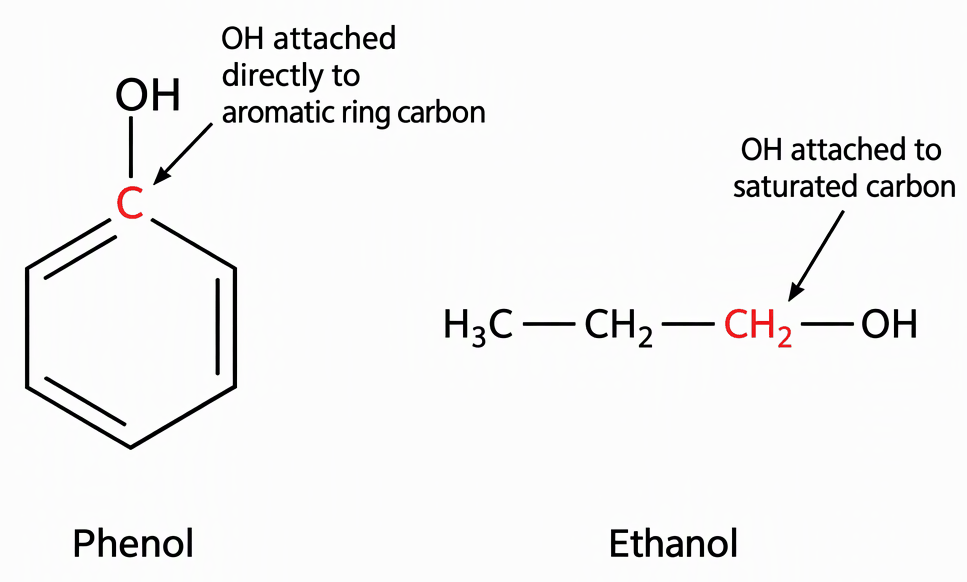
Sharing a hydroxyl group does not make these compounds interchangeable in functional-group tests. Here, the stated condensation forms phenolphthalein, and subsequent addition of sodium hydroxide produces pink colour. This supports B) Phenolic, not D) Alcohol: use the starting structure and the full reagent sequence, not the hydroxyl group alone.
Can you solve three related questions from Organic Compounds Containing Oxygen?
Use these checks to distinguish product formation, colour development and acid–base behaviour. They are original related practice questions, not additional verified NEET PYQs.
What colourless product forms when phenol is heated with phthalic anhydride and concentrated sulphuric acid?
Answer: phenolphthalein. Heating phenol with these condensation reagents produces the colourless compound named in the official solution. This is the stage before sodium hydroxide is added, so the pink colour has not yet developed.
Which expected observation is missing if the condensation is completed but NaOH is omitted?
Answer: the pink colour in alkaline medium has not yet been developed. The condensation has formed phenolphthalein, but sodium hydroxide is still needed to provide the alkaline medium. Colourless phenolphthalein at the first stage is consistent with the supplied solution.
Which reacts appreciably with aqueous NaOH under ordinary conditions, phenol or ethanol?
Answer: phenol. It reacts to form sodium phenoxide and water:
Phenoxide is resonance-stabilised: its negative charge is spread through the aromatic system. Ethoxide lacks this resonance stabilisation, making it less stable than phenoxide. Ethanol does not react appreciably with aqueous sodium hydroxide under ordinary conditions.
For a numerical check, suppose the reacting amounts are:
The equation gives a one-to-one mole ratio, so sodium hydroxide is the limiting reagent. The amount of sodium phenoxide formed is:
This is sodium phenoxide formation, not phenolphthalein dye formation; no pink dye-test result follows. Before selecting an answer, check whether the question describes simple neutralisation or condensation followed by colour development.
Next step: the past-paper archive on NEET JEEnius AI and search past NEET papers by year, subject or chapter, each with a worked solution (100 free searches a month).
Read next: Interference and Diffraction NEET 2026: Why Option 3 Is Correct.
Frequently asked questions
Which functional group gives a positive phthalein dye test?
A positive phthalein dye test identifies the phenolic group. Phenol first forms colourless phenolphthalein through condensation with phthalic anhydride; subsequent addition of sodium hydroxide develops the pink colour.
What reagents are used in the phthalein dye test?
Heat phenol with phthalic anhydride in the presence of concentrated sulphuric acid to form colourless phenolphthalein. Then add sodium hydroxide to provide the alkaline medium and develop the pink colour.
Does adding NaOH directly to phenol produce a pink colour?
No, adding sodium hydroxide directly to phenol does not produce the pink phthalein dye-test result. It forms sodium phenoxide and water instead. The dye test requires phenolphthalein formation through condensation before sodium hydroxide is added.
Why is the answer phenolic and not alcohol in the phthalein dye test?
In phenol, the hydroxyl group is attached directly to an aromatic ring carbon; in ethanol, it is attached to a saturated carbon. A shared hydroxyl group does not make them interchangeable in functional-group tests. The stated condensation and subsequent pink colour identify the phenolic group, not an ordinary alcohol.