What is the correct answer to the skeletal muscle NEET 2023 question?
The skeletal muscle NEET 2023 answer is option (2), B and C only. A confuses fascia with fascicle, while D confuses the central M line with the whole sarcomere. The worked explanation checks each statement before matching the options.
This NEET UG 2023 Biology question belongs to Human Physiology. It is medium on this question bank’s scale. The expected solving time is 60 seconds, a practice target based on four short statement checks, not a measured student average or an official NTA difficulty rating.
Evaluate these four claims:
The answer combinations are:
Why is A false but B true?
Skeletal muscle contains bundles of muscle fibres, and each fibre contains myofibrils with repeating sarcomeres. A is false because the binding tissue is fascia, not fascicle; B is true because the sarcoplasmic reticulum stores calcium ions.
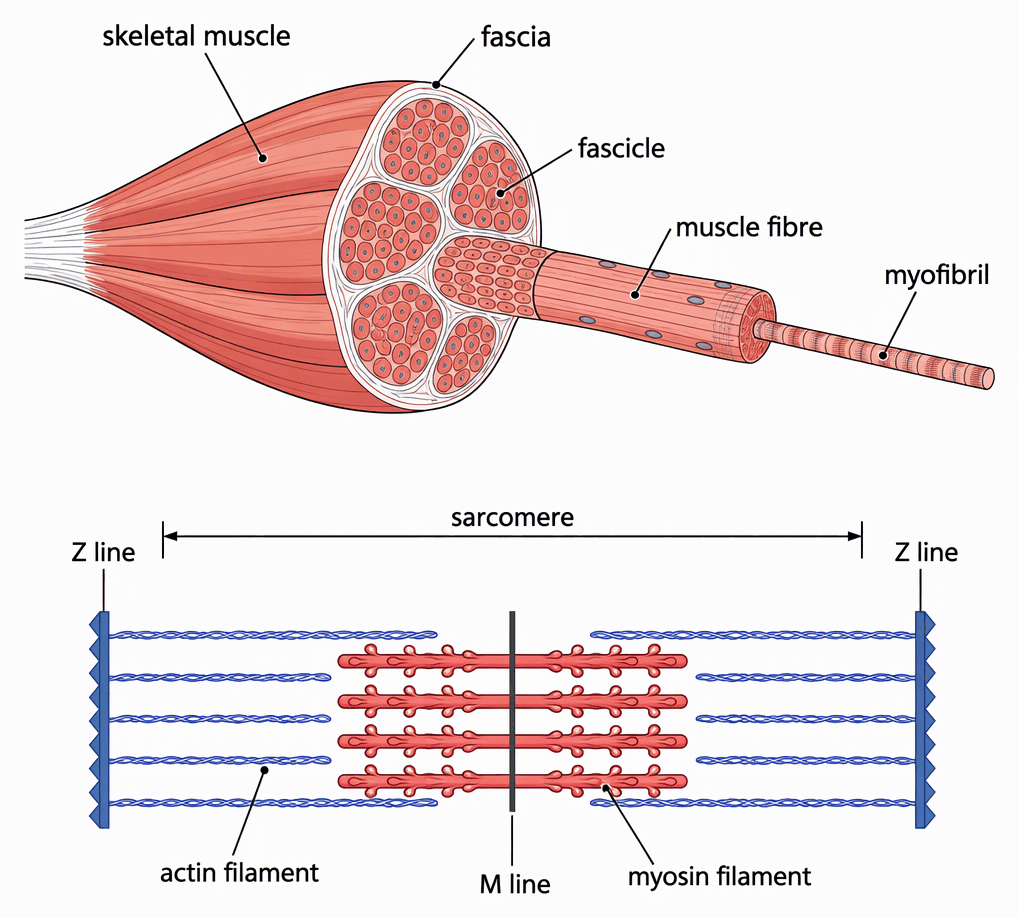
Step 1: Check the noun in A. The collagenous connective tissue holding muscle bundles together is fascia. A muscle bundle itself is a fascicle. One term names the binding tissue; the other names what it binds.
Repair A: Muscle bundles are held together by a collagenous connective tissue layer called fascia. Replacing “fascicle” with “fascia” makes the claim correct.
Step 2: Check the storage function in B. The sarcoplasmic reticulum stores calcium ions within the muscle fibre, so B is true. Do not shorten this term to “sarcoplasm”: sarcoplasm is the muscle fibre’s cytoplasm, not the name of its specialised calcium-storage network.
Why is C true but D false?
C correctly connects striations to protein arrangement; D incorrectly names a central landmark as the entire contractile unit. Check the repeating pattern for C and the segment’s boundaries for D. These are separate structural checks, not questions about the steps of contraction.
Step 3: Check what produces the bands. Actin and myosin have an organised distribution within myofibrils. This repeating arrangement produces the alternating bands responsible for the striated appearance of skeletal muscle fibres.
The key word is arrangement, not merely presence. Saying that a fibre contains actin and myosin does not explain a repeated banding pattern. C gives the relevant reason and is true.
Step 4: Check the boundaries in D. A sarcomere extends between two successive Z lines. The M line lies centrally within it, so it cannot name the whole unit.
Repair D: The Z-line-to-Z-line segment of a myofibril is the functional unit of contraction called the sarcomere. D is therefore false.
How do the four verdicts lead to option (2)?
Step 5: Match the true statements to the options. The complete verdict sequence is A false, B true, C true, D false. Collecting only the true statements gives B and C only, exactly the combination in option (2).
Check the remaining choices against those verdicts:
Final answer: option (2).
How does confusing fascia with fascicle produce option (1)?
Treating fascicle as the connective tissue’s name makes A appear true. Retain the correct judgments on B, C and D, and the selection becomes A, B and C only: option (1).
The mistake is recognising a familiar word without checking whether it names a bundle or its binding tissue. Before accepting an anatomical term, ask which category it fits:
- Structure: A fascicle is a bundle.
- Binding tissue or covering: Fascia holds the bundles together.
- Landmark: The M line marks the centre.
- Segment: The sarcomere extends from Z line to successive Z line.
Under a marking scheme awarding 4 marks for a correct response and -1 for a wrong response, the difference is:
Check the definition before matching the option.
Can you apply these distinctions to two related questions?
Identify each structure’s role before choosing an answer number. These are original practice questions from the same Human Physiology chapter, not verified past-paper questions. Attempt both before reading their worked answers.
Question 1: Which sequence correctly names the collagenous tissue holding muscle bundles together, a muscle bundle, and the calcium-ion store?
Worked answer: Read the roles in sequence: binding tissue means fascia; bundle means fascicle; calcium store means sarcoplasmic reticulum. Therefore, option (1) is correct. Sarcoplasm cannot replace the specific storage network.
Question 2: Which pair correctly identifies the boundaries of a sarcomere and its central landmark?
Worked answer: Separate the full repeating segment from its midpoint. Z line to successive Z line defines the sarcomere, with the M line centrally located. Therefore, option (1) is correct; Z line to M line is not the full sarcomere.
Next, apply the same name-to-function check to White Blood Cells (WBCs) NEET 2023: Basophil Answer. Justify each statement before matching its option.
Frequently asked questions
What is the correct answer to the skeletal muscle NEET 2023 question?
The correct answer is option (2), B and C only. B correctly identifies the sarcoplasmic reticulum as the calcium-ion store, and C correctly links striations to the arrangement of actin and myosin. A confuses fascia with fascicle, while D confuses the M line with the sarcomere.
What is the difference between fascia and fascicle?
Fascia is the collagenous connective tissue holding skeletal muscle bundles together. A fascicle is a bundle of muscle fibres, not the tissue binding the bundles.
Does the sarcoplasmic reticulum or sarcoplasm store calcium ions?
The sarcoplasmic reticulum is the specialised calcium-ion storage network within a muscle fibre. Sarcoplasm is the muscle fibre's cytoplasm and cannot replace sarcoplasmic reticulum in this statement.
Is the M line the same as a sarcomere?
No. A sarcomere is the functional unit of contraction extending between two successive Z lines. The M line is a central landmark within the sarcomere, not the whole unit.
What causes striations in skeletal muscle?
The organised, repeating arrangement of actin and myosin within myofibrils produces the alternating bands seen as striations. Their arrangement, not merely their presence, explains the banding pattern.