What does the tapetum and microsporangium NEET 2026 question actually test?
Option C is correct: Statement I is true and Statement II is false in the tapetum and microsporangium NEET 2026 question. The archive labels it Tapetum and microsporangium under Reproduction, but its statements test NCERT Class 11 Biology, Chapter 10, Cell Cycle and Cell Division, not tapetal anatomy.
The supplied question is from NEET 2026, held on 21 June 2026, Code-50. Its medium difficulty is the question bank’s classification, not an official exam-wide rating.
The two claims, paraphrased, are:
- Statement I: By the conclusion of prophase I, chromosomes have reached complete condensation.
- Statement II: The first meiotic division is the division comparable to mitosis.
The choices are:
Although the bank tags this as Assertion–Reason, these choices ask only whether each statement is true. Do not test whether one explains the other.
Why is Statement I true at the end of prophase I?
Diakinesis is the final substage of prophase I, when chromosomes are fully condensed. The official solution first identifies the stage described by “the end of prophase I”, then checks its NCERT features.
The five substages occur in this order:
- Leptotene.
- Zygotene.
- Pachytene.
- Diplotene.
- Diakinesis.
In diakinesis, the meiotic spindle is assembled. The nucleolus disappears and the nuclear envelope breaks down as prophase I ends, preparing the cell for the next stage of division.
The key word in Statement I is end, not start. Chromosome condensation begins earlier, during leptotene; the statement does not claim that condensation first begins in diakinesis.
The statement would be false if it said chromosomes start condensing only at the end of prophase I. It says condensation is complete by then, so Statement I is true.
Why does meiosis II resemble mitosis, rather than meiosis I?
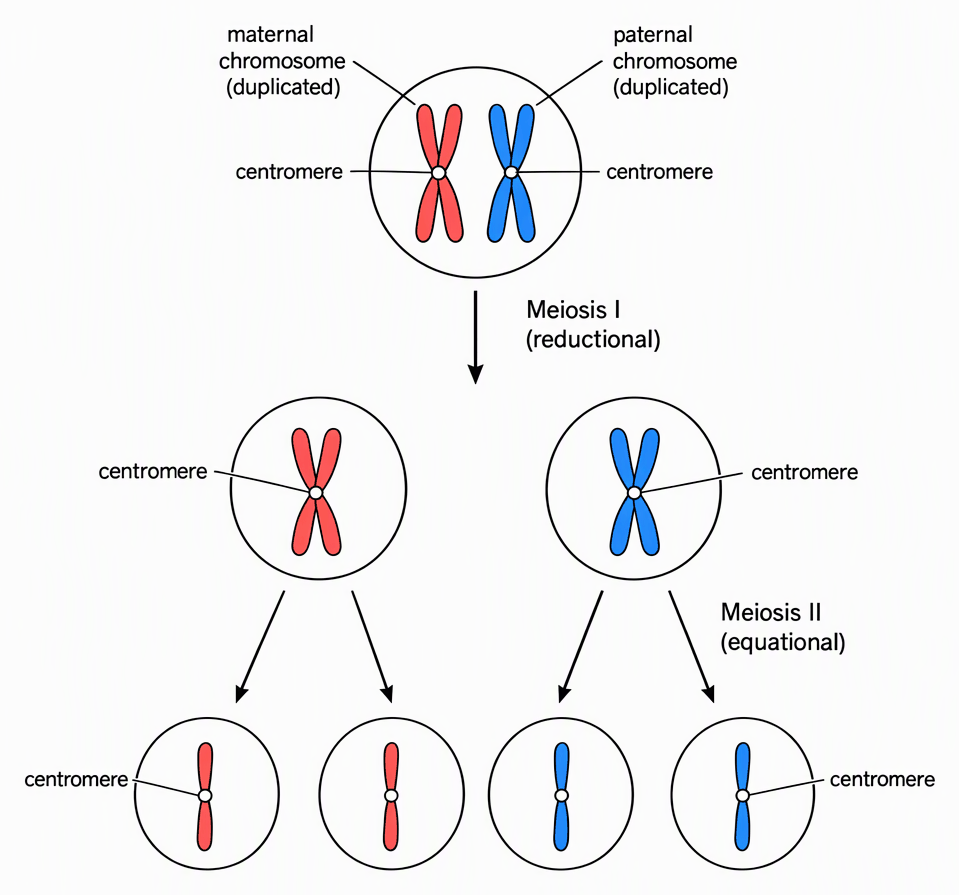
Meiosis I separates homologous chromosomes and reduces the chromosome-set number; meiosis II separates sister chromatids without reducing it further. NCERT’s comparison with mitosis applies to meiosis II. To judge Statement II, track what separates instead of relying on familiar stage names.
A diploid cell undergoing meiosis I produces two haploid cells whose chromosomes still contain paired sister chromatids. Meiosis II then separates those chromatids into the resulting cells.
The chromosome-set change in meiosis I is:
For each cell undergoing meiosis II:
Compare the separating units:
- Meiosis I: Homologous chromosomes separate; reductional division.
- Meiosis II: Sister chromatids separate; equational division.
- Mitosis: Sister chromatids separate; equational division.
“Resembles” does not mean meiosis II and mitosis are identical in every context. Meiosis II follows the first meiotic division and starts with haploid cells. Their relevant similarity is sister-chromatid separation with chromosome number retained in each resulting cell, so Statement II is false.
How do the two findings give option C?
The final truth pair is: Statement I true; Statement II false. Match that pair directly to the displayed choices. The bank’s Assertion–Reason tag does not change what these options ask you to judge.
- Eliminate A: It requires Statement II to be true.
- Eliminate B and D: Both require Statement I to be false.
- Select C: It matches both findings.
Option C is correct because full chromosome condensation occurs in diakinesis, while meiosis II, not meiosis I, resembles mitosis.
How can confusing the two divisions produce option A?
Start with Statement I correctly judged true. The error occurs when you remember “a meiotic division resembles mitosis” but overlook the Roman numeral I in Statement II. You silently substitute meiosis II for meiosis I, accept the second statement, and get the mistaken true–true pair: option A.
The presence of prophase and metaphase does not establish NCERT’s comparison. Those names occur across divisions, but the separating units and chromosome-set changes differ. Judge the comparison by chromosome behaviour, not shared stage names.
Use this repair method:
- Underline the division number: I or II.
- Identify what separates: Homologous chromosomes or sister chromatids.
- Check the result: Is the chromosome-set number halved or retained?
Apply these checks to the division actually named in the statement, not the one you recall from a familiar sentence.
Which three related questions should you solve next?
Practise the final substage, the separating unit and centromere behaviour. These are original related practice questions, not additional verified NEET PYQs. They target Cell Cycle and Cell Division, the chapter actually tested, and include a numerical check of reductional division.
Question 1: Which prophase I substage has complete chromosome condensation and spindle assembly?
Answer: Diakinesis. From the choices leptotene, pachytene, diplotene and diakinesis, select the last one. It is the final substage of prophase I, when chromosomes are fully condensed and the meiotic spindle is assembled.
Leptotene marks the beginning of visible condensation, not its completion. The word “complete” separates these two possibilities.
Question 2: Which event makes meiosis I reductional?
Answer: Separation of homologous chromosomes, not separation of sister chromatids. Each daughter cell receives one homolog from each pair, reducing the number of chromosome sets.
For a worked numerical example, take a hypothetical diploid cell with four chromosomes arranged as two homologous pairs:
After meiosis I, the chromosome count in each daughter cell is:
Each chromosome still has two sister chromatids. Therefore, each daughter cell has:
Question 3: At anaphase II, do homologs separate without centromere division or do sister chromatids separate after it?
Answer: Sister chromatids separate after centromere division. Homolog separation without centromere division belongs to anaphase I.
The anaphase II mechanism explains the resemblance to mitosis. Cover the answers and state, for each division, what separates and whether chromosome number is halved or retained before checking your response.
Next step: photograph a doubt on NEET JEEnius AI and photograph any question you are stuck on and get a step-by-step solution across Physics, Chemistry and Biology (20 free a month).
Keep going with Equilibrium NEET 2008: Pressure Ratio of 36:1 Explained.
Frequently asked questions
What is the correct answer to the tapetum and microsporangium NEET 2026 question?
Option C is correct: Statement I is true and Statement II is false. Chromosomes are fully condensed by diakinesis, the final substage of prophase I. Meiosis II, not meiosis I, resembles mitosis in separating sister chromatids without further reducing the chromosome-set number.
Which NCERT chapter does this question actually test?
Despite its tapetum and microsporangium archive label, the statements test NCERT Class 11 Biology, Chapter 10, Cell Cycle and Cell Division. The relevant concepts are chromosome condensation during prophase I and the distinction between meiosis I and meiosis II.
In which stage of prophase I are chromosomes fully condensed?
Chromosomes are fully condensed in diakinesis, the final substage of prophase I. Condensation begins earlier, during leptotene. The distinction between the start and completion of condensation makes Statement I true.
Why does meiosis II resemble mitosis but meiosis I does not?
Meiosis II and mitosis both separate sister chromatids and retain the chromosome-set number in each resulting cell. Meiosis I separates homologous chromosomes, reducing the chromosome-set number from diploid to haploid. Judge the comparison by what separates, not by shared stage names.