Frog anatomy NEET 2026: how many cranial-nerve pairs does a frog have?
A frog has 10 pairs of cranial nerves, so the frog anatomy NEET 2026 answer is option C. This question appeared in NEET UG 2026, re-held on 21 June 2026, Code-50; “medium” is the question bank’s difficulty classification, not an official exam rating.
The stem asks: “How many pairs of nerves originate from a frog’s brain?”
Correct answer: C, 10 pairs.
This is a factual count. Identify the organism, the nerve origin and the counting unit; no spatial interpretation is needed.
How do organism, origin and counting unit give the answer?
Check frog, brain, then pairs, and retrieve the NCERT statement: 10 pairs, option C. The supplied official solution uses a textbook fact, not a calculation based on the brain’s structure.
- Identify the organism: frog. Do not import the human anatomical count. A remembered number must belong to the animal named in the stem.
- Identify the origin: brain. Nerves arising from the brain are cranial nerves. Spinal nerves arise from the spinal cord instead.
- Identify the unit: pairs. The question does not ask for individual nerves.
- Apply NCERT. NCERT Class 11 Biology, Chapter 7, Structural Organisation in Animals, states: “Ten pairs of cranial nerves arise from the brain.”
The supplied solution’s supporting context is that the frog’s brain lies inside the cranium and has forebrain, midbrain and hindbrain divisions. Cranial nerves I–X arise from it.
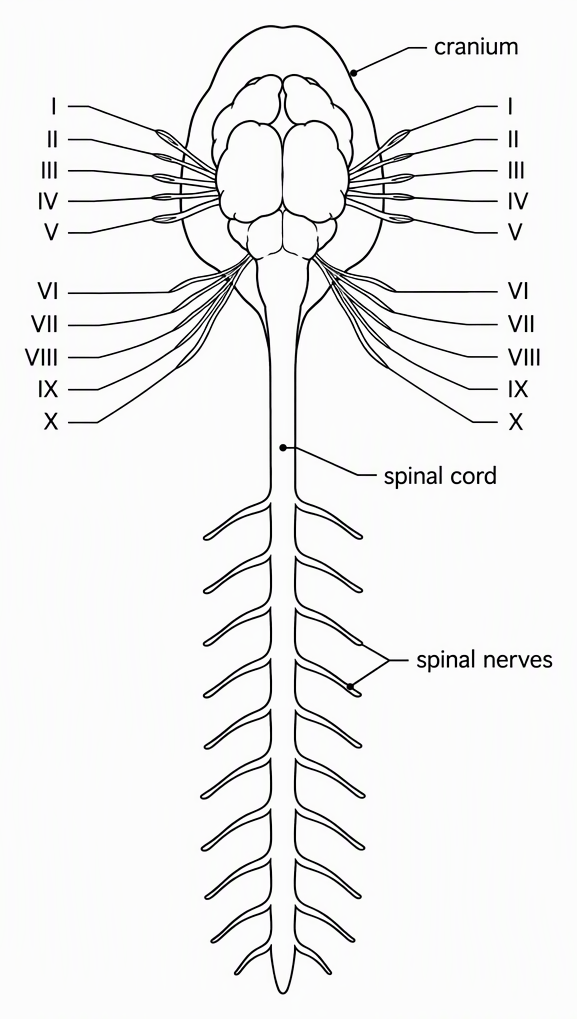
Each pair contains 2 individual nerves, so 10 pairs means 20 individual nerves. Twenty is not the requested answer: the stem asks for pairs. The brain’s three divisions provide no calculation for the ten pairs.
Why is option D, 12 pairs, wrong for a frog?
Twelve pairs is the human cranial-nerve count, not the frog count. Choosing D transfers a correct fact to the wrong organism. The error is in recalling the fact, not in arithmetic, so the repair is to check “frog” before recalling the number.
- Frog cranial nerves: 10 pairs, numbered I–X, arising from the brain.
- Human cranial nerves: 12 pairs, numbered I–XII, arising from the brain.
- Frog spinal nerves: the supplied solution also gives 10 pairs, arising from the spinal cord.
The equal frog counts do not make cranial and spinal nerves interchangeable. Their origins differ, and the stem specifically says “from the brain”.
Selecting C because you remember the spinal-nerve count reaches the correct option through the wrong reasoning. Attach the count to its origin before selecting an answer.
Related question 1: what are the divisions of a frog’s brain?
Answer: A, forebrain, midbrain and hindbrain. These are the major divisions of the brain itself. This and the next two questions are original chapter practice, not additional verified NEET PYQs.
Which set correctly names the major divisions of the frog brain?
Worked explanation: This tests subdivisions of the brain; the main PYQ tests nerves arising from it. The spinal cord is a separate central nervous system structure, while peripheral nerves are not brain regions.
Related question 2: which nerves form the frog’s peripheral nervous system?
Answer: B, cranial nerves and spinal nerves. The brain and spinal cord form the central nervous system; the nerves arising from them belong to the peripheral nervous system.
Which combination belongs to the frog’s peripheral nervous system?
Worked explanation: Cranial nerves arise from the brain; spinal nerves arise from the spinal cord. An origin question asks where nerves begin. A classification question asks which nervous-system division they belong to. Those require different facts, even when both mention the brain.
Related question 3: how many chambers are in a frog’s heart?
Answer: B, three chambers, comprising two atria and one ventricle. Apply the organism-first check again: this is a frog, not a human.
Which arrangement correctly describes the chambers of a frog’s heart?
Worked explanation: Importing the human four-chambered arrangement would incorrectly produce D. Recall the frog’s arrangement before counting its chambers.
Cover the answers and complete this retrieval check: frog cranial nerves: 10 pairs; human cranial nerves: 12 pairs; frog heart: three chambers.
Next step: the past-paper archive on NEET JEEnius AI and search past NEET papers by year, subject or chapter, each with a worked solution (100 free searches a month).
For a worked example of the same idea, see Electromagnetic Induction NEET 2005: Series LCR Solution.
Frequently asked questions
How many pairs of cranial nerves does a frog have?
A frog has 10 pairs of cranial nerves arising from its brain, numbered I–X. That means 20 individual nerves, but the answer is 10 when the question asks for pairs.
Does a frog have 10 or 12 pairs of cranial nerves?
A frog has 10 pairs; humans have 12 pairs. Check the organism before recalling the count so that you do not apply the human count to a frog.
What is the difference between cranial and spinal nerves in a frog?
Cranial nerves arise from the brain, while spinal nerves arise from the spinal cord. Both belong to the frog’s peripheral nervous system; the brain and spinal cord form its central nervous system.
What are the three major divisions of a frog’s brain?
A frog’s brain has three major divisions: forebrain, midbrain and hindbrain. These are brain regions, not categories of nerves, and their number does not determine the cranial-nerve count.
How many chambers does a frog’s heart have?
A frog’s heart has three chambers: two atria and one ventricle. The human four-chambered arrangement does not apply to a frog.