
What is the correct option for the electromagnetic induction NEET 2005 LCR question?
Option A is correct: capacitive reactance must exceed inductive reactance by exactly the resistance. In this electromagnetic induction NEET 2005 question, a resistor R, inductor L and capacitor C form one series loop driven by an AC source of frequency f. The current is 45° ahead of the source voltage, and you must find C.
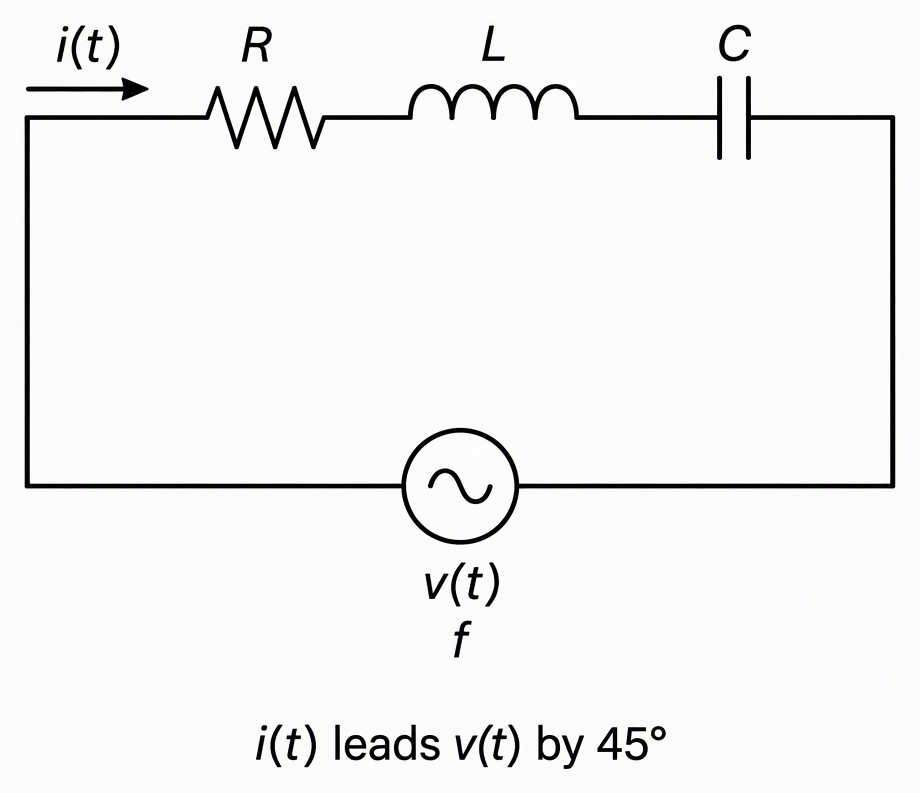
The supplied choices are:
- A
- B
- C
- D
The chapter is Electromagnetic Induction and Alternating Currents, but this problem tests AC circuit phase, not Faraday’s law. The question bank rates it hard and sets a 90-second target; neither is an official performance statistic. The worked solution below explains why the denominator needs the plus sign.
Why is the phase angle negative when current leads by 45°?
The angle is negative because the official formula measures source voltage relative to current, not current relative to voltage. Define the phase angle using that convention. Current leading voltage by 45° means voltage lagging current by 45°.
The series LCR relation is:
Therefore:
Substitute the tangent value:
Multiply both sides by resistance, then reverse the difference:
Capacitive reactance exceeds inductive reactance by exactly the resistance, with all three measured in ohms. A leading current alone establishes only that capacitive reactance is larger; the 45° condition fixes the difference. The direction of the phase shift gives the sign, while its size gives the reactance difference.
How do you calculate the capacitance and verify option A?
The denominator needs a plus sign because capacitive reactance equals inductive reactance plus resistance. Substitute the reactance formulas into that relation, then isolate capacitance.
The reactances are:
Substitute them:
Move the inductive term to the right:
Multiply both sides by angular frequency and capacitance:
Now isolate capacitance:
Convert frequency to angular frequency:
Hence:
This is option A. Replace angular frequency in both positions, outside the bracket and inside it, rather than changing only the inductive term.
Check the physics by recovering capacitive reactance:
The result is capacitive, so current leads voltage as required. Use this physical check rather than memorising “leading means plus”: reactance ordering does not depend on which phase convention you choose.
How does the wrong phase sign produce option C?
The error is inserting positive 45° into the voltage-relative-to-current formula while retaining the statement that current leads. That mixes two reference conventions. Correct algebra after this mistake still answers the wrong question.
The incorrect starting point is:
It produces:
That is option C, not the answer to the stated problem. It gives a finite positive capacitance only when:
Its inductive reactance exceeds its capacitive reactance. It therefore describes current lagging voltage by 45°.
The repair is specific: define whose phase is measured relative to whose, then assign the sign. “Leads” does not automatically mean positive in every formula.
Use NEET Silly Mistakes: Find the Cause and Fix the Check to make this a repeatable checking step. Write “voltage relative to current” beside the phase formula before substitution.
How do you solve related lagging-current, resonance and 30° questions?
Keep the voltage-relative-to-current convention and change only the stated phase condition. These are original related practice questions from the same chapter, not additional verified PYQs. Use the same angular-frequency definition throughout:
What capacitance makes current lag voltage by 45°?
With resistance, inductance and frequency unchanged, voltage now leads current. The phase angle is positive:
A finite positive capacitance requires:
For a worked numerical practice example, choose:
Check the phase:
The positive tangent confirms that voltage leads current by 45°. Current therefore lags, as requested.
What capacitance makes current and voltage stay in phase?
At the same frequency, zero phase difference requires equal reactances. This is resonance:
Compare this value with the original leading-current answer:
The original capacitance is smaller than the resonance value. That increases capacitive reactance, consistent with current leading.
What changes if current leads voltage by 30°?
Voltage now lags current by 30°, so the phase angle remains negative. Substituting its tangent gives the new reactance difference:
Before checking any answer choice, write the expected reactance ordering. For a leading-current question, reject a result that makes inductive reactance larger.
Next step: photograph a doubt on NEET JEEnius AI and photograph any question you are stuck on and get a step-by-step solution across Physics, Chemistry and Biology (20 free a month).
Frequently asked questions
What is the correct answer to the electromagnetic induction NEET 2005 LCR question?
Option A is correct: C = 1/[2πf(2πfL + R)]. Current leading voltage by 45° requires capacitive reactance to exceed inductive reactance by exactly R, giving 1/(ωC) = ωL + R, where ω = 2πf.
Why is the phase angle negative when current leads voltage by 45°?
In tan φ = (X_L − X_C)/R, φ measures source voltage relative to current. If current leads voltage by 45°, voltage lags current by 45°, so φ = −45°.
Why is option C wrong in the NEET 2005 LCR question?
Option C results from using φ = +45° in the voltage-relative-to-current phase formula. It describes current lagging voltage by 45°, not leading, and gives a finite positive capacitance only when ωL > R.
Is the capacitance for a 45° leading current smaller than the resonance capacitance?
Yes, for R > 0 at the same frequency and inductance. The leading-current value is C = 1/[ω(ωL + R)], while the resonance value is C₀ = 1/(ω²L), so C < C₀. The smaller capacitance increases capacitive reactance, consistent with current leading voltage.