
How do I find the real cause of NEET silly mistakes?
- Retry before reading the solution. Diagnose NEET silly mistakes by solving the question independently, with the answer key covered. Then explain the concept behind your answer. Recognising a solution does not prove you could have produced it yourself. If you cannot solve and explain it, repair the knowledge or recall gap first.
- Identify the first failed action. Find where your attempt first departed from a valid solution. Missing NOT/EXCEPT is a reading failure. A wrong unit or sign, or faulty arithmetic, is a solving failure. Matching the result to the wrong option is a selection failure. Entering something different from your selected option is a recording failure.
- Write a matching prevention rule. Replace “be careful” with an action at that exact point: “write the current in amperes before substitution” or “match the option label to the answer entry.” Use evidence from your working, not hindsight alone.
Keep the mistake log short enough to use after every mock:
- Template: question reference | first failed action | evidence from the working | next-time check.
- Illustrative entry: resistor practice question | used 200 milliamperes as 200 amperes | no conversion written | convert to 0.200 amperes before substitution.
The marking changes are:
A wrong-to-correct change is a five-mark swing. But not every wrong answer is an avoidable five-mark loss: some need learning, not better checking.
How do I check answers without solving every question twice?
- State what the question asks. Before solving, underline the qualifier and requested quantity in a paper-based mock: correct/incorrect, NOT/EXCEPT, magnitude/direction, or the required unit. Restate the target briefly: “find the incorrect statement” gives your reading a specific purpose.
- Solve with the relevant checkpoint. Write unit conversions and signs explicitly before substitution. Choose one check suited to the risk: dimensions for a formula, approximate magnitude for a numerical, or a known biological classification for a statement question. Do not apply every check to every question.
- Match and record the final option. Treat recording as part of solving. Follow this chain:
The official paper has 180 compulsory questions in 180 minutes. One minute per question is an overall average, including reading, recording and review, not an equal allowance for every question. A direct recall item and a multi-step numerical should not receive identical time.
I would pick targeted checks over solving everything twice because they direct review time to an identified risk. Flag an unresolved sign, uncertain qualifier or doubtful option match; revisit that step. Change an answer when you find evidence, such as a missed word or incorrect substitution, not merely because it feels suspicious.
For paper-based mocks, match the booklet question number to the OMR row, especially after a blank. Leaving one question unanswered must not shift subsequent entries.
Offline pen-and-paper OMR applies through 2026. The 2027 testing mode is not confirmed; check neet.nta.nic.in for official instructions. The read–solve–select–record routine applies in either mode.
How can a unit check prevent a wrong Physics answer?
Convert milliamperes to amperes before substitution: the answer below is C, 2 volts. This and the next two examples are constructed illustrations, not NEET previous-year questions or student performance data.
Question: A current of 200 milliamperes flows through a 10-ohm resistor. Find the potential difference.
The faulty route uses the correct formula but substitutes the unconverted current:
Apply the checkpoint before substitution. The requested quantity is voltage, and the current must be in amperes:
A quick magnitude check supports this result: a current smaller than 1 ampere through 10 ohms must produce a voltage smaller than 10 volts. Match the result to option C, not merely to a remembered option position.
Log unit conversion, not multiplication, as the first failure if you already understand the milli prefix. The multiplication in the faulty route was correct. If you cannot independently convert milliamperes to amperes, repair metric prefixes first; calling that careless hides the learning task.
How do I stop answering the opposite Biology question?
Underline NOT before judging any option: the required answer below is D, ADH. In this constructed illustration, recognising a pituitary hormone is not enough; you must check which hormone is not released by the specified part.
Question: Which hormone is NOT released by the anterior pituitary?
- A. TSH
- B. ACTH
- C. FSH
- D. ADH
The tempting failure is recognising TSH as a pituitary hormone and selecting A without processing NOT. That answers the opposite question.
Restate the target: “Find the one not released by the anterior pituitary.” TSH, ACTH and FSH are anterior pituitary hormones. ADH is synthesised in the hypothalamus and released from the posterior pituitary, so select D.
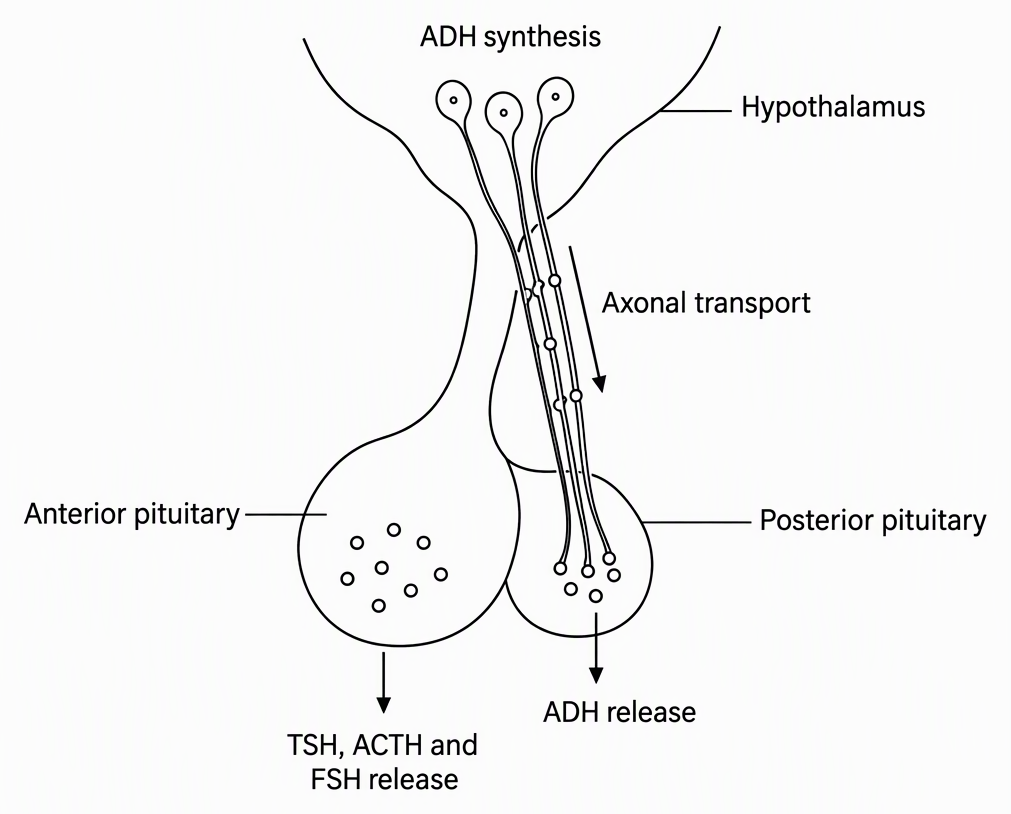
Synthesis and release are not interchangeable. Classify this as a reading slip only if you already know these hormone locations; otherwise, it is a content gap.
Biology contributes 90 of 180 questions and 360 of 720 marks. A checking routine limited to Physics calculations misses half the paper.
For fresh qualifier-check practice, NEET JEEnius AI daily practice problems provide a fresh set on a topic every day, with 20 free attempts a month.
How do I prevent correct Chemistry working from becoming a wrong entry?
Match the result to the option, then check the entry against the same question number. In this constructed illustration, the correct response is B, 10 electrons. The attempt is complete only when B is recorded in the right place.
Question: How many electrons are present in a sodium ion with atomic number 11, mass number 23 and charge positive one?
- A. 11
- B. 10
- C. 12
- D. 23
Underline electrons. A neutral sodium atom has 11 electrons; forming the positive ion removes one:
Suppose the working ends at 10, but the student records C. The prevention rule belongs at recording: match 10 to B, then verify B against the same question number.
Selecting C through the following calculation is a different failure:
That calculation counts neutrons, not electrons. Diagnose whether the student missed the requested particle or misunderstood particle counts. Do not log it as a recording slip.
For an OMR rehearsal, suppose question 41 was skipped and this sodium item is question 42. Check booklet question 42 against OMR row 42, then enter B there. Row 41 remains blank; the next answer must not move into it.
What should I practise to check whether the error is returning?
Start with your latest mock: retry relevant wrong answers without solutions, classify them and target the most repeated execution failure first. Test whether that failure returns on unseen questions, not whether yesterday’s answer now feels easy.
Use this sequence:
- Repair the underlying concept. If Physics errors expose missing concepts, use NEET Physics Revision Strategy: A 30-Day Repair Plan.
- Practise the checkpoint untimed. Write conversions before substitution, or identify the qualifier before reading options.
- Attempt fresh questions with timing. Keep the checkpoint while adding time pressure.
- Test it in a full mock. Check whether you still use it across subject changes, skipped questions and answer recording.
Repeating only the original question is insufficient. Remembering “option C” can hide whether you now convert units correctly.
For each set, record questions attempted, execution errors, and whether the targeted error returned. Compare similar sets, such as fresh current-electricity questions of similar difficulty. Fewer errors after attempting fewer questions is not automatically improvement; there is no universal error-rate benchmark to chase.
Keep entries factual and brief. Students and parents should use the log to choose the next action, not attach a “careless” label.
As an optional source of unseen practice, NEET JEEnius AI practice mode offers topic sets that skip questions already seen, with 60 free sets a month. Keep your own log and check your working.
Every recurring error needs a specific check, and every check must be tested on an unseen question.
Next step: daily practice problems on NEET JEEnius AI and get a fresh set on a topic every day (20 free attempts a month).
Frequently asked questions
How do I know if a NEET mistake is silly or a concept gap?
Retry the question independently with the answer key covered, then explain the concept behind your answer. If you cannot solve and explain it, repair the knowledge or recall gap first. If you can, use your original working to identify the first failed action in reading, solving, selecting or recording.
How can I check NEET answers without solving everything twice?
Choose a check that matches the risk: verify units before substitution, restate NOT or EXCEPT, or match your result to the option text and label. Flag unresolved steps for review rather than repeating every solution. Change an answer when you find evidence of an error, not merely because it feels suspicious.
What should I write in my NEET mistake log?
Record the question reference, first failed action, evidence from your working and a next-time check. Replace vague reminders such as 'be careful' with a specific action, such as converting milliamperes to amperes before substitution. Test that checkpoint on unseen questions, then under timing and in a full mock.
How do I avoid OMR mistakes after skipping a question?
In paper-based mocks, match the booklet question number to the OMR row before recording your selected option, especially after a blank. If you skip question 41, leave row 41 blank and record question 42 in row 42. Check the chain from final result to option text, option label and matching answer entry.