
How should I revise Physics in the last month for NEET?
Repair partly understood topics before rebuilding chapters with several missing prerequisites. Your neet physics revision strategy should follow one daily loop: recall formulas without looking, solve timed questions, diagnose errors and retest later. Start with about three focused Physics hours within an eight-hour study day, a planning recommendation, not a universal requirement. Protect daily Biology and Chemistry revision.
This plan is for students who have studied much of the syllabus but cannot yet use it reliably. It is not a timetable for completing an untouched syllabus.
What does an eight-hour NEET revision timetable look like?
Use two 90-minute Physics blocks, three hours of Biology and two hours of Chemistry. The first Physics block repairs one weakness; the second tests recall and application under a timer. This is a full-day revision template for students with no school or coaching commitments during these hours, not eight extra hours after classes.
- 07:00–08:30 | Physics
Task: 20 minutes of closed-book formula recall, 40 minutes repairing one selected concept and 30 minutes of targeted questions.
Required output: Checked recall, an explanation of the repaired idea and reviewed targeted attempts.
- 08:45–10:15 | Biology
Task: Recall a selected NCERT portion without looking, check against NCERT, then answer MCQs.
Required output: Corrected omissions and reviewed MCQ errors.
- 11:00–12:00 | Chemistry
Task: Numerical practice, reaction recall or NCERT-based factual revision, chosen from your errors.
Required output: Reviewed calculations, a checked reaction sequence or corrected factual recall.
- 14:00–15:30 | Physics
Task: 45 minutes of timed mixed questions, 30 minutes of solution analysis and 15 minutes of due mistake retests.
Required output: Attempt record, error categories and retest results.
- 16:00–17:30 | Biology
Task: Recall another selected portion, verify against NCERT and solve MCQs.
Required output: Checked recall and explanations for wrong or guessed answers.
- 18:00–19:00 | Chemistry
Task: Alternate among numerical, reaction and factual work according to unresolved errors.
Required output: A reviewed practice set and the next repair task.
Checked totals: Physics 3 hours, Biology 3 hours, Chemistry 2 hours, giving 8 focused hours. The gaps are for meals, rest and other responsibilities, not hidden study assignments.
For a five-hour day, use Physics 2 hours, Biology 2 hours and Chemistry 1 hour. Divide Physics into 15 minutes of recall, 25 minutes of repair, 35 minutes of timed questions, 30 minutes of analysis and 15 minutes of retests.
Shorten the question set before cutting error analysis. Shorten the work, not sleep, and move the clock times around existing commitments. Full-mock days replace this timetable; they are not added on top.
How should I divide time between Physics, Chemistry and Biology?
Keep Biology daily and adjust the Physics-Chemistry balance using recoverable errors from full mocks. The sample allocation gives extra attention to Physics because that is the repair problem here. It assumes Chemistry is relatively stable; study time need not mechanically follow each subject’s share of marks.
The supplied current paper split is:
- Physics: 45 questions, 180 marks.
- Chemistry: 45 questions, 180 marks.
- Biology: 90 questions, 360 marks.
- Total: 180 questions, 720 marks.
Biology carries half the questions and half the marks. Letting its recall weaken while rescuing Physics can damage your total.
The sample hour split, in Physics-Chemistry-Biology order, is:
Treat this as a temporary repair allocation, not the ideal for everyone. After each full mock, check the cause of lost marks. If repeated Chemistry errors are recoverable while Physics is stable, transfer 30 minutes from Physics to Chemistry, rather than extending the day.
Separate weak understanding from weak execution. A student who cannot explain force directions needs concept repair; a prepared student making arithmetic, reading or pacing errors needs controlled drills and timed decisions. Use the same block, but change its task.
For the Chemistry adjustment, use NEET Chemistry Revision Strategy: A 30-Day Repair Plan. Keep a separate Chemistry repair queue so its allocated time has a definite job.
What mistakes waste the last month of Physics revision?
Passive formula reading, lecture marathons and unreviewed question sets leave recall and application untested. Judge a revision block by what you can explain and solve afterwards, not by pages read or questions attempted. Review guessed and unusually slow correct answers as well as wrong ones: a correct option alone does not show a reliable method.
- Reading formulas passively: Recognition is not recall. Close the sheet, reproduce the relationship and state when it applies before checking. A formula recalled without its conditions is unfinished revision.
- Watching lectures all day: Use a short explanation to answer one diagnosed question. Then return to problems; do not restart a chapter playlist because one application went wrong.
- Counting questions without reviewing them: Review wrong answers, guessed answers and unusually slow correct answers. Record the failed step, not just the question number or correct option.
- Making an elaborate new formula notebook: That is a production task. Annotate existing material with missing conditions, units and recurring traps instead of copying what you already own.
- Following predicted high-weightage lists: This article has no verified chapter-frequency data to justify rankings. Predictions are not a defensible reason to abandon the rest of the current syllabus.
- Immediately repeating familiar questions: You may remember the answer rather than the method. Use a delayed retest, followed by a fresh question testing the same idea.
- Carrying every missed block forward: An unfinished Tuesday must not create an overnight backlog. Keep Wednesday’s scheduled retests and move only the highest-priority unfinished repair into the next available slot.
Choose a repair small enough to finish and specific enough to test. Replace “revise magnetism” with “fix which angle belongs in magnetic flux”.
How do I decide which Physics topic to revise next?
Start with a recent analysed mock and select the next weakness from its errors. If you have no usable paper, take a 45-question mixed Physics diagnostic with a suggested 60-minute cap. That cap is a practice choice, not an official sectional limit. Analyse the paper before choosing chapters or opening lectures.
Classify each sampled topic by what you can currently do:
- Secure: You can solve and explain the method. Maintain it through mixed practice.
- Repairable: A specific recall, concept or execution gap blocks you. Give it the first repair slots.
- Foundation-heavy: Several prerequisites are missing. Give it bounded attention, not several uncontrolled days.
Choose a repeated, identifiable error in a partly understood topic first. If two repairs compete, start with the one you can fix and test within the next block. For foundation-heavy work, use one scheduled concept block to identify the missing prerequisite, then reassess.
Use these error categories: missing formula or condition; conceptual misunderstanding; diagram or sign error; unit or arithmetic error; misreading; pacing. “Careless” does not tell you what to practise.
Keep an error log with topic, error type, evidence, next repair and retest date. These are illustrative entries, not student performance data:
- Topic: Magnetic flux. Error type: Missing condition. Evidence: Used the angle to the surface. Next repair: Label the normal and solve fresh applications. Retest date: Day 5.
- Topic: Current electricity. Error type: Unit error. Evidence: Substituted milliamperes as amperes. Next repair: Convert units before substitution. Retest date: Day 6.
- Topic: Kinematics. Error type: Misreading. Evidence: Found distance when displacement was asked. Next repair: Identify the requested quantity before calculating. Retest date: Day 6.
Knowing the magnetic-flux formula but confusing the angle to the surface with the angle to its normal calls for a labelled sketch and fresh applications. It does not call for a complete electromagnetism lecture.
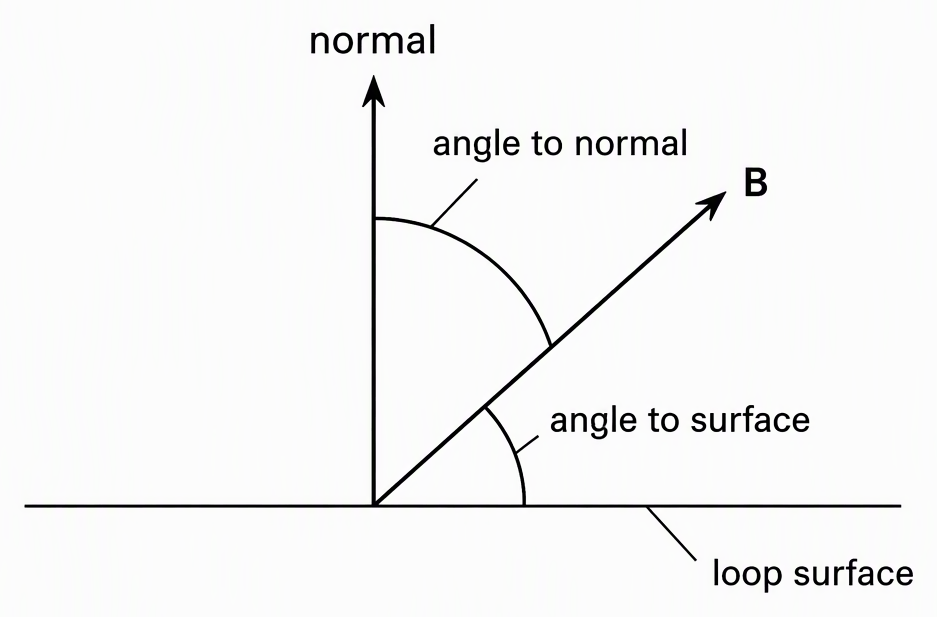
For every recalled formula, check the relationship, symbol meanings, units, applicability conditions and one common trap. Verify notes and older previous-year questions against the current official syllabus at neet.nta.nic.in.
Use Electromagnetic Induction Practice Questions NEET: 5 Solved MCQs for applications, not complete chapter coverage. Exit the repair queue only when you can explain why the original method failed and solve a fresh variant later, not when you have watched the solution.
How should I organise the 30 days and schedule retests?
Move from diagnosis towards more mixed timed work, while keeping recall and retests active throughout. These are shifts in emphasis: mixed questions begin early, and serious concept errors still get repaired late. Each evening, choose tomorrow’s targeted topic from the repair queue. Rotate mixed sets through your entire current Physics syllabus rather than repeatedly choosing favourite chapters.
- Days 1–2: Audit and diagnose. Check syllabus coverage, analyse a recent paper or use the diagnostic, and build the first repair queue. Separate topics you have forgotten from topics you never understood.
- Days 3–16: Repair selected weaknesses. Keep the two-block structure. Give repairable topics first attention, maintain secure topics through mixed questions and check whether each repair survives a delay.
- Days 17–24: Increase mixed timed work. Shift some concept time into mixed questions when understanding is stable. Do not increase question volume by removing solution analysis.
- Days 25–28: Consolidate repeated errors and execution. Work on recurring conditions, sign choices, calculations, reading and time losses. Repair serious conceptual gaps with a narrow task rather than ignoring them because the month is ending.
- Days 29–30: Taper. Use compact formula-and-condition recall, selected previously repaired errors and light familiar practice. Avoid a new resource, a major untouched chapter or an exhausting last-minute mock.
Full mocks on Days 2, 9, 16, 23 and 27 are a workable sample cadence, not a compulsory number or a guaranteed route to a score. Each replaces the normal day.
Retest repaired errors after 1, 3, 7 and 14 days, where those intervals fall before the exam. An error repaired on Day 4 returns on Days 5, 7, 11 and 18. For late errors, arrange a next-day check and another before the exam where feasible.
NEET JEEnius AI’s free mistake notebook automatically saves every wrong question and returns it at 1, 3, 7 and 14 days until marked mastered. A paper log can support the same habit.
If a retest fails, return the error to the queue. Do not mark the chapter complete because its scheduled block is over.
How should mocks change my Physics revision plan?
Use each mock to choose the next repair, not merely record a score. Track Physics correct, wrong and unattempted counts; time spent; repeated error categories; and delayed-retest results. Use these to separate understanding, execution and pacing problems, and to check whether earlier repairs held when the topic returned among unrelated questions.
The supplied current pattern is 180 compulsory single-correct MCQs in 180 minutes, with no optional Section B. No optional section does not mean you must guess every answer.
An unreasoned guess is not evidence of a repaired topic, even when correct. Include it in analysis.
Use this eight-hour mock-day replacement:
- Full paper: 3 hours.
- Analysis: 2 hours.
- Physics repair: 1 hour.
- Biology revision: 1 hour.
- Chemistry revision: 1 hour.
Turn the evidence into a task:
- Repeated concept errors: Assign targeted explanation and applications.
- Repeated execution errors: Assign short drills on units, signs, calculation or reading.
- Repeated time losses: Practise question selection and pacing.
The diagnostic’s 60-minute Physics cap is not an official sectional limit. Test subject order and time allocation in full papers, not on exam day.
Match answer-recording practice to the officially confirmed format for your exam year. The supplied format is offline pen-and-paper OMR through 2026; a future computer-based transition is not confirmed. Check neet.nta.nic.in before changing how you practise.
Before tomorrow:
- Analyse one paper.
- Select one repair topic.
- Schedule its retest.
- Protect Biology and Chemistry blocks.
Should I restart Physics lectures in the last month?
Use a short explanation for one diagnosed gap, not a full restart. Return to questions immediately afterwards. If several prerequisites are missing, classify the topic as foundation-heavy and keep its work bounded.
Can I revise only important Physics chapters?
Do not abandon coverage based on predicted chapter lists. Prioritise personal repairs, but rotate mixed practice through the current syllabus.
Are three hours of Physics compulsory every day?
No. Three hours is the full-day recommendation here, while the shorter plan uses two. Review the allocation after mocks and transfer time between subjects instead of extending the day.
What should I do if I miss a revision day?
Keep the next day’s scheduled retests and both other subjects. Move only the highest-priority unfinished Physics repair into the next available block, and set its new retest date before starting.
Next step: the mistake notebook on NEET JEEnius AI and every question you get wrong is saved automatically and returned to you at 1, 3, 7 and 14 days until it is marked mastered (free).
Frequently asked questions
Which Physics topics should I revise first in the last month?
Start with repeated, identifiable errors in partly understood topics from a recent analysed mock. Prioritise a gap you can repair and test within one study block. Maintain secure topics through mixed practice and give topics with several missing prerequisites bounded attention.
How many hours should I study Physics daily for NEET revision?
The eight-hour revision template allocates three hours to Physics, three to Biology and two to Chemistry. For a five-hour day, use two hours each for Physics and Biology and one for Chemistry. These are planning recommendations, not compulsory targets; adjust the allocation using recoverable errors from mocks.
How often should I retest Physics mistakes?
Retest repaired errors after 1, 3, 7 and 14 days where those intervals fall before the exam. For example, a repair completed on Day 4 returns on Days 5, 7, 11 and 18. If a retest fails, return the error to the repair queue rather than marking it complete.
What should I do if I miss a NEET revision day?
Keep the next day's scheduled retests and Biology and Chemistry revision. Move only the highest-priority unfinished Physics repair into the next available block, and set its new retest date before starting. Do not carry every missed task forward or cut sleep to clear the backlog.