
Which free electromagnetic induction practice questions should I use for NEET?
For free electromagnetic induction practice questions for NEET, start with solved chapter MCQs if concepts are uncertain. Use authenticated NEET PYQs to check exam-style application, and full mocks to test performance alongside the rest of the syllabus. None replaces the other two.
Below are five original, free, single-correct MCQs with worked solutions. They diagnose reasoning errors; they are not official NEET questions or a complete chapter test.
How do solved chapter MCQs, NEET PYQs and free full mocks compare?
Chapter questions isolate reasoning errors, authenticated PYQs test actual exam wording, and full mocks test decisions across subjects. Choose by the problem you need to solve, not by question count.
- Purpose
- Original solved MCQs here: Diagnose flux, direction, motional emf and self-induction errors.
- Authenticated NEET PYQs: Check application using actual exam wording.
- NEET JEEnius AI full-length mocks: Use these to test performance within a complete paper.
- EMI focus
- MCQs here: Five EMI questions.
- PYQs: Chapter filtering depends on the source.
- Mocks: Full-syllabus papers, not verified EMI-only sets. No fixed EMI question count per mock is established.
- Explanations
- MCQs here: Worked reasoning below.
- PYQs: Worked-solution availability depends on the source; official keys establish answers.
- Mocks: A scored per-subject breakdown is provided, not a claim of worked explanations.
- Exam context
- MCQs here: Original, isolated concept checks.
- PYQs: Authentic wording when checked against the original paper and official key.
- Mocks: Each paper has 180 questions, 720 marks and 180 minutes.
- Free access
- MCQs here: All five questions and explanations are on this page.
- PYQs: Free access depends on the source.
- Mocks: NEET JEEnius AI provides 30 free full-length mocks a month.
- Main limitation
- MCQs here: Diagnosis, not comprehensive chapter coverage.
- PYQs: Remembered answers can conceal weak reasoning.
- Mocks: A Physics score alone cannot establish EMI mastery.
Which practice route should Class 11, Class 12 students and droppers choose?
Choose by demonstrated difficulty, not class label. If you confuse the flux angle, cannot establish current direction or select a formula without identifying what changes, solved chapter MCQs are the best next step. A full-paper score cannot explain or repair those errors by itself.
- Class 11 students studying ahead: Secure vectors, magnetic-field direction and basic circuit reasoning first. A weak area-vector concept is not a speed problem.
- Class 12 students: Choose PYQs when you can explain chapter examples independently but struggle to interpret actual exam wording. Return to targeted questions when your reasoning breaks down.
- Droppers: Derive or explain familiar PYQ answers afresh before counting them as mastered. Recognising an option is weaker evidence than reproducing the reasoning.
Choose full mocks when EMI answers are reliable in isolation but Physics performance deteriorates during a complete paper. Check pacing, question selection and attention across subjects before assuming you need another chapter worksheet.
Can I try five free electromagnetic induction MCQs now?
The five questions below are original practice, not PYQs, and every question has one correct option. Attempt them before reading the next section, which contains the answer key and explanations.
This is a diagnostic sample, not a complete EMI test or a prediction of likely NEET questions. Treat all listed quantities as positive where applicable:
Write one sentence explaining each choice. A correct option without reasoning may be a guess.
1. What is the magnetic flux through a tilted plane loop?
A plane loop lies in a uniform magnetic field. Its area, field magnitude and angle between the area normal and the field are respectively:
Choose the magnetic flux through the loop.
2. What current flows when a perpendicular magnetic field increases?
A stationary single-turn loop has the area and total resistance given below. A spatially uniform field perpendicular to its plane increases at a constant rate. Neglect self-inductance and choose the induced-current magnitude.
3. Which way does current flow when a north pole approaches a loop?
A bar magnet’s north pole approaches a stationary conducting loop along its axis. Choose the induced-current direction as viewed from the approaching magnet’s side.
- (a) Clockwise
- (b) No current
- (c) Anticlockwise
- (d) Cannot be determined without the magnet’s speed
4. Can a moving isolated rod develop a potential difference?
An isolated straight conducting rod moves through a uniform magnetic field. The rod, velocity and field are mutually perpendicular. Its length, speed and field magnitude are:
Choose the magnitude of the end-to-end potential difference after charge redistribution.
- (b) Zero because there is no closed circuit
5. What is the self-induced emf when current increases steadily?
Current through an ideal inductor increases at a constant rate. The inductance and current-change rate are:
Choose the magnitude of the self-induced emf, not its signed value.
What are the answers, and what does each mistake reveal?
The correct options are 1(b), 2(d), 3(c), 4(a), 5(d). Explain a correct guess before treating the concept as secure. Use each mistake to choose a repair task, not to predict a NEET score or claim complete chapter mastery.
Why does Question 1 use cosine rather than sine?
Magnetic flux is the dot product of the magnetic field and the area vector. The angle is measured from the normal, not the plane.
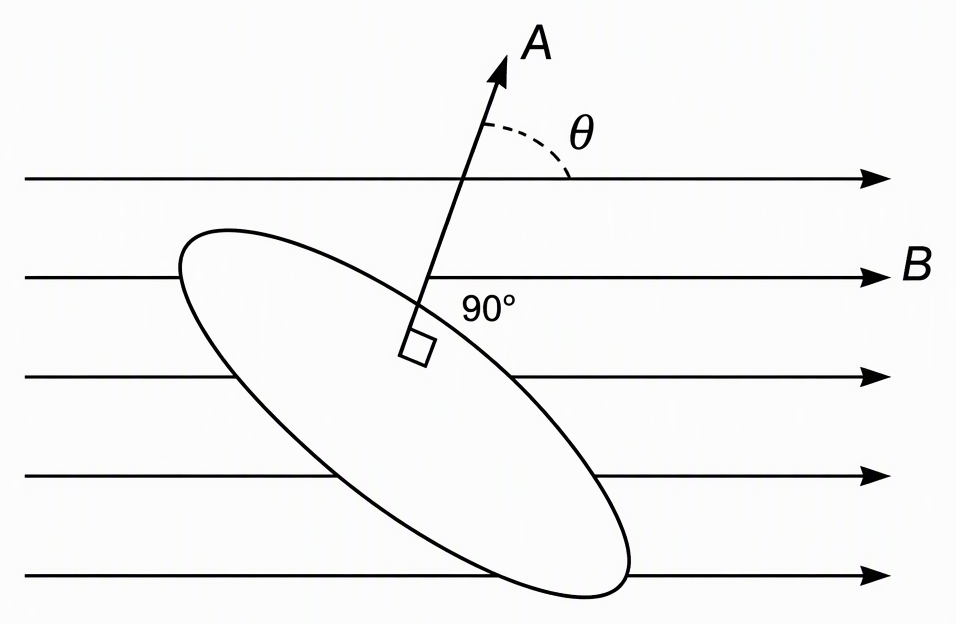
Repair: Redraw the normal before substituting; convert an angle given with the plane to its complementary angle. Sine uses the plane angle, while maximum flux and zero flux apply only at special orientations.
Why is the answer to Question 2 current rather than just emf?
Faraday’s law gives induced emf. Ohm’s law converts that emf into current using the total resistance.
Repair: Separate the two laws. Zero is incorrect because flux changes even though the loop is stationary; the other expressions incorrectly increase current with resistance.
Why is the answer to Question 3 anticlockwise?
The induced current opposes the increasing flux from the approaching north pole, making the loop’s near face north. From the magnet’s side, this requires anticlockwise current.
Repair: State the viewpoint before applying the right-hand rule. Clockwise reinforces the change; no current ignores changing flux; speed affects magnitude, not this direction.
Why is the answer to Question 4 nonzero without a circuit?
Magnetic force separates charges along the moving rod. Redistribution continues until the electric and magnetic forces balance in magnitude.
Repair: Distinguish potential difference from sustained current. Charge separation needs no closed circuit; dividing by speed or length gives the wrong dependence and dimensions.
Why does Question 5 ask for a positive magnitude?
The question asks how large the emf is, not its direction. Self-induced emf depends on the rate of current change:
The minus sign expresses opposition to current change, not a negative magnitude. Repair: Identify the changing quantity; zero requires no current change, while the reciprocal options fail dimensional checking.
When are authenticated NEET PYQs the better next step?
Move to PYQs when you can justify the diagnostic answers without copying solutions or merely recognising options. At that stage, actual exam wording tests application better than another set of identical formula substitutions.
- Authenticate the question. Check the exam year, paper or booklet identification where applicable, and the official answer key. Use official NTA material at neet.nta.nic.in for verification.
- Solve before opening the key. An official answer key establishes the accepted option. A publisher’s worked explanation is separate and must still make physical sense.
- Record the error. Write the physical change, applicable law and reason your chosen option failed.
- Re-solve independently. Close the explanation and reproduce the argument.
For a remembered answer, reverse the viewing direction or ask what happens when motion or field variation stops. Repeated exposure to a small collection can build recognition without independent reasoning. Count a question as secure only when you can explain such a change.
What should I check before choosing more free EMI practice?
Check whether you need conceptual repair, actual exam wording or full-paper practice. The questions below address authenticity, daily volume and direction errors.
Are these official NEET previous-year questions?
No. This page supplies five original questions with worked solutions, not an official previous-year compilation. Authenticate a claimed PYQ against its original paper and official key.
Are PYQs alone enough for electromagnetic induction?
No. PYQs provide authentic exam practice, but repeated conceptual errors need targeted repair. Full-paper performance also requires practice alongside Chemistry and Biology.
How many EMI questions should I solve daily?
There is no universal daily quota. Progress when you can solve and explain fresh questions independently, not after reaching a count through familiar substitutions.
How do I stop making Lenz’s-law direction errors?
Write the viewing direction and identify the flux change being opposed before choosing clockwise or anticlockwise. Without those statements, the same physical current can receive opposite labels when viewed from opposite sides.
When does a free full mock add value?
Full-paper practice adds value after targeted repair, or when the main difficulty is maintaining accuracy and managing decisions across subjects. Do not use a complete paper as the first response to one unresolved Lenz’s-law error. Fix that reasoning locally before testing it within a full paper.
The current NEET pattern is 180 compulsory single-correct questions in 180 minutes for 720 marks, with no optional section:
- Physics: 45 questions.
- Chemistry: 45 questions.
- Biology: 90 questions.
Marking is +4 for a correct answer, −1 for a wrong answer and 0 for an unattempted question. The paper-wide average is one minute per question, not a compulsory limit for every Physics question.
For this stage, NEET JEEnius AI provides 30 free full-length mocks a month, each following that question, mark, duration and subject structure, with a scored per-subject breakdown. Use the Physics score to assess subject performance, then separately review relevant EMI mistakes; the score does not isolate chapter mastery.
Follow this sequence: repair the specific error, check transfer on authenticated PYQs, then test within a complete paper.
Next step: full-length mock tests on NEET JEEnius AI and sit a full 180-question, 720-mark, 180-minute paper, 45 Physics, 45 Chemistry and 90 Biology, and get a scored per-subject breakdown (30 free a month).
Related on NEET JEEnius AI: Embryo Sac Structure NEET 2026: Anther Counts Explained.
Frequently asked questions
Where can I find free electromagnetic induction questions for NEET with solutions?
This article provides five free, original, single-correct MCQs with worked solutions covering magnetic flux, induced current, Lenz's law, motional emf and self-induction. Use them to identify reasoning errors, not as a complete chapter test.
Are these official NEET previous-year questions?
No. These five questions are original practice MCQs, not official NEET PYQs. Verify any claimed PYQ against the original exam paper and official answer key.
Are PYQs alone enough for electromagnetic induction in NEET?
No. Authenticated PYQs test actual exam wording, but recurring conceptual errors need targeted practice with explanations. Full mocks serve a separate purpose: testing accuracy, pacing and question selection across Physics, Chemistry and Biology.
How many electromagnetic induction questions should I solve daily?
There is no universal daily quota. Judge progress by whether you can solve and explain fresh questions independently, rather than by a count of familiar substitutions. Repair recurring errors before increasing question volume.
How do I avoid Lenz's-law current direction mistakes?
State the viewing direction and identify the magnetic flux change being opposed before choosing clockwise or anticlockwise. Then apply the right-hand rule. The same physical current appears clockwise from one side of a loop and anticlockwise from the other.