How many theca are present in each lobe of a typical anther?
A) 2 is the keyed answer for the “Embryo Sac Structure” NEET 2026 question. The supplied topic label is misleading: this is an anther question from Sexual Reproduction in Flowering Plants, not a female-gametophyte question.
The supplied question bank identifies this single-correct Biology item as NEET 2026, re-held on 21 June 2026, Code-50. “Medium” is the question bank’s difficulty classification, not an official exam rating.
Consider a typical flowering-plant anther with two lobes. Determine the number of theca assigned to just one lobe, keeping that scope separate from the whole anther.
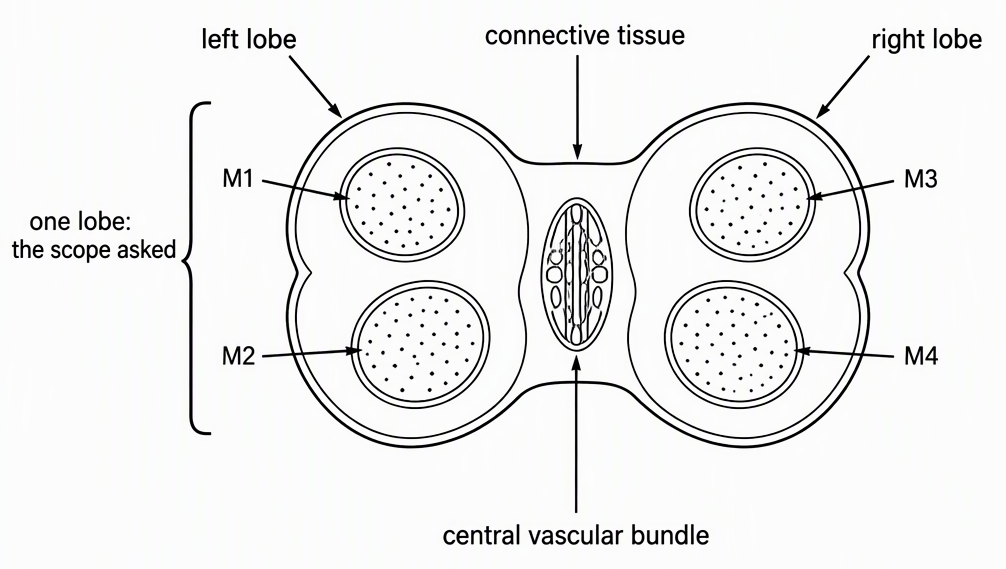
How many theca are present in each lobe of a typical bilobed angiosperm anther?
What exactly should I count in this question?
Count theca, and restrict the answer to each lobe. Do not count lobes, microsporangia, pollen mother cells or microspores. Identify the unit and scope before choosing a number.
“Bilobed” describes the whole anther. It does not tell you to multiply the requested per-lobe count by two. That would change the scope from one lobe to the whole organ.
The figure locates the lobes and microsporangia; it does not establish a conversion between microsporangia and theca. The requested thecal count is settled by the NCERT wording used in the supplied solution. This is a factual-recall solution, so no algebra is needed.
Which NCERT statement gives the answer A) 2?
The decisive statement, attributed in the supplied solution to NCERT Class 12 Biology, Sexual Reproduction in Flowering Plants, describes a typical angiosperm anther as bilobed, with two theca in each lobe. Applying that statement directly gives A) 2.
Match the requested quantity to the stated count:
- Requested quantity: theca in one lobe.
- Stated count for one lobe: two.
- Therefore, choose: A) 2.
B) 6, C) 8 and D) 12 do not match the directly stated per-lobe count. Reject them on that basis, without constructing extra counting steps.
A separate structural check is useful: a typical anther has four microsporangia in total, with two in each lobe. Keep this fact separate from the requested thecal count.
The supplied commentary’s secondary theca-to-microsporangia counting chain is internally inconsistent, so do not use it to derive the total. The keyed result follows from direct NCERT recall, not from multiplying together anatomical counts.
Why would multiplying by meiotic products give the wrong answer C) 8?
Multiplying the required count of two by the four products of meiosis gives eight, but it combines different kinds of quantities. This is a possible incorrect calculation, not a claim about how often students choose option C.
The wrong calculation lands on C) 8. Its arithmetic is correct, but the biological operation is invalid:
Theca are anatomical structures. The four microspores in a tetrad are cellular products of one pollen mother cell undergoing meiosis. Meiotic products provide no conversion factor from theca to theca, and a pollen sac is not equivalent to one pollen mother cell.
Before multiplying, name what each number counts. Then check whether the operation still answers the requested unit and scope. Here, the question asks for theca in one lobe, so introducing microspore production cannot help.
How can I separate anther counts from embryo-sac counts in practice?
Use the named structure to select the relevant fact: microsporangia belong to anther anatomy, while egg cells and polar nuclei belong to the embryo sac. These three questions are related practice questions, not additional verified PYQs. They test both structures without treating the original anther question as an embryo-sac question.
How many microsporangia occur in a typical bilobed anther?
Four microsporangia occur in the whole anther. Multiplication is valid here: the question asks for both lobes, and each lobe has two microsporangia.
How many cells and nuclei are in a typical mature Polygonum-type embryo sac?
Seven cells and eight nuclei are present before polar-nuclear fusion. Count the central cell once as a cell, but count its two polar nuclei separately.
- One egg cell contains one nucleus.
- Two synergids contain two nuclei.
- Three antipodals contain three nuclei.
- One central cell contains two polar nuclei.
Where are the egg apparatus and antipodals located?
The egg apparatus is at the micropylar end, while the antipodals are at the chalazal end. The egg apparatus consists of one egg cell and two synergids, not the egg cell alone.
Use the NEET Biology Revision Strategy: A 30-Day NCERT Plan to revise these counts. Before answering, mark the structure and scope: anther questions concern male reproductive anatomy; embryo-sac questions concern the female gametophyte. Their numerical facts are not interchangeable.
Frequently asked questions
How many theca are present in each lobe of a typical anther?
The supplied question bank keys A) 2, using the NCERT statement cited in its solution that each lobe has two theca. The question asks for the count in one lobe, so do not multiply it by the number of lobes or by meiotic products.
How many microsporangia are present in a typical bilobed anther?
A typical bilobed anther has four microsporangia in total, with two in each lobe. Keep this structural count separate from the thecal count requested in the supplied question.
How many cells and nuclei are in a mature embryo sac?
A typical mature Polygonum-type embryo sac has seven cells and eight nuclei before polar-nuclear fusion. It contains one egg cell, two synergids, three antipodals and one central cell. The central cell counts as one cell but contains two polar nuclei.
Where are the egg apparatus and antipodals located in the embryo sac?
The egg apparatus lies at the micropylar end, while the antipodals lie at the chalazal end. The egg apparatus consists of one egg cell and two synergids, not the egg cell alone.