
How should I revise Biology in the last month for NEET?
Recall, questions and targeted NCERT repair should drive your neet biology revision strategy, not repeated cover-to-cover reading alone. Use a daily cycle of closed-book recall, NCERT checking, MCQs and scheduled mistake review. Four hours of Biology within eight net study hours is a sample workload, not a universal requirement. Every topic in the current official syllabus needs a coverage check; repeated revision should follow demonstrated weaknesses.
What should my daily timetable and 30-day Biology plan look like?
Use the daily timetable below, changing topics according to recall and test errors. It gives Biology four hours while protecting Physics and Chemistry. All timings and mock intervals are recommendations, not official requirements or measured success rates. Move the clock times to fit your commitments, but keep question review.
Ordinary day: time, task, net duration and observable output
- Time: 08:00–10:00. Task: Biology closed-book recall followed by targeted NCERT repair. Net duration: Two hours. Observable output: Checked topic list and corrected recall gaps.
- Time: 10:00–12:15. Task: Physics concept repair, problems and review. Net duration: Two hours. Observable output: Reviewed solutions and a recorded reason for each unresolved error.
- Time: 13:00–15:00. Task: Chemistry recall, questions and correction. Net duration: Two hours. Observable output: Corrected facts, reactions or calculation steps.
- Time: 15:30–17:00. Task: Biology MCQs and explanation review. Net duration: 90 minutes. Observable output: Answers classified as wrong, guessed, slow or confident.
- Time: 19:00–19:30. Task: Biology due mistakes and diagram or table recall. Net duration: 30 minutes. Observable output: Reviewed corrections and an updated next-action list.
The Biology blocks total four hours:
The full day totals eight net study hours:
All gaps are breaks, meals or personal time. They are not hidden revision slots, and bedtime is not a spare block for unfinished questions.
Monthly sequence: days, task and completion evidence
- Day 1: Audit existing test errors against the current official syllabus. Output: a topic checklist showing checked topics, unchecked topics and known weaknesses.
- Days 2–14: Give remaining topics their first coverage check. Output: recall evidence and reviewed questions, rather than ticks based on reading.
- Days 15–23: Revisit weak and uncertain topics with mixed practice. Output: previously missed distinctions answered without cues.
- Days 24–28: Emphasise test-led repair. Output: corrections linked to recent mistakes, including those from full papers.
- Days 29–30: Taper the workload. Output: manageable reviews of compact recall material, with no expanding backlog.
A coverage check is a brief recall-and-question check, not a promise to relearn every chapter in 13 days. Split larger topics across several blocks and combine smaller familiar topics. On day 1, distribute unchecked topics across the available ordinary mornings; move unfinished checks forward rather than marking them complete.
Use full-paper mocks on days 7/30/2014 as an adjustable planning example. These intervals are not an evidence-backed optimum. Reduce or move a mock if its analysis would remain unfinished.
Replacement mock-day schedule
- Time: 08:00–11:00, full-paper mock; 11:30–13:30, cross-subject analysis; 14:30–16:30, Biology repair; 17:00–18:00, weakest Physics or Chemistry issue. Net duration: Three, two, two and one hours respectively. Observable output: Completed paper, classified errors, repaired Biology gaps and one reviewed non-Biology issue.
This replaces the ordinary timetable. The Biology MCQ block and evening review are not extra obligations on top of it.
How do I protect Physics and Chemistry while giving Biology enough time?
Start with half your available study time for Biology, but adjust it using errors across all three subjects. Biology carries half the paper’s marks, making this a reasonable starting point. Exam weight alone does not determine study time: learning speed, unfinished work and current weaknesses differ.
Official subject allocation
- Biology: 90 questions, 360 marks.
- Physics: 45 questions, 180 marks.
- Chemistry: 45 questions, 180 marks.
Within Biology, Botany and Zoology have 45 questions each. Check coverage in both, but do not force an equal daily repair split. A day spent repairing weak Botany is sensible if Zoology is being recalled reliably and still receives mixed checks.
For six available net hours, use this suggested alternative:
- Biology: Three hours, retaining recall, NCERT repair, MCQs and mistake review.
- Physics: 90 minutes of focused problems and correction.
- Chemistry: 90 minutes of recall, questions and correction.
Reduce question volume before cutting explanation review. Without review, you cannot distinguish missing knowledge from a misread question.
If Physics or Chemistry remains weak, reassign a block from Biology topics already recalled independently after a gap. Protect weak Biology topics rather than cutting all Biology work equally. Use NEET Physics Preparation: A 90-Minute Daily Plan to structure a protected Physics block.
Count coaching, school and test commitments before choosing your net self-study target. The eight-hour example assumes a largely available day; it is not an extra requirement after school. Choose the workload from your available hours, then retain recall and correction within that limit.
What mistakes can make this revision plan fail?
Passive rereading, unchecked MCQs and mocks added to an already full day can crowd out recall, correction and rest. Judge progress by whether previously uncertain material can be recalled and answered without cues. When that evidence is missing, change the task rather than adding more hours.
- Passive rereading: Recognising an NCERT sentence is not the same as recalling it. Close the book and reproduce the fact, sequence or distinction before checking. If recall fails, repair that passage rather than rereading the entire chapter automatically.
- Counting chapters finished: Replace page-count targets with a delayed check. Count previously uncertain material as secure only after you can answer it again without cues, not when you reach its final page.
- MCQ volume without analysis: Every wrong answer needs a reason and a correction. A guessed correct answer also needs checking; the score alone hides that uncertainty.
- Rigid daily quotas: A long unfamiliar chapter and a short familiar chapter should not receive equal time automatically. Divide the long chapter into bounded topics and use saved time from familiar material for unresolved gaps.
- Unsupported “high-weightage” lists: Do not skip syllabus topics because an online list assigns them few marks. Use current syllabus coverage and your own error evidence, not invented chapter-wise predictions.
- Mocks added to a full day: Replace ordinary study blocks with the mock and its analysis. If you cannot review the paper, shorten another task rather than collecting another unexplained score.
- Biology-only preparation: Improving your favourite subject does not justify letting Physics and Chemistry disappear. Keep their protected blocks unless a planned full-paper day replaces them.
- Outdated paper format: Practise the current format of 180 compulsory questions in 180 minutes, with no optional Section B. Older questions can still help, but an old paper’s instructions should not determine your current mock structure.
- Fresh notebooks, new resources and lost sleep: Keep NCERT, your existing question source and a compact correction list. If work repeatedly spills into sleep, shorten tomorrow’s task list rather than designing a more elaborate timetable.
What exactly should I do inside each Biology revision block?
Choose one bounded topic, recall what you know, check the exact NCERT wording, then test it without the book. Record the tested distinction and the reason for any error. The output should be a compact correction for later recall, not a fresh set of copied notes.
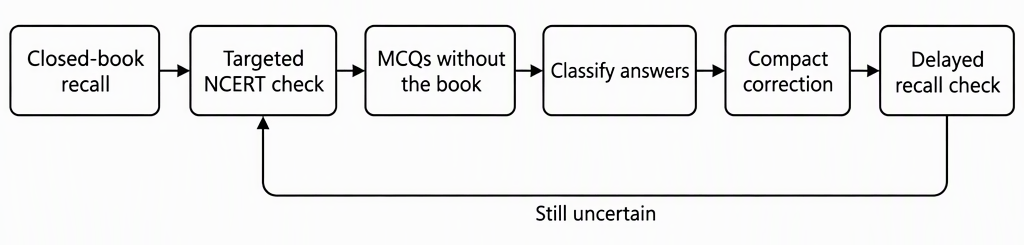
- Choose a bounded topic and recall it. Pick “population interactions” rather than “all Ecology”. Use headings, an unlabelled diagram, comparison-table headings or a sequence of events. Write or speak what you remember before opening NCERT; empty spaces reveal what needs checking.
- Check the relevant NCERT pages precisely. Look for qualifiers, examples, exceptions, diagram labels and table entries. Words such as “usually” and “only” can change a statement’s meaning. Consult a trusted explanation only where understanding remains unresolved, then return to the tested point.
- Answer questions without NCERT open. Use syllabus-aligned MCQs and relevant previous-year questions. Stop in time to review them rather than chasing a fixed questions-per-hour target. Reading explanations while attempting questions removes the recall test.
- Classify the result and diagnose the cause. Mark each answer wrong, guessed correct, slow but reasoned or confidently correct. Then separate a knowledge gap from confused alternatives or a misread stem. For slow reasoning, try another comparison task; for missing knowledge, return to the source.
- Record a compact correction. Include the tested distinction, why you missed it and the NCERT page or topic to revisit. Do not copy the entire explanation. A paper correction list is sufficient if you date the next review and attempt recall before looking.
For a worked Ecology example, recall how commensalism differs from mutualism, then name an example of each. Check NCERT’s account of an orchid growing on a mango branch. The orchid benefits from support, while the mango tree is neither benefited nor harmed.
Now answer an MCQ asking which interaction this illustrates. Commensalism is correct; mutualism is a wrong distractor because it requires both organisms to benefit. If you chose mutualism merely because two species were associated, record that reasoning error beside the corrected distinction.
Use Ecology Practice Questions NEET: 6 MCQs Explained for further practice, not as a substitute for checking all Ecology topics. When revising examples, recall the distinguishing feature, not just the organism names.
For diagrams, hide labels and state relationships between structures, including direction of movement where relevant. For tables, cover entries and reconstruct the contrasts. Test both the label and its relationship to nearby structures.
Schedule later checks of uncertain material, adjusting them to the remaining days. Reviews due after the exam do not need to be forced into an overloaded final evening.
How do I choose tomorrow’s topics and keep the final two days light?
Choose tomorrow’s work from due mistakes and unresolved recall, not whichever chapter feels comfortable. Review due mistakes and red topics first, then amber topics, while retaining brief mixed checks of green topics. In the final two days, reduce workload and use compact corrections rather than starting another exhaustive reread or a late mock you cannot analyse.
Use this tracker structure, with one entry per bounded topic:
- Topic: Population interactions.
- Syllabus coverage checked: Yes, recall and questions attempted.
- Latest error or uncertainty: Confused commensalism with mutualism.
- Correction source: NCERT, population interactions.
- Next action: Explain both outcomes without notes, then answer a fresh question.
Apply these status rules:
- Red: Unresolved wrong answers or failed recall.
- Amber: Guessed, slow or inconsistently recalled material.
- Green: Recalled independently and answered correctly again after a gap.
Keep brief mixed checks of green topics to verify retention. Move a topic back to red or amber when new errors or uncertainty appear.
Calculate your Biology practice score using official marking:
Correct answers earn four marks, wrong answers lose one, and unattempted questions score zero. Biology’s maximum is 360 marks. Track wrong, guessed and unattempted answers alongside the score; neither one good mock nor faster completion proves readiness.
Full-paper practice is 180 questions in 180 minutes. Any Biology-only time limit is your chosen training constraint, not an official subject-wise limit.
On days 29–30, use shorter sessions for the correction list, diagrams, tables, examples and manageable due reviews. Avoid a new resource, a fresh exhaustive reread or a late test that cannot be analysed. Keep this schedule relative to your confirmed exam day; check the current syllabus and official notices at neet.nta.nic.in.
If major portions remain unfinished, call the task selective recovery, not revision. Identify the gaps honestly and choose feasible repairs; one month does not guarantee complete mastery. Tonight, list tomorrow’s due mistakes, choose the first unresolved red topic and name the NCERT passage to check after closed-book recall.
Next step: the mistake notebook on NEET JEEnius AI and every question you get wrong is saved automatically and returned to you at 1, 3, 7 and 14 days until it is marked mastered (free).
Frequently asked questions
How many hours should I revise Biology daily for NEET?
Start with about half your available net study time for Biology, then adjust using weaknesses across all three subjects. The sample plan assigns four hours to Biology within an eight-hour day, or three hours within a six-hour day. These are starting points, not requirements; count school and coaching commitments before setting your self-study target.
Is rereading NCERT enough for NEET Biology revision?
Repeated NCERT reading alone does not show whether you can recall and apply the material. Close the book, reproduce a fact, diagram or distinction, then check the relevant NCERT passage. Follow this with MCQs without the book and review wrong, guessed and slow answers.
How do I choose which Biology topics to revise first?
Check coverage against the current official syllabus and prioritise due mistakes, failed recall and unresolved wrong answers. Next, revisit guessed, slow or inconsistently recalled material while keeping brief mixed checks of secure topics. Do not skip syllabus topics because an online list predicts low chapter weightage.
What should I revise in Biology in the last two days before NEET?
Use shorter sessions for compact corrections, diagrams, tables, examples and manageable due reviews. Avoid new resources, another exhaustive reread or a late mock that you cannot analyse. Reduce the task list rather than letting unfinished work consume sleep.