
Which ecology practice format should I start with for NEET?
Start with focused NCERT-aligned MCQs for free ecology practice questions for NEET, then use verified PYQs and full-length mocks. Chapter-wise questions expose knowledge gaps, previous-year questions reveal actual exam wording, and mocks test execution across subjects. None is universally best because each serves a different purpose. Six original ecology questions, with answers and explanations, appear below, free to attempt here without visiting another page or paying to see the key.
How do chapter-wise ecology MCQs compare with PYQs and full mocks?
Choose focused questions to find ecology gaps, verified PYQs to study exam wording, and full mocks to test whole-paper performance. Advertised question counts do not establish answer quality or suitability for your next practice session.
- Ecology focus: This article: ecology-only practice. Verified PYQs: ecology questions selected from official papers. NEET JEEnius AI mocks: whole-paper practice, not an ecology-only drill.
- Answer provenance: This article: original NCERT-aligned editorial material, not official NEET questions or authenticated PYQs. Verified PYQs: official papers and final keys establish provenance. Mocks: product practice questions, not presented here as PYQs.
- Explanations: This article: every answer explained below. Verified PYQs: teaching explanations require separate work beyond the official key. Mocks: the verified offer establishes a scored per-subject breakdown, not explanatory solutions.
- Best use: This article: finding knowledge gaps. Verified PYQs: understanding actual wording. Mocks: practising attention and cross-subject time use.
- Main limitation: This article: a small sample. Verified PYQs: chapter sorting takes work; remembered answers can mislead. Mocks: supplied facts do not establish chapter-level analytics or a dedicated ecology bank.
- Established free access: This article: all questions and explanations. Verified PYQs: use publicly released official papers and final keys, not an assumed free sorted collection. Mocks: 30 free monthly, each with 180 questions, 720 marks and 180 minutes: 45 Physics, 45 Chemistry and 90 Biology.
What should I choose as a Class 11 student, Class 12 student or dropper?
Pick focused questions when knowledge is incomplete, verified PYQs when you need to apply it to exam wording, and full papers when execution is the problem. Your preparation state matters more than your school year. A dropper with basic concept gaps needs focused practice before more full papers.
- Class 11, studying ecology ahead of the usual sequence: Read the relevant NCERT material first. An unfamiliar term is missing instruction, not evidence of weak ability. Use focused questions after you can explain the passage in your own words.
- Class 12, just finished revising a topic: Attempt chapter-wise MCQs before PYQs. Then use verified PYQs to check whether your textbook knowledge survives wording you did not rehearse.
- Dropper, recognising PYQ answers: Choose unseen original MCQs and explain why you rejected each alternative. Remembering an option letter is not the same as understanding the concept.
- Accurate in isolated ecology practice, careless in full papers: Choose full-length mocks. Review question selection, attention and time spent across subjects rather than adding another ecology-only set.
Can I attempt free ecology practice questions for NEET here?
Attempt these six single-correct MCQs before scrolling to the key, and record one reason for each choice. This is original NCERT-aligned practice, not PYQs, predicted questions or a complete ecology syllabus test. Six is the editorial set size, not a statement about NEET weightage. Before opening the answers, label each attempt certain, eliminated or guessed.
1. Two species interact. Species P gains food, while species Q gains protection that improves its survival. Which classification follows from these effects?
- A. Commensalism, because P benefits while Q is unaffected.
- B. Mutualism, because both species benefit.
- C. Parasitism, because P benefits while Q is harmed.
- D. Competition, because both species suffer reduced access to resources.
2. Which situation most directly shows a density-dependent influence on a population?
- A. A sudden frost damages plants regardless of how closely they grow.
- B. A storm uproots trees through strong winds.
- C. Crowding increases competition among seedlings for a limited supply of water.
- D. A volcanic eruption destroys vegetation beneath lava.
3. Leaf litter in waterlogged soil decomposes more slowly through aerobic processes than similar litter in well-aerated soil. What best explains this difference?
- A. Water permanently converts all litter into substances that no organism can use.
- B. Aerobic decomposers obtain more oxygen when soil pores remain filled with water.
- C. Waterlogging proves that the soil contains no decomposer organisms.
- D. Limited oxygen restricts the activity of aerobic decomposers.
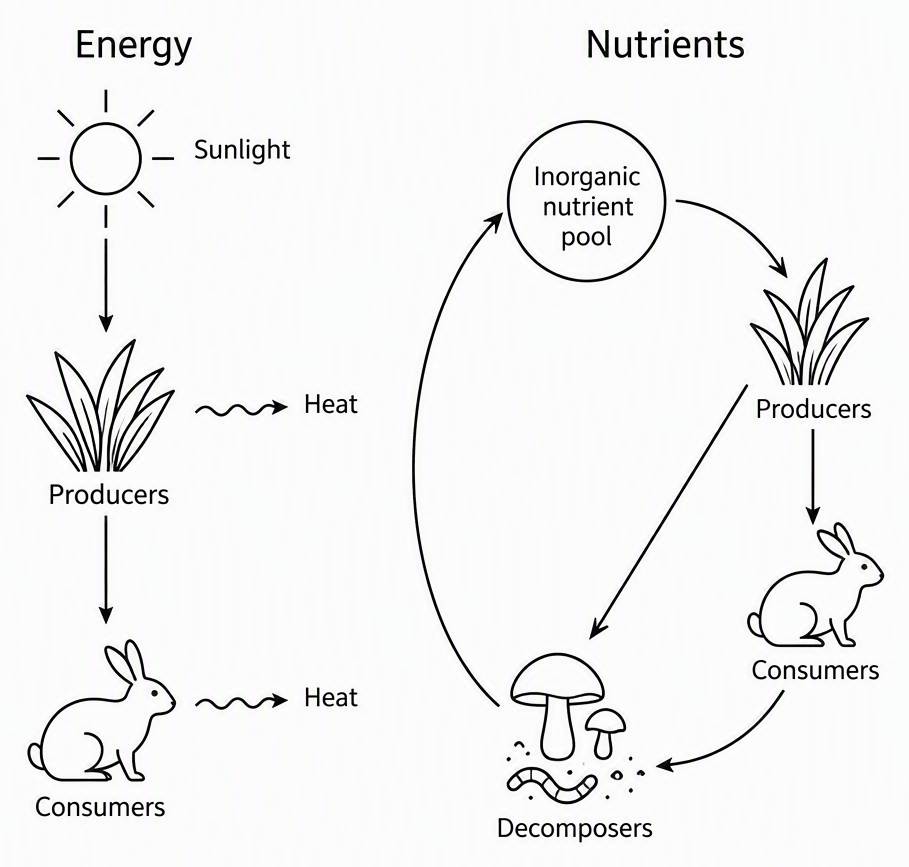
4. Which statement correctly distinguishes energy flow from nutrient movement in an ecosystem?
- A. Energy flows in one direction and becomes dispersed as heat, while nutrients cycle between organisms and their surroundings.
- B. Energy and nutrients both return to producers through identical closed cycles.
- C. Nutrients disappear permanently when decomposers act, while energy is recycled.
- D. Heat released by consumers returns to producers as a recycled supply for photosynthesis.
5. Which statement about ecological pyramids is correct?
- A. Energy pyramids become inverted whenever the biomass pyramid is inverted.
- B. Biomass pyramids must be upright in every aquatic ecosystem.
- C. Energy pyramids are always upright, while biomass pyramids can be inverted in aquatic ecosystems.
- D. Energy pyramids are inverted whenever consumers are larger than producers.
6. Which action is an example of in situ conservation?
- A. Storing seeds of a threatened plant in a seed bank.
- B. Protecting a threatened plant population within its natural forest habitat.
- C. Growing the threatened plant in a botanical garden outside its natural habitat.
- D. Preserving the plant’s tissues in a cryopreservation facility.
What are the correct answers and why do the alternatives fail?
The key is 1 B, 2 C, 3 D, 4 A, 5 C and 6 B. Check your reasoning as well as your letter: a correct answer reached through a false explanation still needs revision.
- B, mutualism: Both organisms benefit, even though the benefits differ. A fails because commensalism requires one organism to remain unaffected, whereas Q gains protection. C requires harm to one participant, and D requires a negative effect on both.
- C, competition for limited water: As crowding increases, more seedlings compete for the available resource. Frost in A may affect a dense population, but the stated cause does not depend on crowding. B and D likewise describe physical disturbances rather than density-dependent competition.
- D, oxygen limitation: Aerobic decomposers need oxygen, and waterlogging can restrict its supply. B reverses that relationship: water-filled pores do not improve aeration. A makes an unjustified claim about all litter, and C wrongly treats slower activity as proof that decomposers are absent.
- A, energy flows while nutrients cycle: Nutrient elements can return to the environment and be taken up again, but energy transferred through feeding is progressively dispersed as heat. B is tempting because both pass through organisms, yet that does not make both movements cyclic. C wrongly claims nutrients disappear, and D treats heat as recycled photosynthetic input.
- C, different quantities give different pyramids: Energy transfer over time produces an upright pyramid because less energy reaches each successive trophic level. B confuses standing biomass with energy flow: rapidly renewed phytoplankton can support greater consumer biomass at a given time. A and D incorrectly allow an inverted energy pyramid.
- B, protection within the natural habitat: In situ conservation protects organisms where they naturally occur, retaining their ecological setting. C may involve living plants and active care, but moving them outside their natural habitat makes it ex situ conservation. Seed banking in A and cryopreservation in D are also ex situ methods.
How should I score the attempt and identify what went wrong?
Use NEET marking: 4 marks for each correct answer, minus 1 for each wrong answer, and zero for each unattempted question. Calculate four times the number correct minus the number wrong. This short ecology score cannot support a projected NEET total or a readiness cutoff.
Keep the certain, eliminated and guessed labels you assigned before opening the key. Treat a guessed correct answer as a revision flag, not proof that the concept is secure.
- Missing NCERT knowledge: You could not recall what in situ means. Revisit the relevant passage, then write the distinction from ex situ without looking.
- Confused concepts: You treated energy and nutrients as equally recyclable. Explain what moves through the food chain and what returns to the environmental pool.
- Careless reading: You knew the concept but missed “both”, “limited” or “always”. Identify the exact word that changed the answer before reattempting.
For question 4, memorising “A” repairs nothing. Explain why decomposers return nutrient elements to the surroundings without returning usable energy to producers in a closed loop.
Revisit the relevant NCERT passage, then reattempt missed and guessed questions after a gap. Check whether you can reject the alternatives, not just recognise the answer.
What should I practise next without paying for the wrong resource?
Return to NCERT and focused questions if these explanations still feel unfamiliar. If your reasoning is secure, move to ecology PYQs checked against official papers and final keys. Before trusting a free collection, check its sources and whether its answers are accessible.
- Provenance: Can a claimed PYQ be matched to an official paper?
- Key quality: Does its answer match the official final key?
- Explanation quality: Does it explain the concept and reject the tempting alternative?
- Free access: Can you read the answers and explanations without payment?
Use neet.nta.nic.in for official paper and key checks where available. Fit the next practice block into How to Prepare for NEET 2027: A September Study Plan.
Current full papers contain 180 compulsory questions in 180 minutes, with no optional Section B. Do not copy the optional-section structure of older papers as the current mock format.
Choose NEET JEEnius AI full-length mocks when you need whole-paper practice; the allowance is 30 free per month, not a target to exhaust. Use the scored per-subject breakdown to review overall performance, then inspect ecology questions separately to identify ecology-specific mistakes before your next attempt.
Next step: full-length mock tests on NEET JEEnius AI and sit a full 180-question, 720-mark, 180-minute paper, 45 Physics, 45 Chemistry and 90 Biology, and get a scored per-subject breakdown (30 free a month).
Frequently asked questions
Where can I practise ecology questions for NEET for free?
This article provides six free, original NCERT-aligned ecology MCQs with answers and explanations. You can attempt them and read the complete key without payment or visiting another page. They are not official NEET questions or authenticated PYQs.
Should I start ecology practice with chapter-wise MCQs or PYQs?
Start with focused NCERT-aligned MCQs when your knowledge is incomplete or you have just revised a topic. Move to verified PYQs to test your understanding against actual exam wording. Use full-length mocks when isolated ecology practice is accurate but whole-paper execution remains weak.
How do I calculate my score in the six ecology questions?
Award 4 marks for each correct answer, deduct 1 for each wrong answer and give zero for unattempted questions. Your score is four times the number correct minus the number wrong, with a maximum of 24 marks. This small set cannot establish a projected NEET total or a readiness cutoff.
How should I revise wrong and guessed ecology answers?
Classify each error as missing NCERT knowledge, confused concepts or careless reading. Revisit the relevant NCERT passage, then reattempt missed and guessed questions after a gap. Explain why the alternatives fail; a guessed correct answer is still a revision flag.