
How should I start preparing for NEET 2027 in September 2026?
Start with four focused self-study hours on school days: two for Biology, one for Physics and one for Chemistry, with testing and review built into the week. This starting routine for how to prepare for NEET 2027 is a sample prescription, not a minimum required for selection or a score guarantee. Use NCERT-led study, independent MCQ solving and repeated correction of mistakes.
This plan is for students starting or resetting preparation in September 2026. It uses an expected early-May 2027 planning window, based on the historical scheduling pattern, not an announced exam date. Check neet.nta.nic.in for the official 2027 schedule and pattern, then update the plan.
What NEET 2027 timetable can fit around school or a drop year?
Use four weekday hours only if they fit around school, travel, meals and sleep. Students with school plus coaching should use the reduced version rather than borrow hours from sleep. Droppers without daytime coaching can expand the weekday plan. Each study block below has an output you can check.
School-day schedule: time, task, observable output
- 06:00–07:00 | Biology recall and NCERT checking | Retrieve yesterday’s material with the book closed, then correct missing statements and labels.
- 07:00–17:00 | Getting ready, school, travel, meals and recovery | Do not count these as independent NEET study hours.
- 17:00–18:00 | Physics concepts and independent problems | Write solutions and identify the first step you could not complete.
- 18:00–18:15 | Break | Step away from the desk.
- 18:15–19:15 | Chemistry study and questions | Complete the selected task and correct errors before stopping.
- 19:15–20:00 | Dinner | Eat without attaching another lecture to the meal.
- 20:00–21:00 | Biology questions and correction | Attempt questions, then check the exact NCERT source of each error.
- 21:00–21:45 | Board-format homework when required | Finish written answers or school assignments.
- 21:45–22:00 | Wind down | Prepare materials for the morning.
- 22:00–06:00 | Sleep | Protect an eight-hour sleep window.
Every subject block includes correction time. Reserve its final 10–15 minutes for checking and repairing work rather than leaving all solutions until Sunday.
Weekend schedule: time, task, observable output
- Saturday 08:00–10:00 | Biology | Recall and question practice covering both Botany and Zoology.
- Saturday 10:30–12:30 | Physics | Repair a prerequisite gap and solve related problems independently.
- Saturday 14:00–16:00 | Chemistry | Repair a weak topic, then check it through questions.
- Sunday 09:00–12:00 | Testing | Complete an appropriate chapter, cumulative or full-paper test.
- Sunday 13:00–15:00 | Analysis | Classify errors and identify repair tasks.
- Sunday 15:30–16:30 | Targeted repair | Relearn and reattempt one priority weakness.
Five four-hour weekdays, six hours on Saturday and six on Sunday give the following total. Sunday analysis is included, not added again.
A dropper without daytime coaching can add 09:00–10:00 Physics and 10:15–11:15 Chemistry on weekdays. That produces six daily hours, split equally across the three subjects.
For school plus coaching, start with two self-study hours: one hour Biology and 30 minutes each for Physics and Chemistry. This requires tighter prioritisation and does not deliver identical coverage. Coaching replaces available clock time; the same hour cannot count as both a lecture and independent practice.
If Saturday is a school day, move or shorten its blocks. The 32-hour total applies only when all the listed sessions fit.
How should I divide study time between Biology, Physics and Chemistry?
Start with Biology receiving 50% of school-day self-study time, and Physics and Chemistry receiving 25% each. Biology supplies half the questions and marks in the current official paper. Marks share is a starting point, not a fixed study-time rule: repeated errors should determine where extra time goes.
Current official paper data: subject, questions, marks
- Biology | 90 questions | 360 marks: Botany and Zoology contribute 45 questions each.
- Physics | 45 questions | 180 marks: Prioritise independent problem solving.
- Chemistry | 45 questions | 180 marks: Match the study task to the branch.
In Biology, read the relevant NCERT material, close the book and retrieve its key statements or diagram labels. Attempt questions before reopening the text. For each error, locate the exact statement, distinction or label you missed.
Include both Botany and Zoology across the week. Do not spend every Biology session rereading the part you already enjoy. Recognising a page is weaker evidence than recalling its content without prompts.
In Physics, connect the concept to a worked example, then solve a related problem without looking at the solution. Check units, signs and mathematical steps. Watching someone reach the answer is not the same as reproducing their reasoning independently.
Use different methods within Chemistry:
- Physical Chemistry: Choose the relation, substitute carefully, track units and complete the calculation yourself.
- Organic Chemistry: Connect concepts across reactions, explain why a transformation occurs and retrieve reagents and products.
- Inorganic Chemistry: Use NCERT-based recall, checking exact statements and distinctions after attempting questions.
Extra time should follow the cause of an error, not your favourite subject. Nor should it automatically follow the lowest raw score: Physics and Biology have different maximum marks. Compare performance relative to the available marks, then inspect the mistakes.
Suppose repeated test reviews show Physics concept gaps while Biology recall remains secure. Temporarily move 30 minutes from secure Biology revision to Physics. The four-hour day becomes 90 minutes Biology, 90 minutes Physics and 60 minutes Chemistry.
Keep that change only while later independent attempts show it is needed. One difficult test should not overturn the whole timetable.
If Chemistry needs an expanded block, use NEET Chemistry Preparation: A 90-Minute Daily Plan. Its longer routine belongs in a 90-minute Chemistry allocation, not inside the baseline one-hour slot.
What mistakes can make this timetable fail?
The biggest failure is counting occupied time as learning. School attendance, watched lectures and highlighted pages do not prove that you can recall material or solve questions independently. If the plan repeatedly cuts into sleep or leaves no correction time, reduce its scope before adding hours or resources.
- Overcounting productive time: School, coaching and travel consume the day, but they are not interchangeable with independent retrieval and problem solving. Record lectures separately from self-study.
- Calling a highlighted chapter complete: Require an independent question attempt and a later closed-book recall check. A watched explanation is not evidence of retained learning.
- Repaying missed days with sleep: Resume the next scheduled block. Move the unfinished task into a planned backlog slot, replacing a lower-priority task if necessary. Do not double tomorrow’s workload.
- Collecting resources: Keep one core route: NCERT-led theory, your established notes where needed and a consistent question source. Consult another explanation only for a diagnosed gap, then return to solving.
- Testing without analysis: More mocks can reproduce the same mistakes. Another score does not repair a repeatedly misused relation or misread instruction. Schedule the repair before increasing test volume.
- Trusting promotional targets: Coaching-series titles, advertised score targets and scholarship promotions are not evidence of likely results. Resource announcements do not establish a completion rate or score gain.
- Assuming a computer-based paper: Offline pen-and-paper OMR is confirmed through 2026. A move to computer-based testing from 2027 remains an unconfirmed expectation; no official basis for that expectation is supplied here. Continue OMR practice and check official NTA updates rather than preparing around an assumed change.
Parents can protect the agreed study windows. Judge completed work, not how long the student appears to sit at a desk.
How should I plan September to the exam around Class 11 backlog and boards?
Begin with a chapter audit against the latest applicable official syllabus, then protect current learning while repairing the gaps that block it. Treat the phases below as adjustable milestones, not universal completion deadlines. Your starting level and available hours determine the pace; the expected early-May 2027 window, based on historical scheduling, is only a planning estimate.
Find the applicable syllabus through neet.nta.nic.in. Classify each chapter using recall and independent question attempts:
- Untouched: You have not studied it meaningfully.
- Studied but unreliable: You recognise the content but cannot retrieve or apply it consistently.
- Retrievable and independently solvable: You can recall essentials, solve representative questions and correct previously missed ideas on a later attempt.
The last category defines usable chapter completion, without an invented universal accuracy threshold. Use this audit, not an unsupported chapter-weightage ranking, to choose repair tasks.
- September–November 2026: Protect ongoing Class 12 work so that backlog repair does not create fresh backlog. Use Saturday Physics and Chemistry blocks for prerequisite gaps, and Sunday repair time for weaknesses exposed by tests. If weak vector resolution blocks the current Physics lesson, repair that before polishing an already strong chapter merely because revision feels easier.
- December 2026–January 2027: Work toward a first usable syllabus pass, cumulative revision and broader timed tests. This is a planning target that must change with your starting level and available hours. If substantial content remains untouched, revise the scope and milestones rather than label chapters complete after watching lectures.
- During your actual board-exam period: Combine shared theory revision with board-style written answers. Maintain a reduced NEET retrieval-and-MCQ routine, but let your real board timetable determine the daily load. MCQs alone do not train written presentation.
- After boards and into the expected early-May window: Prioritise mixed-paper practice, error repair and recall. Avoid restarting the syllabus from its first chapter whenever a test feels disappointing.
For droppers, replace current-school-work priority with targeted rebuilding from the audit. Do not automatically repeat every lecture; use explanations where independent attempts reveal a gap.
A typical Class 11 student in September 2026 should check the appropriate attempt year and official eligibility. NEET 2027 is generally the immediate cycle for current Class 12 students and eligible droppers, not a reason to compress a normal two-year school course.
This roadmap uses an estimated exam window, not an announced schedule. Update it when NTA announces the 2027 schedule and pattern.
How should I use weekly tests to decide next week’s study hours?
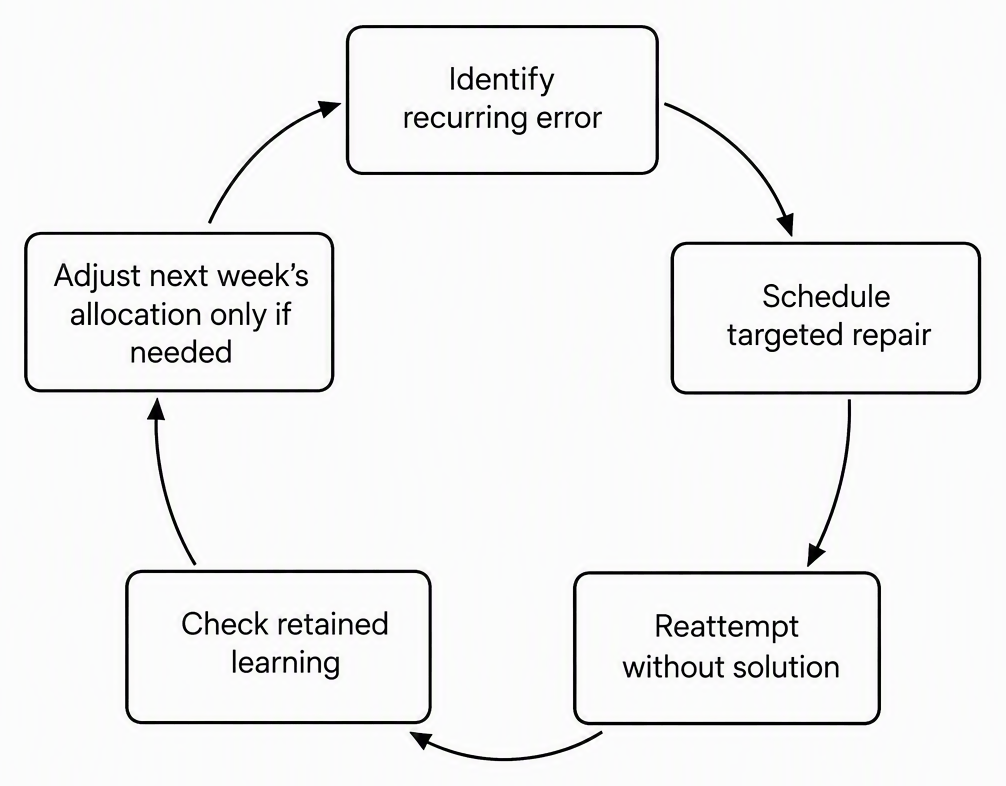
Use Sunday to identify recurring errors, schedule repairs and check whether earlier corrections have held. Test at the level your coverage supports, inspecting uncertain answers as well as wrong ones. Change subject hours only when repeated errors justify it, rather than reacting to one paper or collecting another score.
While coverage is limited, use the 09:00–12:00 slot for chapter or cumulative tests. Spend any remaining time on recall instead of forcing a premature full paper.
As coverage improves, practise the current full-paper format: 180 compulsory single-correct MCQs in 180 minutes for 720 marks, with no optional Section B. This averages one minute per question overall, not an instruction to give every Biology and Physics question identical time.
The current marking scheme awards four marks for a correct answer, deducts one for a wrong answer and awards zero for an unattempted question. Calculate the score as follows:
During analysis, review wrong answers, unattempted questions and correct guesses. A lucky answer can conceal the same weakness as a wrong one. Classify each cause as a concept gap, recall failure, calculation error, reading error or poor time use.
Turn recurring causes into a repair loop. Reattempt without the solution visible; otherwise, you are checking recognition rather than independent understanding.
Track only evidence that changes a decision:
- Planned versus completed blocks: Reduce unrealistic scheduling before adding tasks.
- Chapters independently checked: Count demonstrated learning, not pages highlighted.
- Recurring errors: Choose the next repair priority.
- Timed-test accuracy and completion: Separate wrong attempts from work left unfinished.
If a Physics concept error returns after repair, keep extra Physics time next week. If it disappears on later independent attempts, reconsider that allocation. Do not turn these records into unsupported rank or cutoff predictions.
A paper error log is sufficient. Neither a product nor these sample study hours guarantees selection.
For questions practised on NEET JEEnius AI, the free mistake notebook saves every wrong question automatically and returns it at 1, 3, 7 and 14 days until it is marked mastered. On Sunday, take the most persistent error from that notebook or your paper log, put its repair into a specific weekday block, and schedule a closed-solution reattempt.
Next step: the mistake notebook on NEET JEEnius AI and every question you get wrong is saved automatically and returned to you at 1, 3, 7 and 14 days until it is marked mastered (free).
Frequently asked questions
How many hours should I study daily for NEET 2027?
A sample school-day routine is four self-study hours: two for Biology and one each for Physics and Chemistry. Students with school plus coaching can start with two hours, while droppers without daytime coaching can expand to six. These are adjustable starting plans, not minimum requirements for selection; protect sleep and include correction time.
How do I clear Class 11 backlog while preparing for NEET 2027?
Audit chapters against the latest applicable official syllabus using closed-book recall and independent questions. Protect current Class 12 learning, then prioritise prerequisite gaps that block it. Use weekend repair blocks for these gaps and weaknesses exposed by tests rather than restarting every chapter.
How should I prepare for NEET 2027 during board exams?
Combine shared theory revision with board-style written answers, while maintaining a reduced NEET recall-and-MCQ routine. Let your actual board timetable determine the daily workload. MCQs alone do not prepare you for written presentation.
When should I start full mock tests for NEET 2027?
Use chapter or cumulative tests while your syllabus coverage is limited, then introduce full-paper practice as coverage improves. Review wrong answers, unattempted questions and correct guesses, and schedule repairs before increasing test volume. Use the current official format for practice and check NTA updates for the confirmed 2027 pattern.