
How should I prepare Chemistry for NEET?
NEET Chemistry preparation should turn NCERT study into answers you can produce without help. Follow the current official syllabus, use worked examples where needed, then practise closed-book recall, MCQs and scheduled mistake correction. Physical Chemistry needs numerical application, Organic Chemistry needs conceptual links between reactions, and Inorganic Chemistry needs accurate recall supported by trends and reasoning.
Start with 90 minutes of Chemistry daily if your workload allows it. This is a recommended starting allocation, not a universal requirement or a score guarantee. Check syllabus coverage against the official NTA site, neet.nta.nic.in, before selecting material.
How can I fit Chemistry into a four-hour NEET study day?
Reserve 90 minutes for Chemistry inside four focused self-study hours, leaving Biology 90 minutes and Physics 60 minutes. Every allocation below is a suggested planning choice, not a research finding or official requirement. Move the clock times around school and coaching, and use this schedule only when four hours fit your existing workload.
Daily schedule, listed as time, work and focused minutes:
- 6:00–7:00 am: Biology recall and MCQs, 60 minutes.
- 5:00–6:00 pm: Physics concepts and problems, 60 minutes.
- 6:00–6:30 pm: Break, 0 minutes.
- 6:30–8:00 pm: Chemistry, 90 minutes.
- 8:00–8:30 pm: Dinner/break, 0 minutes.
- 8:30–9:00 pm: Biology revision, 30 minutes.
The total is four focused hours daily: Chemistry 90 minutes, Physics 60 minutes and Biology 90 minutes. School, coaching, meals and breaks do not count as self-study here. This is a capacity example, not an instruction to sacrifice sleep or add four hours after an already full day.
Divide the Chemistry block by output:
- 35 minutes, learning or recall: Read a small syllabus-aligned section, work through an explanation, or retrieve previous learning.
- 35 minutes, questions: Solve independently before checking answers.
- 20 minutes, correction: Identify the cause of each mistake and redo the relevant step.
On revision days, move the learning time into retrieval and questions. Do not remove correction time to increase the question count.
Suggested weekly branch schedule:
- Monday and Thursday: Physical Chemistry.
- Tuesday and Friday: Organic Chemistry.
- Wednesday and Saturday: Inorganic Chemistry.
- Sunday: Mixed Chemistry test and review.
For Sunday, try 45 mixed questions in 60 minutes, followed by 30 minutes of initial review. The 60-minute limit is a training choice, not an official sectional time limit. Carry unfinished corrections into the next Chemistry block.
Across seven days, this gives 28 focused hours: Chemistry 10.5 hours, Physics 7 hours and Biology 10.5 hours. Chemistry contains 180 minutes per branch, plus 90 minutes for the mixed test and review.
For a temporary three-hour repair day, use Chemistry 60 minutes, Physics 60 minutes and Biology 60 minutes. Reduce Chemistry to 20 minutes each for learning, questions and correction.
Match the content to your stage:
- Class 11: Use current chapters and repair their prerequisites.
- Class 12: Combine current work with scheduled Class 11 retrieval.
- Droppers: Replace already-mastered lecture time with diagnostic practice.
How much time should Chemistry get compared with Physics and Biology?
Give Chemistry extra time only when its errors justify it, while keeping daily Biology retrieval and Physics problem-solving intact. The sample schedule is a Chemistry-repair allocation, not the ideal split for every aspirant. Use marks share alongside your Chemistry strength, current school demands and unfinished corrections to decide where to spend the next study hour.
The official subject comparison is:
- Chemistry: 45 questions, 180 marks.
- Physics: 45 questions, 180 marks.
- Biology: 90 questions, 360 marks.
Biology accounts for half the questions and marks. That does not mean every student must spend exactly half their self-study time on it. A student forgetting NCERT Biology facts needs a different allocation from one whose Biology recall holds up but Chemistry calculations repeatedly fail.
Protect Biology retrieval using NEET Biology Preparation: NCERT, Recall and Revision. Protect Physics problem-solving too: understanding an explanation does not establish that you can solve independently.
If either subject deteriorates, redistribute existing time rather than simply lengthening the day. Reduce Chemistry’s new-content scope, or return time from a Chemistry topic that now holds up under testing.
This section allocates time among the three examination subjects. The later workflow allocates time within Chemistry. A weak Organic topic does not automatically justify taking another hour from Biology, and a timetable copied from a topper is not evidence for that decision.
Why does a Chemistry timetable fail even when I follow it?
A timetable fails when it records time spent but not learning produced. Reading, watching and solving can fill a block without fixing why answers go wrong. Keep the time budget, but replace weak tasks with recall, independent solving and correction. Use the following checks before adding more study time or another resource.
- Passive NCERT rereading: Replace “finish these pages” with “close the book and retrieve the ideas.” Then answer questions testing the same material. Reopen NCERT to correct specific omissions, not to restart the whole reading.
- Watching another lecture whenever a question feels difficult: First identify the obstacle: missing concept, forgotten fact, calculation error or misread condition. Use an explanation for a concept gap. A forgotten fact needs retrieval, not another lecture.
- Treating every branch identically: Physical needs independent numerical work, Organic needs reaction reasoning, and Inorganic needs verified factual recall. Highlighting cannot supply all three outputs.
- Counting MCQs but ignoring mistakes: Reserve correction time before starting. Record guessed-correct answers as uncertain, not mastered. Check that you can explain and independently retry them.
- Borrowing repeatedly from Biology, Physics or sleep: Reduce today’s Chemistry scope. Continue in the next scheduled block instead of making other subjects pay for every backlog.
- Using too many books or predicted high-weightage lists: Use NCERT, one consistent explanation source where necessary and one question source, all checked against the current official syllabus. Choose the next topic from errors and prerequisites, not unsupported predictions.
- Letting test review overflow invisibly: Replace planned new work with pending correction. If review occupies the next block, mark it as review. Do not pretend the original new-learning task still fits into the same hour.
How should I study Physical, Organic and Inorganic Chemistry differently?
Use one Chemistry time budget but demand three different outputs: solved numericals for Physical, reconstructed reaction links for Organic, and corrected recall for Inorganic. NCERT is the anchor, not a reason to ignore current-syllabus topics or avoid an extra explanation when a concept remains unclear. Choose the method by the skill the question tests.
How do I turn Physical Chemistry theory into solved numericals?
Identify the quantities and conditions, study a worked example, then solve independently with the solution hidden. Check equation choice, unit handling and arithmetic separately. Use that diagnosis to decide whether to revisit the concept or repair a calculation step, rather than labelling every wrong answer “weak numericals” and repeating the same lesson.
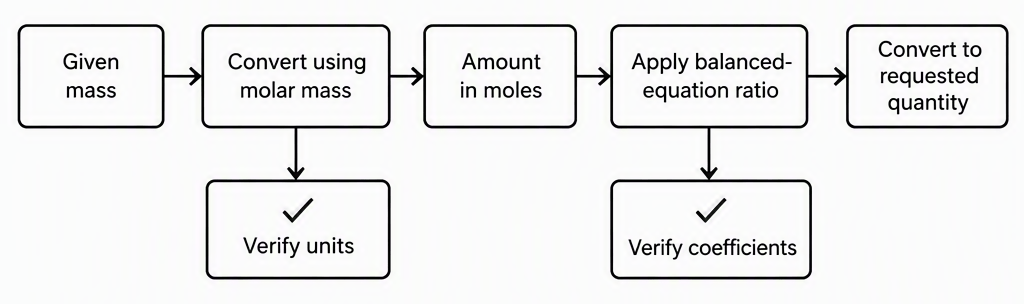
In mole-concept work, identify what the given data represent before choosing a relationship. If mass is given, convert it into moles using molar mass. Then apply the balanced-equation ratio or other relevant relationship, and convert the result into the requested quantity.
The mass-to-moles relationship is:
Here, amount of substance is measured in moles; the mass and molar-mass units must match. Do not jump directly from one substance’s mass to another substance’s mass using coefficients alone.
After solving, identify the failed step: translating the data, selecting the relationship, converting units or calculating. Redo that step, then solve the whole question without help.
Your output is a compact equation-and-conditions sheet plus independently solved questions. Copied derivations alone do not demonstrate numerical application.
How do I learn Organic Chemistry without memorising disconnected reactions?
Repair nomenclature, isomerism and electronic effects before memorising more transformations. These prerequisites help you identify the reacting structure and explain why a change occurs. For each studied reaction, retrieve the starting material, reagent, relevant conditions and product, then explain selectivity or exceptions wherever the syllabus and your source require them.
Work through a connected group of reactions, then close the source and rebuild the links. Remembering the product but forgetting the reagent is incomplete recall.
Use application questions that change the starting structure or ask you to choose between plausible outcomes. Check whether your reasoning survives that change rather than relying on familiarity with the original example.
When an answer fails, check for a misread structure, an ignored electronic effect or a forgotten condition. Repair that link instead of rereading the entire chapter.
Your output is a reaction map reconstructed from memory, followed by unfamiliar application questions. Recognising a solved example is not independent recall.
How do I remember Inorganic Chemistry accurately?
Read the relevant NCERT text and tables, connect trends to their explanations, then turn exceptions and comparisons into closed-book prompts. Verify every recalled answer against the source. Keep only missed or confused material on your correction sheet, rather than creating a second handwritten textbook that takes too long to revise.
For each comparison, retrieve both the order and its reason. For each exception, state exactly what differs from the trend.
Ionisation-order questions need more than a memorised direction across the periodic table: the electronic configuration of the species losing the electron matters. Use D- and f-Block Elements: Second Ionization Order to practise that distinction.
Your output is a corrected recall sheet containing only missed or confused material. Remove secure material from the active repair list after successful retrieval.
The initial equal branch allocation is diagnostic, not a claim of equal question counts or marks. After reviewing comparable question sets, move one 30-minute weekly block from a demonstrably stronger branch to a weaker one. Base that decision on recurring errors, not one unusually difficult set, and preserve the total Chemistry budget.
How should weekly tests decide what I study next?
Use the weekly test to choose corrections and the next session, not to predict your final score. Record correct, wrong and unattempted answers separately, then review how each uncertain answer was reached. A chapter-specific or self-selected test is a learning diagnostic, not a validated prediction of your final NEET Chemistry score.
For the suggested 45-question test, calculate marks out of 180:
Unattempted questions receive zero. Keep guessed-correct questions marked for checking even though they earn marks.
Match each reviewed error to an action:
- Concept gap: Relearn the missing idea and explain why it applies.
- Recall gap: Retrieve the fact or reaction without looking, then verify it.
- Calculation error: Redo the calculation with units and intermediate steps.
- Question-reading error: Identify the overlooked wording and explain how it changes the task.
Use these fields for each weekly tracker entry. This is an illustrative completed entry, not student performance data:
- Branch/topic: Physical Chemistry, mole concept.
- Error type: Calculation, inconsistent mass units.
- Correction: Reworked the conversion with matching units.
- Retest due: The following day.
- Retest result: Solved independently; a separate unseen question also used the conversion correctly.
- Guess check: No guess on either retry.
Retry missed questions without the solution, then test transfer on unseen questions. Repeated recognition of the same answer is not enough.
Full NEET simulations use 180 compulsory questions in 180 minutes, with no optional Section B. A full-paper mock replaces study time; it is not added to the timetable.
When it replaces the sample four-hour day, allocate three hours to the paper and one hour to initial review. Carry remaining review into later blocks. The sample weekly subject totals then change, so record the actual allocation rather than retaining the original totals.
For scheduled retries, NEET JEEnius AI’s free mistake notebook automatically saves every question you get wrong and returns it at 1, 3, 7 and 14 days until marked mastered.
Tomorrow, choose one current-syllabus Chemistry topic. Run the scheduled learning, questions and correction block, then use its errors to set the following session.
Next step: daily practice problems on NEET JEEnius AI and get a fresh set on a topic every day (20 free attempts a month).
Frequently asked questions
How many hours should I study Chemistry daily for NEET?
Start with 90 minutes daily if your school, coaching and self-study workload allows it. Divide this into 35 minutes of learning or recall, 35 minutes of questions and 20 minutes of correction. This is a suggested starting allocation, not a universal requirement; adjust it without sacrificing Biology, Physics or sleep.
How should I study Physical, Organic and Inorganic Chemistry for NEET?
For Physical Chemistry, use worked examples where needed, then solve numericals independently and check equations, units and arithmetic. For Organic Chemistry, repair prerequisites such as nomenclature, isomerism and electronic effects, then reconstruct reaction links from memory. For Inorganic Chemistry, retrieve NCERT facts, trends and exceptions without looking, verify them and record only missed or confused material.
How should I take and review weekly NEET Chemistry tests?
Try 45 mixed Chemistry questions in 60 minutes, followed by 30 minutes of initial review; this timing is a training choice, not an official sectional limit. Calculate marks as four times the correct answers minus the wrong answers, with zero for unattempted questions. Review wrong answers and guessed-correct answers, identify the error type and schedule independent retries plus unseen questions.
Why am I not improving in Chemistry even after following a timetable?
A timetable can record hours without showing whether you can recall or solve independently. Replace passive rereading with closed-book recall, diagnose the obstacle before watching another lecture and reserve time to correct mistakes. If test review remains unfinished, let it replace planned new work rather than borrowing from other subjects or sleep.