
How should I prepare Biology for NEET?
NEET Biology preparation needs a recall-and-repair loop: organise NCERT study using the current official syllabus, recall with the book closed, practise syllabus-aligned MCQs and previous-year questions, then revisit mistakes. Biology contributes 90 questions and 360 of the paper’s 720 marks, so give it daily attention without neglecting Physics and Chemistry. Two hours of Biology within four hours of daily self-study is an illustrative starting plan, not an official requirement or a guarantee of marks.
What does a four-hour timetable with two hours of Biology look like?
Use one morning Biology block for learning and recall, and one evening block for questions and repair. Keep separate hours for Physics and Chemistry. Every allocation below is a suggestion, not an exam statistic or an evidence-backed minimum. Each entry gives the clock time, duration, subject or task, and expected output.
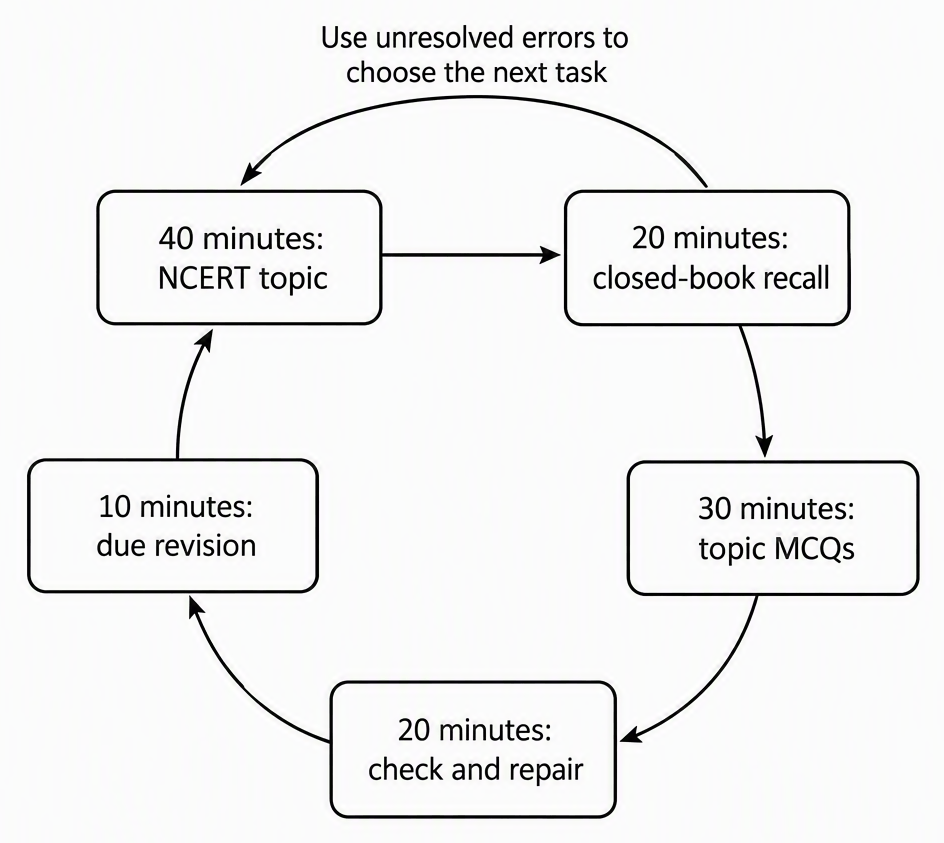
- 06:00–07:00; 60 minutes; Biology: Study one manageable NCERT topic for 40 minutes. Spend 20 minutes recalling its sequence, comparisons or diagram labels without looking. Output: a closed-book response with gaps identified.
- 17:00–18:00; 60 minutes; Physics: Work on a concept and related problems. Output: attempted solutions and a correction for each point where the reasoning failed.
- 18:00–18:15; 15 minutes; break: Step away from study. This break is excluded from the four study hours.
- 18:15–19:15; 60 minutes; Chemistry: Study the planned topic and practise related questions. Output: completed attempts with errors checked.
- 20:15–21:15; 60 minutes; Biology: Spend 30 minutes on topic MCQs, 20 minutes checking wrong and uncertain answers, and 10 minutes on due revision. Output: reviewed answers, repair prompts and completed revisits.
The study total is Biology 120 minutes, Physics 60 minutes and Chemistry 60 minutes. That gives four hours of self-study:
School, coaching, meals and travel occupy the unlisted periods. Coaching hours are not included in this total. Move the blocks around your actual school schedule rather than shortening sleep to match these clock times.
For a compressed two-hour day, use these suggested allocations. Reduce the new Biology topic size, not error review:
- Biology: 60 minutes, covering a smaller topic while retaining recall and error review.
- Physics: 30 minutes, focused on one concept and its problems.
- Chemistry: 30 minutes, focused on study and related questions.
How should I divide time between subjects and between Botany and Zoology?
Half the sample self-study time goes to Biology because it carries half the marks, but that is a starting point, not a universal rule. Protect regular Physics and Chemistry problem-solving. A comfortable Biology chapter should not become an excuse to avoid a numerical topic that is exposing a weakness.
The official subject split supports this starting allocation. Your recent errors should determine adjustments:
- Biology: 90 questions, 360 marks.
- Physics: 45 questions, 180 marks.
- Chemistry: 45 questions, 180 marks.
Within Biology, Botany and Zoology contribute 45 questions each. Include both across the week, but give more revision time to the side with more unresolved errors. Equal question counts do not mean your repair work must take equal time.
Do not use an assumed Class 11 versus Class 12 distribution to drop chapters. Cover the official syllabus, with study order guided by current teaching, prerequisite concepts and gaps in recall.
For a dropper who genuinely has six self-study hours available, use this adjustable example. These are suggested allocations, not required hours:
- Biology: 2.5 hours, using the extra time for cumulative revision.
- Physics: 2 hours, with protected problem-solving time.
- Chemistry: 1.5 hours, combining study with question practice.
Move time according to the work needed to correct recent mistakes, not according to which subject feels easiest. Extra Biology time should go to retrieval and repair, not another passive reading session.
What mistakes can make this Biology timetable fail?
Reading and question totals cannot replace evidence of learning. Keep the recall and review blocks protected, even when that means covering less new material. Wrong answers, guessed correct answers and facts forgotten after revision identify what needs attention. Use those gaps to choose the next task, rather than treating completed pages as proof of mastery.
- Passive familiarity: Recognising a highlighted sentence is not the same as retrieving it or separating similar options. Close the book, state the answer, then check the exact wording.
- Question-count chasing: Explain yesterday’s errors before starting another set. Attempt fewer questions if necessary and protect the review block. Use NEET Score Improvement: Fix Errors Before Your Next Mock to organise that repair work.
- Counting a lucky answer as mastery: A correct guess can hide a missing fact or confused concept. Mark uncertain answers during practice and review them alongside wrong ones.
- Copying NCERT into another notebook: Rewriting paragraphs consumes time needed for retrieval. Retain useful comparisons, difficult process sequences and short error prompts, not a second version of the chapter.
- Following obsolete paper-format advice: The current paper contains 180 compulsory questions in 180 minutes, with no optional Section B. Do not practise using an old optional-section format.
- Blind guessing: A correct answer earns 4 marks, a wrong answer loses 1 mark, and an unattempted question earns zero. There is no universal attempt target. Use knowledge and valid elimination rather than treating a familiar-looking option as evidence.
- Skipping chapters through unofficial weightage lists: A study order helps you manage work; it does not prove that syllabus content can be ignored. Prioritise weak prerequisites and current teaching without turning priority into permanent omission.
What should I do inside each Biology study block?
Use the morning block to understand one topic and test recall, then use the evening block to apply it and repair errors. Start with the current official syllabus from neet.nta.nic.in and use NCERT Class 11 and Class 12 as your primary study texts. Check coverage instead of relying on an old deleted-chapter list.
How should I study NCERT and recall it without looking?
Choose a subsection that fits the block, such as population interactions, rather than an entire large chapter. During the suggested 40-minute reading period, identify definitions, examples, qualifiers, exceptions, comparisons, tables, diagrams and relationships. Treat these as recall targets, not an instruction to highlight every line. If the topic overruns, make the next subsection smaller.
For concept-heavy genetics or physiology, explain the relationship or process before memorising isolated statements. If one doubt persists, seek a focused explanation from a teacher or relevant lesson, then return to the text.
Use the 20-minute closed-book period for a task with a checkable output. Label a diagram from memory, reconstruct a process in order, or distinguish interactions by their effects:
- Mutualism: Both organisms benefit.
- Competition: Both are negatively affected by the interaction.
- Parasitism: The parasite benefits and the host is harmed.
Check your response against NCERT and correct the gaps. Recognition on the page does not establish that you can retrieve the answer.
How should I practise questions and repair mistakes?
Use the suggested 30-minute question block for fresh topic MCQs and syllabus-aligned previous-year questions, then reserve 20 minutes for checking. These questions test application as well as recall. Do not assume every Biology question is a direct NCERT quotation or that a fixed percentage will repeat. Mark uncertainty before checking the answer key.
Check every wrong or uncertain answer against the relevant text or concept. Assign a cause and match the repair to it:
- Missing fact: Create a recall prompt that requires the forgotten detail.
- Confused concept: Explain the relationship in your own words and retry the question.
- Missed qualifier: Compare the exact wording of the stem and options, especially words such as “only”, “incorrect” or “except”.
- Diagram-reading error: Identify the misread label or relationship, then test it again without the answer visible.
For manual tracking, record the question reference, cause of error and a recall prompt, then schedule revisits. NEET JEEnius AI’s free mistake notebook saves every wrong question automatically and returns it at 1, 3, 7 and 14 days until marked mastered.
Use the final 10 minutes for due prompts, attempting each before revealing its answer. A chapter is complete when you can recall its main structure, explain reviewed errors and handle a mixed question set without referring to the text. Finishing the final page is only the reading milestone.
How should I adjust the plan each week without creating a revision backlog?
Use recent errors to decide next week’s work, and periodically replace an evening Biology block with a mixed test and review. Do not add an unplanned extra session. Keep the test small enough to check wrong and uncertain answers within the same block; available review time should determine its scope.
Keep a short weekly learner record. These are records of your work, not promised performance benchmarks:
- Topics studied: Name the subsection and the recall task completed.
- Wrong answers: Record the references and causes.
- Guessed correct answers: Keep them open until you can explain the choice.
- Repeated mistakes: Mark errors that returned after revision.
Use the error causes to change the task, not just the total study time. Apply these rules to the next week:
- Repeated forgetting: Increase closed-book retrieval and shorten the new topic.
- Concept errors: Use a targeted explanation, then attempt related questions.
- Misreading: Compare qualifiers and competing options before selecting an answer.
If due revision exceeds its allotted 10 minutes, temporarily take time from new-content work. Do not keep adding chapters while the revision queue grows.
Keep the recall-and-repair loop at every stage. Change which topics enter it:
- Class 11: Build new study around current teaching and keep older completed topics in the revision queue.
- Class 12: Pair current Biology teaching with a manageable Class 11 revision queue. Board-answer writing trains a different output from NEET MCQs, so practise both rather than counting one as a substitute for the other.
- Droppers: Diagnose retained and weak topics through recall and mixed questions before restarting every chapter at equal depth.
After a missed day, resume due revision and the next manageable task. Do not double the following day’s workload.
Before you stop today, select tomorrow’s NCERT topic, assign the two Biology blocks and identify the mistakes due for review. Write down what the closed-book response should contain so that tomorrow’s first task is already decided.
Next step: the mistake notebook on NEET JEEnius AI and every question you get wrong is saved automatically and returned to you at 1, 3, 7 and 14 days until it is marked mastered (free).
Frequently asked questions
How many hours should I study Biology daily for NEET?
Two hours of Biology within four hours of daily self-study is a suggested starting plan, not an official requirement or a guarantee of marks. Split Biology between learning with closed-book recall and question practice with error review. Adjust the allocation using recent mistakes while protecting Physics and Chemistry study time.
How should I study NCERT Biology for NEET?
Check the current official syllabus and choose a manageable subsection from NCERT Class 11 or Class 12. Study definitions, examples, qualifiers, diagrams and relationships, then close the book and reconstruct the key information. Check your response against NCERT and turn gaps into recall prompts.
How should I review wrong answers in NEET Biology MCQs?
Review wrong answers and uncertain correct answers against the relevant text or concept. Identify whether the cause was a missing fact, confused concept, missed qualifier or diagram-reading error. Match the repair to that cause and revisit the question or recall prompt without revealing the answer first.
Should I give equal study time to Botany and Zoology?
Botany and Zoology contribute 45 questions each, so include both across the week. Equal question counts do not require equal revision time. Give more repair time to the side with more unresolved errors.
How can I revise Class 11 Biology while studying in Class 12?
Pair current Class 12 Biology teaching with a manageable queue of Class 11 revision prompts. If due revision exceeds its allotted time, temporarily reduce new-content work rather than letting the backlog grow. Practise NEET MCQs separately from board-answer writing because they test different outputs.