
How can I improve my NEET score without adding study hours?
For NEET score improvement, start by recovering marks lost in your latest completed mock, not by adding another lecture. Sort each wrong or skipped question into conceptual gaps, forgotten facts or formulas, calculation or reading errors, time-pressure skips and OMR mistakes.
The official marking scheme is:
Changing a wrong answer into a correct answer recovers 5 marks. Changing an unattempted answer into a correct answer adds 4 marks.
Choose your next study task from the errors actually present, not a universal list of “high-scoring” chapters. A repeated unit-conversion mistake needs a different repair from a forgotten NCERT distinction. Verify each repair in subsequent tests rather than assuming a score increase.
How many marks can I recover by correcting different errors?
A wrong-to-correct change offers the largest gain per question, but prioritise repeated errors with a specific fix. The useful repair is one you can reproduce independently, not one you understand only while reading the solution.
Each entry below gives the answer change, old contribution, new contribution and net marks gained:
- Wrong → correct: minus 1 mark; plus 4 marks; 5 marks gained.
- Unattempted → correct: 0 marks; plus 4 marks; 4 marks gained.
- Wrong → unattempted: minus 1 mark; 0 marks; 1 mark gained.
These are arithmetic differences from the official marking scheme, not observed student gains or score predictions. Indiscriminately reducing attempts is not an improvement strategy.
Hypothetical calculation: Correcting 5 wrong answers would add 25 marks. Correctly answering 5 previously unattempted questions would add 20 marks.
These gains require successfully changing those outcomes in a comparable future paper. Reading the answer key earns nothing by itself.
What is the difference between NEET marks, percentile and normalisation?
Raw marks measure your answer outcomes; percentile describes relative performance within a comparison group. Percentile is not the percentage of 720 marks you obtained.
Unattempted questions contribute zero. Where officially used, normalisation adjusts results across test sessions under the examination authority’s stated method; this does not establish a particular NEET normalisation formula.
Use neet.nta.nic.in for official scoring notices, not an assumed marks-to-percentile conversion. Keep preparation focused on controllable raw-score gains.
Does one higher mock score mean I have improved?
One higher score does not prove that a weakness has been repaired. Mock-test sessions can differ in syllabus coverage and difficulty, so compare part-syllabus papers with similar coverage or full-syllabus papers under the same duration and marking scheme.
Score interpretation and any marks-to-percentile relationship can vary by session and year because paper difficulty and the comparison group can differ. This is not a claim that NEET currently uses multiple normalised sessions.
Track these across several comparable tests:
- Total score and individual subject scores.
- Correct, wrong and unattempted counts.
- Recurring error types and whether repaired errors return.
A coaching-platform percentile describes performance within that platform’s comparison group. It is not an official NEET percentile.
How should I repair mistakes in Biology, Chemistry and Physics?
Match the repair to the error instead of giving every subject another round of passive revision. Biology deserves substantial attention because it is half the paper, but your next revision block should follow the recoverable errors in your own mock.
The official subject split is:
- Biology: 90 questions, 360 marks.
- Chemistry: 45 questions, 180 marks.
- Physics: 45 questions, 180 marks.
Biology factual errors: Revisit the exact NCERT passage, diagram or table behind the mistake. Close the book and retrieve the distinction you confused, including why the competing option is wrong. Recognition while rereading is not reliable recall.
Chemistry errors: Separate factual recall, reaction or concept confusion, and numerical execution. A forgotten condition needs retrieval practice; confused reaction pathways need a comparison of conditions and products; a numerical error needs the faulty step identified and redone. After a kinetics error, use Chemical Kinetics Practice Questions NEET: 8 Free MCQs as focused follow-up practice, not a complete chapter resource.
Physics errors: First check whether you understood the physical setup. If you did, inspect algebra, units, signs and calculation separately instead of replaying the whole lecture. Repair the specific step, then solve fresh questions without the solution beside you.
Log a correct answer reached by guessing as unverified, not mastered. Check the concept on a fresh question before treating it as secure.
How do I build a test–repair–retest cycle?
Leave enough time between mocks to repair the weaknesses the previous paper exposed. Use the test to diagnose errors, targeted revision to address their causes and fresh questions to check whether the repair holds without answer-key support.
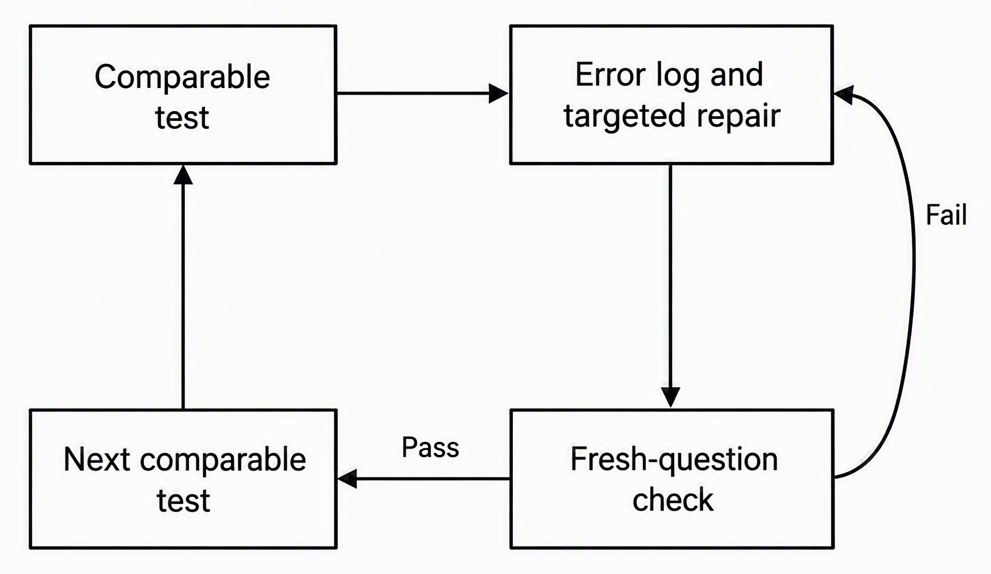
- Log the cause: Record the question or concept, error cause, required repair and result on a fresh follow-up question.
- Repair recurring weaknesses: Complete targeted revision before the next comparable mock.
- Check independently: Attempt fresh questions without notes, then inspect the reasoning as well as the answer.
- Retest: Check whether those error types recur under timed conditions.
Class 11 students with incomplete coverage should diagnose taught material through chapter or part-syllabus tests, not judge themselves by full-syllabus totals. Class 12 students and droppers should balance targeted repair with full-paper practice as coverage permits.
The current full-paper conditions are 180 compulsory questions in 180 minutes, with no optional Section B. Include OMR practice when preparing for a pen-and-paper examination; “compulsory” means no optional question section, not that you must guess every answer.
NEET JEEnius AI offers 30 free full-length mocks a month: each has 180 questions, 720 marks and 180 minutes, with 45 Physics, 45 Chemistry and 90 Biology questions, plus a scored per-subject breakdown. That availability is not a recommendation to take 30 mocks monthly: analysis and repair must fit between tests.
Use How to Crack NEET 2027: Daily Plan and Revision Roadmap to fit this cycle into your broader schedule.
What target should I set before my next NEET mock?
Target a recurring error, such as a repeated unit mistake or a biological distinction you cannot recall without notes. Judge progress by whether that error stops appearing on fresh questions and comparable tests.
Reject guarantees such as a 100-mark improvement in a month. Your starting point, syllabus coverage and the nature of your errors determine what needs repair.
Before your next test:
- Select one recurring error type and list the affected concepts.
- Choose a repair task: redo the faulty unit-conversion step or retrieve the confused biological distinction without notes.
- Calculate potential recovery using the marking scheme: 5 marks per wrong-to-correct change and 4 per skipped-to-correct change. Label this an opportunity, not a forecast.
- Attempt fresh questions and record whether the specific error returned.
Next step: full-length mock tests on NEET JEEnius AI and sit a full 180-question, 720-mark, 180-minute paper, 45 Physics, 45 Chemistry and 90 Biology, and get a scored per-subject breakdown (30 free a month).
Frequently asked questions
How can I improve my NEET score without studying more hours?
Start with your latest completed mock and classify wrong or skipped answers by cause: conceptual gaps, forgotten facts, calculation or reading errors, time pressure and OMR mistakes. Use your next study block to repair a recurring error instead of adding another lecture. Check the repair on fresh questions without notes, then in the next comparable test.
How many marks do I gain by correcting a wrong NEET answer?
Changing a wrong answer into a correct answer gains 5 marks because its contribution changes from −1 to +4. Changing an unattempted answer into a correct answer gains 4 marks. These are potential gains under the marking scheme, not predictions of your next mock score.
Does a higher NEET mock score mean I have improved?
One higher mock score does not prove that a weakness has been repaired because papers can differ in difficulty and syllabus coverage. Compare several tests with similar coverage, duration and marking scheme. Track subject scores, correct, wrong and unattempted counts, and whether the same errors return.
How should I fix mistakes in NEET Biology, Chemistry and Physics?
For Biology factual errors, revisit the exact NCERT passage, diagram or table, then recall the confused distinction with the book closed. In Chemistry, separate factual recall, reaction or concept confusion, and numerical execution before choosing the repair. In Physics, check the physical setup first, then inspect algebra, units, signs and calculations, and verify the fix on fresh questions.