
How can I crack NEET 2027 with a realistic daily plan?
Corrected practice matters more than an impressive hours claim. The practical answer to how to crack NEET 2027 is NCERT-led Biology and relevant Chemistry study, daily Physics problems, spaced revision, and timed tests followed by error correction. Use four school-day self-study hours or six dropper hours as sample budgets, not qualifying requirements or guarantees. Change the allocation when repeated errors justify it.
What daily timetable can I follow for NEET 2027?
Use the schedule that fits your commitments, with revision and correction inside each block. These are alternative schedules, not blocks to combine. The school plan totals four self-study hours; the dropper plan totals six. Neither includes school or coaching attendance, meals, travel or breaks.
- Biology recall and NCERT
- School student: 06:15–07:15.
- Dropper: 08:00–09:30.
- Output: Recall yesterday’s material without looking, read one named NCERT subsection, then close the book and retrieve its facts or redraw its labelled structure.
- Physics concept and independent problems
- School student: 17:00–18:30.
- Dropper: 10:00–12:00.
- Output: Check a prerequisite, understand one worked example, solve a bounded set independently, and correct mistakes involving concepts, units or signs.
- Chemistry study and application
- School student: 18:45–19:45.
- Dropper: 14:00–15:30.
- Output: Complete a named concept or NCERT passage, attempt related questions, and reattempt an earlier error without its solution.
- Biology questions and correction
- School student: 20:00–20:30.
- Dropper: 16:00–17:00.
- Output: Answer questions from the morning’s subsection, check wrong answers against the exact NCERT lines, and retrieve previously missed facts.
Write the subsection before the block starts. “Recall the stages of the cardiac cycle and check missed steps” is an output; “finish Biology” is not. Choose a question set small enough to leave time for correction, rather than treating review as an extra shift.
The school example assumes your evening is available from 17:00. It also requires an early bedtime: protect at least eight hours of sleep for school-age students. If late coaching or travel makes these times impossible, move or reduce blocks rather than borrowing from sleep.
On a genuinely overloaded day, use a two-hour continuity option: 45 minutes Biology, 45 minutes Physics and 30 minutes Chemistry. Keep recall and correction within those minutes. This preserves contact with the subjects, but it is not a complete long-term preparation plan.
A weekly test replaces scheduled study blocks rather than adding to an already full day. Put its review into the timetable too, even if that means covering less new material that week.
How should I split Biology, Physics and Chemistry, and when should I change it?
Start with the recommended split below, then adjust it using comparable test results. Biology accounts for half the current paper, but that does not automatically justify half your study hours. Physics often needs longer uninterrupted problem-solving, while Biology needs frequent retrieval and precise NCERT reading. No time allocation here is an evidence-backed universal optimum.
- Biology: 90 questions, 360 marks; recommended school budget 1.5 hours and dropper budget 2.5 hours. Botany and Zoology contribute 45 questions each.
- Physics: 45 questions, 180 marks; recommended school budget 1.5 hours and dropper budget 2 hours.
- Chemistry: 45 questions, 180 marks; recommended school budget 1 hour and dropper budget 1.5 hours.
For Biology, read a bounded passage, close the book and retrieve the facts or redraw the biological structure. Answer questions next. When you miss one, return to the exact line behind the error, not the beginning of the chapter.
For Physics, check prerequisite mathematics before blaming the chapter. Understand one worked example, solve independently, then explain why you chose the equation. Review units and signs as part of the solution, not merely after the answer disagrees.
For Chemistry, match the method to the task. Check coverage in all three branches against the official syllabus at neet.nta.nic.in.
- Physical Chemistry: Numerical practice, with attention to units and assumptions.
- Organic Chemistry: Reaction reasoning, including the roles of reagents and conditions.
- Inorganic Chemistry: NCERT-led recall.
Move one 30-minute block toward the weakest subject after two weekly reviews show the same recurring problem. Take it from another subject’s existing allocation, retain contact with all three, and review the change the following week. Judge weakness from comparable covered-syllabus tests and repeated error types, not one unusually difficult set.
After learning a concept, NEET JEEnius AI’s practice mode can supply topic sets that skip questions you have already seen, with 60 free sets a month. Use these to check independent application, not to substitute for understanding the worked example.
Which mistakes make a reasonable NEET timetable fail?
Counting lectures and coaching as completed practice, skipping corrections and repeatedly restarting chapters defeat this plan. Watching a solution can support preparation, but it does not prove that you can solve independently. Before adding hours, fix the behaviour that prevents existing hours from producing corrected work.
- Watching a lecture backlog without stopping. A long marathon is not evidence of mastery. Watch a short concept segment, close it, and attempt independent questions before continuing. If you cannot begin, repair that segment rather than watching another hour.
- Restarting from chapter one every Monday. Keep current work moving. Put the older prerequisite blocking today’s task into a scheduled repair slot instead of resetting the whole subject.
- Counting coaching attendance as completed practice. Exposure to a teacher’s solution is different from solving a fresh question. Reserve self-study for independent attempts and correction.
- Making an error notebook that never gets reopened. Schedule closed-book reattempts. Record whether the original cause has changed, not merely whether you now recognise the answer.
- Chasing question volume. Pick the smaller fully reviewed set over the larger unreviewed one. A wrong answer without correction remains unfinished work.
- Changing books, teachers or apps after every poor score. First change the method or time allocation. Replace a resource only when you can identify a specific problem, such as explanations you still cannot follow after seeking clarification.
- Ignoring school examinations or sleep. Reduce that week’s NEET workload explicitly. Do not preserve study hours by cutting sleep.
Reject chapter-weightage shortcuts that justify abandoning syllabus areas. The current pattern supports subject totals, not chapter-level predictions or score-to-college guarantees. Neither a timetable nor a resource can promise selection.
What should my roadmap be from September 2026 to NEET 2027?
As of September 2026, plan around the remaining months, not a fresh two-year window. Early May 2027 is an expected planning window based on the historical schedule, not an announced examination date. The official NTA announcement at neet.nta.nic.in must govern final planning, including any change to the examination window.
Use the phases below as adjustable recommendations. They describe changing priorities, not permission to postpone revision until syllabus completion.
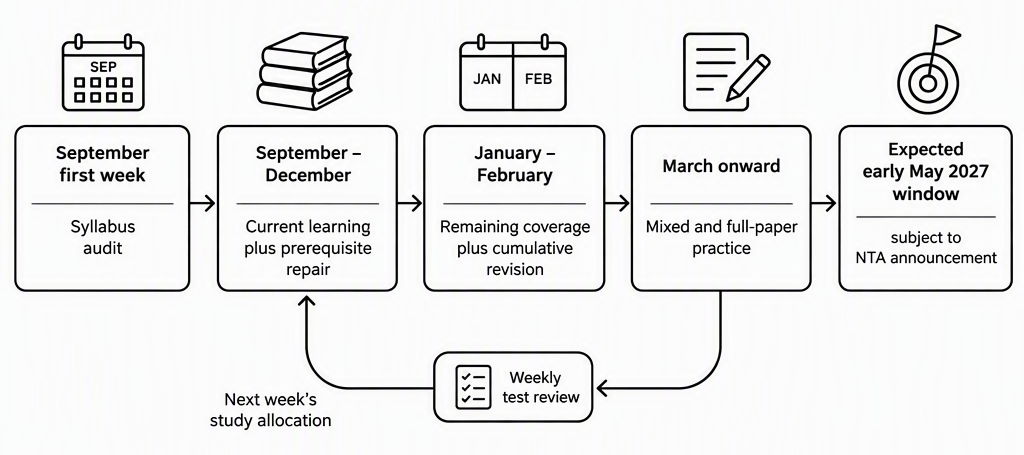
- First week: audit every official syllabus chapter. Use three labels: unstarted, studied but unreliable, and independently solvable after a delayed check. Do not award the third label because you understood yesterday’s explanation. Use a later closed-book attempt.
- September–December: keep current learning and repairs together. Class 12 students should continue current chapters while repairing Class 11 prerequisites. Droppers should prioritise gaps exposed by diagnostic work. Reserve three 30-minute prerequisite-repair slots each week from existing subject hours, not as extra shifts.
- January–February: coordinate coverage with the real school calendar. Plan remaining chapters and cumulative revision around school examinations, practicals and boards. Start cumulative testing before every chapter feels perfect; otherwise, early chapters may never be tested alongside recent ones.
- March onward: increase mixed and full-paper practice. Let errors choose revision tasks. Keep the main resources stable instead of starting several new books when test pressure rises.
Each weekend, name the chapter and subsection for the coming week’s blocks. Mark the three repair slots separately so backlog does not consume every session.
Late starters should compress or rebalance these phases, not claim they are completed on paper. Students currently in Class 11 should first check official qualifying-examination and age eligibility requirements before assuming 2027 is their attempt year. This roadmap mainly serves likely 2027 candidates in Class 12 and droppers.
How can I tell each week whether my NEET plan is working?
Use a weekly covered-syllabus test first, then cumulative tests, followed by regular full papers once coverage makes the result informative. Look for fewer repeated errors, better recall and less avoidable time loss across comparable tests. One mock score does not establish a trend, especially when chapter coverage or paper difficulty changes.
The current full paper has 180 compulsory single-correct MCQs in 180 minutes, for 720 marks. Correct answers earn 4 marks, wrong answers lose 1, and unattempted answers earn 0. The former optional Section B format was discontinued from 2025; do not practise around optional questions.
Track correct, wrong and unattempted counts separately. Keep a compact weekly log containing:
- Tested chapters and score: Record coverage alongside the result.
- Error categories: Count missing knowledge, recall failure, calculation or reading error, and time-management failure.
- Questions left due to time: Separate these from questions you could not solve.
- Next week’s repair tasks: Name the subsection, task and scheduled block.
Match each error to a repair:
- Missing knowledge: A concept block followed by independent questions.
- Recall failure: Closed-book retrieval, then a delayed check.
- Calculation or reading error: Focused reattempts, checking units, signs and the exact wording.
- Time-management failure: Timed sets and review of where you stalled.
A three-hour full mock needs a separate review block. Both replace normal study time: a school student might use three hours for the paper and one for initial review, continuing corrections in the next scheduled block if needed.
NEET remained offline pen-and-paper OMR through 2026. A computer-based move from 2027 is an unconfirmed expectation in the supplied planning information, not an official announcement. Retain OMR familiarity and adapt to official instructions, not rumours.
Which resources should I keep, and how should I revisit mistakes?
Keep a small working stack: the official syllabus, NCERT, one primary teaching source where needed, and a reliable practice source. Their jobs are to define coverage, teach the material, resolve doubts and test independent application. An app does not replace teaching or guarantee selection.
For a worked starting point, use Chemical Bonding Practice Questions NEET: 8 Explained MCQs. Attempt the questions before reading the explanations, identify each error’s cause, then schedule a closed-book reattempt.
Unseen questions test whether you can apply learning to a fresh problem. Scheduled reattempts test whether a correction has stuck. Keep both in the plan; recognising a familiar answer is not enough.
NEET JEEnius AI’s free mistake notebook saves every wrong question automatically and returns it at 1, 3, 7 and 14 days until it is marked mastered. Use those returns inside the correction time already budgeted.
Choose the appropriate timetable for tomorrow and name the subsection for each block. Reserve the first weekly review slot before filling the rest of the week.
Next step: the mistake notebook on NEET JEEnius AI and every question you get wrong is saved automatically and returned to you at 1, 3, 7 and 14 days until it is marked mastered (free).
Frequently asked questions
How many hours should I study daily for NEET 2027?
Start with four self-study hours on school days or six hours as a dropper, excluding school and coaching attendance. These are sample budgets, not qualifying requirements or guarantees of selection. Include revision and error correction within those hours, and protect at least eight hours of sleep if you are school-age.
How should I divide study time between Biology, Physics and Chemistry?
For a four-hour school-day plan, start with 1.5 hours each for Biology and Physics and one hour for Chemistry. For a six-hour dropper plan, use 2.5 hours for Biology, two for Physics and 1.5 for Chemistry. After two weekly reviews reveal the same recurring weakness, transfer one 30-minute block toward that subject while retaining contact with all three.
How can I clear my Class 11 backlog while preparing for NEET 2027?
Continue current Class 12 chapters while repairing the Class 11 prerequisites that block your progress. Reserve three 30-minute repair slots each week within your existing subject hours, naming the chapter and subsection in advance. Check each repair with a delayed closed-book attempt instead of restarting the whole subject.
How should I analyse NEET mock tests?
Record tested chapters, score, correct, wrong and unattempted counts, and questions left because of time. Classify errors as missing knowledge, recall failure, calculation or reading mistakes, or time-management failure. Assign each recurring error a specific repair task and scheduled block, then compare trends across tests with similar coverage and difficulty.