
Which free Chemical Bonding practice should you start with?
Use free Chemical Bonding practice questions for NEET in stages: explained chapter MCQs for unstable concepts, chapter-wise PYQs for exam-style application, and full mocks for mixed-subject practice. Full mocks are not an efficient substitute for targeted Chemical Bonding repair.
This page contains eight original single-correct MCQs with worked explanations, free to attempt below. They are editorial questions, not official NEET questions. Each practice format serves a different stage; none is universally best.
How do chapter MCQs, PYQs and full mocks compare?
Explained chapter questions isolate weaknesses; PYQs show how past papers framed concepts; full mocks test subject switching and pacing. Choose the format that addresses your current errors, rather than treating all question practice as interchangeable.
Read each comparison in this order: original chapter MCQs with explanations; chapter-wise NEET PYQs; full-length NEET mocks.
- Purpose: Repair concepts; calibrate against past exam questions; integrate preparation across subjects.
- Chapter focus: Entirely Chemical Bonding; Chemical Bonding questions from past papers; the full syllabus across subjects.
- Misconception isolation: Strong when explanations examine distractors; useful when you explain each option; limited by the chapter questions present.
- Exam-style calibration: Depends on question design; direct evidence of past question framing; whole-paper practice, not evidence of future difficulty.
- Mixed-subject pacing: Not tested; not tested by a chapter-only set; directly practised.
- Main limitation: Original MCQs do not establish past exam difficulty; repeated PYQs can become answer-recognition exercises; mocks cannot guarantee enough Chemical Bonding questions to diagnose the chapter.
For PYQs, check the original paper and final official answer key through neet.nta.nic.in rather than trusting an unattributed PDF. This page does not supply an authenticated PYQ collection.
For later whole-paper practice, NEET JEEnius AI offers 30 free full-length mocks a month: 180 questions, 720 marks and 180 minutes, with 45 Physics, 45 Chemistry and 90 Biology questions, plus a scored per-subject breakdown. This offering does not establish chapter filters, chapter reports or worked solutions.
Which practice format fits your present mistakes?
Choose by readiness, not by class or number of attempts. Confusing shapes calls for chapter practice; relying on familiar examples calls for PYQs; losing accuracy during subject switches calls for full mocks. Recognising an answer is not the same as deriving it independently.
- Class 11, hybridisation names remembered but shapes confused: Choose explained chapter MCQs. Sketch the Lewis structure, count electron domains, and mark lone pairs before naming the molecular shape. Saying “sp³” does not distinguish ammonia from water.
- Class 12, chapter revised but examples mostly familiar: Choose chapter-wise PYQs. Solve before opening the key, then explain why every rejected option fails. Recognising a question from class notes is not enough.
- Dropper, correct in isolation but losing marks during subject switches: Choose full mocks. Review where switching, reading or pacing broke down, then return to chapter drills for conceptual errors.
A dropper with weak fundamentals belongs in the first route, not automatically in the mock-test route. Preparation history does not replace present understanding.
Classify the error before repairing it. Choosing “diamagnetic” because you incorrectly paired all electrons needs molecular orbital revision; choosing it after overlooking “incorrect statement” needs a reading correction. Rushing the same question near the end of a paper may require pacing work instead.
Can you solve these eight free Chemical Bonding questions with reasons?
Test your reasoning with this editorial diagnostic, not a PYQ set, predicted paper or exhaustive chapter test. It samples formal charge, shape, polarity, molecular orbitals and intermolecular forces, with answers in the following section.
For each question, record your option and a short reason before opening the answers. Mark guesses, including answers remembered without understanding.
Q1. What is nitrogen’s formal charge in NH₄⁺?
Use the usual Lewis structure, with four single N–H bonds and no lone pair on nitrogen. Select the formal charge on nitrogen, not its oxidation state.
- A. Minus three
- B. Zero, because charge belongs only to the whole ion
- C. Plus one
- D. Plus four, one for each N–H bond
Q2. Which pair correctly describes NH₃?
The first entry gives the electron-pair geometry around nitrogen. The second gives the molecular shape, describing the positions of the atoms.
- A. Trigonal planar; trigonal planar
- B. Tetrahedral; trigonal pyramidal
- C. Trigonal pyramidal; tetrahedral
- D. Tetrahedral; tetrahedral
Q3. How do the bond angles in NH₃ and H₂O compare?
Compare the H–N–H angle with the H–O–H angle. Use the usual VSEPR explanation for these molecules.
- A. Water has the larger angle.
- B. Both angles are equal because both central atoms have four electron domains.
- C. Ammonia has the larger angle.
- D. Lone pairs make any comparison impossible.
Q4. What hybridisation label does the conventional NCERT valence-bond model assign to sulfur in SF₆?
Answer strictly within this model. It describes six equivalent bond directions in an octahedral arrangement.
- A. sp³
- B. dsp²
- C. sp³d
- D. sp³d²
Q5. Which molecule is nonpolar despite having polar bonds?
Consider the molecular shape and the vector sum of all bond dipoles. Do not decide solely from the presence of electronegative atoms.
- A. NH₃
- B. H₂O
- C. BF₃
- D. SO₂
Q6. What does molecular orbital theory predict for ground-state O₂?
Choose the correct combination of bond order and magnetic behaviour. Both parts of the option must be correct.
- A. Bond order 2; diamagnetic
- B. Bond order 1; paramagnetic
- C. Bond order 3; diamagnetic
- D. Bond order 2; paramagnetic
Q7. How do the bond orders of O₂⁺ and O₂⁻ compare?
Identify the orbital from which O₂ loses an electron or to which it gains one. Decide whether that orbital is bonding or antibonding.
- A. O₂⁺ has the higher bond order.
- B. O₂⁻ has the higher bond order.
- C. Both have bond order 2.
- D. Both have zero bond order.
Q8. Why does NH₃ have a higher boiling point than PH₃?
Consider the attractions overcome when molecules move from liquid to gas. Distinguish these attractions from bonds within a molecule.
- A. Boiling breaks stronger covalent N–H bonds.
- B. NH₃ forms intermolecular hydrogen bonds.
- C. NH₃ has a greater molecular mass.
- D. Both substances have identical intermolecular forces.
What are the answers, and which misconceptions do they expose?
Answer key: Q1 C; Q2 B; Q3 C; Q4 D; Q5 C; Q6 D; Q7 A; Q8 B. Check your reasoning as well as your letters. Count a correct guess as a concept needing review, not proof that you can handle an unfamiliar question.
Q1: C. Formal charge divides bonding electrons equally between bonded atoms. Calculate it as follows:
Option A gives nitrogen’s oxidation state, which assigns bond electrons according to electronegativity instead. Option B is wrong because formal charges belong to individual atoms; their sum equals the ion’s charge.
Q2: B. Nitrogen has three bonding domains and one lone pair. Four domains give tetrahedral electron-pair geometry, but the three hydrogen positions give a trigonal-pyramidal molecular shape. Option D incorrectly counts the lone pair as an atom when naming the shape.
Q3: C. Both central atoms have four electron domains, but oxygen has two lone pairs while nitrogen has one. In the usual VSEPR explanation, stronger repulsions involving lone pairs compress water’s bond angle more. Option B fails because a shared hybridisation label does not force identical bond angles.
Q4: D. The conventional NCERT valence-bond description assigns sp³d² hybridisation to sulfur in octahedral SF₆. Option C, sp³d, corresponds to five hybrid orbitals rather than six.
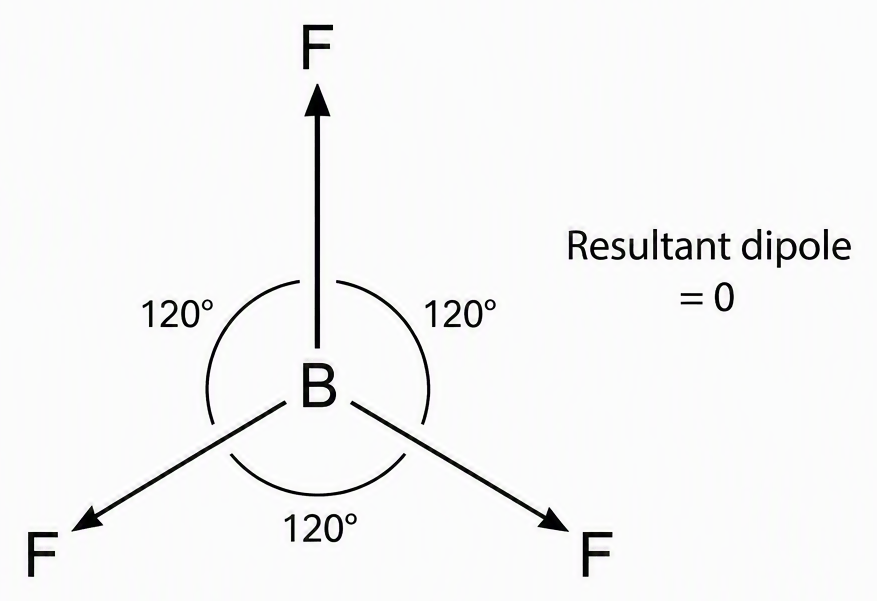
Q5: C. BF₃ is trigonal planar, with three equivalent B–F bond dipoles that cancel as vectors. Its bonds are polar, but the molecule has no net dipole moment. SO₂, option D, is bent, so its bond dipoles do not cancel.
Q6: D. Bond order uses the difference between bonding and antibonding electron counts. For O₂:
O₂ has two unpaired electrons in separate degenerate antibonding π orbitals, causing paramagnetism. Option A gets the bond order right but incorrectly pairs all electrons.
Q7: A. Removing an antibonding electron increases bond order. Adding one decreases it:
Option B treats an extra electron as automatically strengthening a bond. Its orbital matters, not simply its presence.
Q8: B. NH₃ molecules form intermolecular hydrogen bonds; PH₃ does not form comparable hydrogen bonding. More energy is needed to overcome these attractions during boiling. Option A confuses attractions between molecules with covalent N–H bonds within a molecule, which boiling does not normally break.
What should you practise after checking your mistakes?
Repair the topic behind each wrong or guessed answer before moving to broader practice. These eight questions identify explanations you cannot yet reproduce; they do not establish a chapter-mastery percentage or predict a NEET score.
- Q1 errors: Revisit Lewis structures, valence-electron counting and formal charge.
- Q2–Q5 errors: Revisit electron-domain counting, VSEPR, conventional hybridisation and bond-dipole cancellation.
- Q6–Q7 errors: Revisit molecular orbital filling, unpaired electrons and antibonding occupancy.
- Q8 errors: Revisit intermolecular forces, especially hydrogen bonding versus covalent bonding.
Use this repair sequence:
- Revisit the relevant NCERT explanation.
- Close the book and redraw the structure or rederive the answer.
- Solve a different question testing the same principle.
- Explain why its tempting distractor fails.
Remembering this set’s option letters on a second attempt is not evidence of transfer. Apply the reasoning to a changed molecule, ion or statement.
Use NEET Mock Test Analysis: Errors, Repairs and Retests to separate conceptual errors from reading and pacing mistakes. Repair the cause, rather than automatically solving more questions from the same chapter.
The current pattern has 180 compulsory single-correct questions in 180 minutes, with +4 for correct, −1 for wrong and 0 for unattempted answers. There is no optional Section B. Whole-paper timing is not a rigid allowance for every Chemical Bonding question: some need quick recognition; others need a structure or orbital count.
How do you know when to move beyond chapter MCQs?
Move on when you can reason through unfamiliar questions and correct recurring errors. A large completed-question count alone is not enough.
Are Chemical Bonding PYQs enough for NEET?
PYQs calibrate application, but they cannot repair every weak concept by themselves. If you remember the answer before reconstructing the reasoning, switch to an unfamiliar chapter question testing the same principle.
Is NCERT enough, or should I also solve MCQs?
NCERT provides the conceptual base; MCQs test whether you can apply it and reject plausible distractors. Read with a specific error in mind, then test the corrected idea through a fresh question.
How many Chemical Bonding questions should I solve?
There is no universal target. Progress when you can explain unfamiliar questions independently and recurring errors stop surviving your revision.
Are these eight questions actual NEET PYQs?
No. They are original editorial practice questions, not authenticated PYQs. Start your next session with one guessed or incorrect answer, rederive it without looking, then solve a different question using that principle.
Once that reasoning holds, use PYQs for calibration and the free full mocks described above as a later mixed-subject check, not chapter-filtered Chemical Bonding practice.
Next step: full-length mock tests on NEET JEEnius AI and sit a full 180-question, 720-mark, 180-minute paper, 45 Physics, 45 Chemistry and 90 Biology, and get a scored per-subject breakdown (30 free a month).
Frequently asked questions
Are these Chemical Bonding questions actual NEET PYQs?
No. These eight single-correct MCQs are original editorial practice questions with worked explanations, not authenticated NEET PYQs. They sample selected concepts rather than test the entire chapter.
Are Chemical Bonding PYQs enough for NEET?
PYQs show how past papers tested Chemical Bonding, but they cannot repair every weak concept by themselves. If you recognise an answer without deriving it, revisit the relevant NCERT explanation and solve an unfamiliar question testing the same principle.
How many Chemical Bonding questions should I solve for NEET?
There is no universal question target. Move beyond chapter drills when you can explain unfamiliar questions independently and recurring errors stop surviving your revision. A correct guess still needs review.
Should I practise Chemical Bonding MCQs or take full NEET mocks?
Use explained chapter MCQs when your errors involve concepts such as molecular shape, formal charge or orbital filling. Use full mocks when you need mixed-subject pacing and subject-switching practice. Full mocks cannot guarantee enough Chemical Bonding questions to diagnose chapter weaknesses.