
Should I start with chapter questions, PYQs or full mocks?
For Coordination Compounds practice questions for NEET, start with the free in-page diagnostic if you have read the chapter but have not checked your understanding. It contains eight original single-correct MCQs with worked explanations, not actual NEET questions.
Use verified PYQs once you solve chapter exercises independently. Choose full mocks for cross-syllabus performance. Full papers test integration; they are not an efficient substitute for repairing one weak chapter.
How do free chapter MCQs, verified PYQs and full mocks compare?
Chapter questions expose specific chemistry mistakes, verified previous-year questions test authentic exam wording, and full mocks test performance across subjects. Choose the format that addresses your current problem.
- Chapter focus
- This page’s MCQs: Coordination Compounds only, with deliberately limited diagnostic scope.
- Verified NEET PYQs: Chapter focus depends on how the source selects questions.
- NEET JEEnius AI mocks: Full-syllabus practice, without guaranteed Coordination Compounds coverage.
- What each diagnoses
- This page: Selected errors in charge, denticity, naming, isomerism and electron pairing.
- PYQs: Difficulty interpreting and solving questions actually asked.
- Mocks: Pacing and subject-level performance across a complete paper.
- Answer support
- This page: Answer key and worked solutions.
- PYQs: Authenticity requires a traceable paper and final answer key; explanation quality depends on the source.
- Mocks: Scored per-subject breakdown, not a claim of worked solutions or chapter-level analysis.
- Free access
- This page: All eight questions and explanations are free below.
- PYQs: Availability depends on the legitimate source.
- Mocks: NEET JEEnius AI provides 30 free full-length mocks a month: 180 questions, 720 marks and 180 minutes, with 45 Physics, 45 Chemistry and 90 Biology questions.
- Main limitation
- This page: Not complete chapter coverage.
- PYQs: Past questions do not predict the next paper.
- Mocks: A subject score alone cannot explain a specific chemistry error.
Which practice format should I choose right now?
Stay with chapter practice if your understanding is uncertain. Use verified PYQs if your chemistry is sound but exam wording slows you down. Choose mocks if accuracy drops only in complete papers.
- Class 11, studying ahead: First establish oxidation state, coordination number and ligand denticity. Do not assume you should already know this chapter.
- Class 12, chapter just completed: Attempt this set without notes. Review every explanation attached to an uncertain answer, including correct guesses.
- Dropper, repeating mistakes: Use targeted chapter drills and an error log before collecting another large question PDF. Record the faulty rule, not just the question number.
- Comfortable with chapter exercises: Move to verified PYQs for authentic wording, not predictions.
- Accurate in isolation, weaker in full papers: Examine pacing and subject-level performance through mocks.
For parents, more questions attempted is not the same as fewer recurring conceptual errors. Correcting a repeated charge-balance mistake is progress even without completing another large worksheet.
Can I solve eight free Coordination Compounds NEET-style MCQs here?
The eight questions below are original NEET-style practice, not PYQs. Each has exactly one correct option, and the complete answer key follows the set.
Attempt without notes. Beside each answer, write either “certain” or “uncertain” so that a lucky guess does not hide a gap.
Question 1. What is the oxidation state of cobalt in this compound?
- A. Positive one
- B. Positive two
- C. Positive three
- D. Positive five
Question 2. What is cobalt’s coordination number in this ion? Here, en means ethane-1,2-diamine, a ligand that binds through both nitrogen atoms.
- A. Three
- B. Six
- C. Nine
- D. Two
Question 3. Which is the correct systematic name?
- A. Potassium hexacyanidoiron(II)
- B. Potassium hexacyanidoferrate(III)
- C. Tetrapotassium hexacyanidoferrate(II)
- D. Potassium hexacyanidoferrate(II)
Question 4. Two complexes have the same composition and five ammine ligands each. Their nitrite connectivity differs as shown below; the other ligands are omitted from these connectivity fragments.
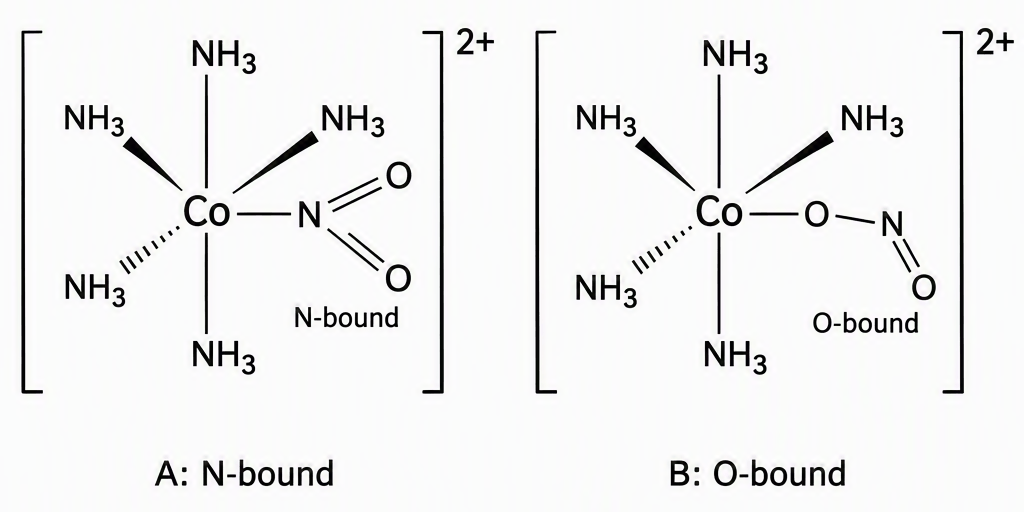
What relationship does this donor-atom change establish?
- A. Linkage isomerism
- B. Geometrical isomerism
- C. Optical isomerism
- D. Ionisation isomerism
Question 5. For this square-planar complex, which statement is correct?
- A. Only one arrangement exists because its coordination number is four.
- B. The two chlorido ligands are opposite in the cis form.
- C. The chlorido ligands are adjacent in cis and opposite in trans.
- D. Cis and trans are non-superimposable mirror images.
Question 6. Which statement about this octahedral ion is correct?
- A. It cannot show optical isomerism because all three ligands are identical.
- B. It has a pair of non-superimposable mirror-image forms.
- C. Its optical isomers differ in cobalt’s oxidation state.
- D. Its optical isomers differ in ligand denticity.
Question 7. How many unpaired electrons occur in these octahedral ions, respectively?
- A. Four and zero
- B. Two and four
- C. Zero and five
- D. Zero and four
Question 8. Which comparison is correct for these ions, respectively?
- A. Square planar and diamagnetic; tetrahedral and paramagnetic
- B. Tetrahedral and paramagnetic; square planar and diamagnetic
- C. Both square planar and diamagnetic
- D. Both tetrahedral and paramagnetic
What are the answers, and which trap does each question test?
Answer key: 1 C; 2 B; 3 D; 4 A; 5 C; 6 B; 7 D; 8 A. Read the solution for every uncertain answer, not only those marked wrong. Record the rule you missed rather than copying the correct option.
1. C, positive three. Error tag: charge balance.
The two chloride ions outside the brackets are counter-ions. They require the coordination sphere to carry two positive charges; inside it, ammonia is neutral and chlorido contributes one negative charge.
The sphere’s charge is not cobalt’s oxidation state. Outer-sphere chloride balances charge but is not coordinated to cobalt.
2. B, six. Error tag: denticity.
Each en ligand supplies two nitrogen donor atoms. Three bidentate ligands therefore make six metal–donor bonds.
Coordination number counts attached donor atoms, not ligand molecules. “Three ligands” does not mean “coordination number three”.
3. D, potassium hexacyanidoferrate(II). Error tag: nomenclature.
Four potassium ions require a complex anion with four negative charges. Each cyanido ligand contributes one negative charge.
Name the cation first: potassium. Six cyanido ligands give “hexacyanido”, and an anionic iron complex uses “ferrate”, followed by iron’s oxidation state, (II). Do not add “tetra” to potassium in this salt name.
4. A, linkage isomerism. Error tag: donor atom.
Nitrite is ambidentate: it can coordinate through nitrogen or oxygen. A has a cobalt–nitrogen bond, while B has a cobalt–oxygen bond, so the attachment atom changes.
Ionisation isomerism instead involves exchanging a coordinated ligand with a counter-ion. No such exchange is shown.
5. C, adjacent in cis and opposite in trans. Error tag: spatial arrangement.
The same ligands occupy different positions around square-planar platinum. Adjacent chlorido ligands define cis; opposite chlorido ligands define trans.
The donor atoms do not change, so this is not linkage isomerism. These cis and trans forms are not an optical pair.
6. B, non-superimposable mirror images. Error tag: optical isomerism.
Three chelating en ligands can wrap around octahedral cobalt in two opposite handed arrangements. These forms are mirror images that cannot be superimposed.
Identical ligands do not automatically make a complex achiral. Oxidation state, donor atoms and denticity remain unchanged between the two forms.
7. D, zero and four. Error tag: electron pairing.
Both ions contain iron in oxidation state positive two: six singly negative ligands give an overall charge of four negative. Removing the two outer electrons from neutral iron gives:
Cyanido gives a strong field and a low-spin arrangement, with electrons pairing in the lower orbitals. Fluorido gives a weak field and a high-spin arrangement, with the upper orbitals occupied before pairing is complete.
Five unpaired electrons would not fit this six-electron count. Establish the metal-ion configuration before applying ligand field strength.
8. A, square planar and diamagnetic; tetrahedral and paramagnetic. Error tag: geometry and pairing.
Both ions contain nickel in oxidation state positive two, with eight d electrons. Their coordination numbers are equal, but their ligands produce different splitting and pairing patterns.
The cyanido complex is square planar with all electrons paired. The chlorido complex is tetrahedral with two unpaired electrons.
Both have coordination number four, but that number does not uniquely fix geometry or magnetism. Do not transfer the result for one ligand to the other.
How should I use my mistakes to choose the next practice format?
Use the type of error, not an arbitrary score out of eight, to choose your next session. This set samples selected ideas and cannot certify complete chapter readiness. Record a correct guess as uncertain until you can explain it independently.
- Charge balance or denticity error: Return to the definitions. Solve targeted examples before attempting a full paper.
- Naming error: Rewrite the complex, recalculate the sphere’s charge and metal oxidation state, then explain which naming rule each alternative breaks.
- Isomerism error: Rewrite or sketch the alternatives. State exactly what changes: donor atom, position or mirror-image relationship.
- Magnetic-behaviour error: Repeat the sequence: oxidation state, d-electron count, geometry, splitting and pairing.
- Independent explanations throughout: Move to verified PYQs. Check that the paper and final answer key are traceable.
For an optional practice tally, use NEET’s marking rule: four marks for a correct answer, minus one for a wrong answer and zero for an unattempted question.
This tally is not a predicted NEET score. Your error log should say “counted ligands instead of donor atoms”, not merely “Question 2 wrong”.
When should I move to full mocks, and what can they not replace?
Move to full papers after addressing chapter-level mistakes and when you are ready to test broader syllabus coverage. NEET’s current format has 180 compulsory questions in 180 minutes, with no optional Section B. That is an average pace, not a rigid one-minute allowance for every question.
NEET JEEnius AI’s 30 free full-length mocks per month, with a scored per-subject breakdown, are an option for this stage. A Chemistry subject score cannot by itself identify the exact Coordination Compounds misconception, so keep reviewing the reasoning behind individual errors.
For a separate chapter check, try Chemical Kinetics Practice Questions NEET: 8 Free MCQs. Before your next session, choose one recurring error from today’s set, write the correct rule, and solve a fresh example without notes.
Frequently asked questions
Are these Coordination Compounds questions actual NEET PYQs?
No. These are eight original NEET-style, single-correct MCQs with a free answer key and worked explanations. For authentic PYQ practice, use questions linked to a traceable exam paper and final answer key.
Should I solve Coordination Compounds chapter questions or PYQs first?
Start with chapter questions if you have read the chapter but cannot yet explain your answers independently. Move to verified PYQs once you can solve chapter exercises without help. Use full mocks to test pacing and performance across subjects, not to repair one weak chapter.
Which topics do these Coordination Compounds MCQs cover?
The set checks oxidation state, coordination number, ligand denticity, nomenclature, linkage isomerism, geometrical isomerism and optical isomerism. It also tests electron pairing, geometry and magnetic behaviour in selected iron and nickel complexes. Eight questions sample these ideas; they do not establish complete chapter readiness.
How should I review mistakes in Coordination Compounds MCQs?
Read the explanation for every wrong or uncertain answer, including correct guesses. Record the faulty rule, such as counting ligand molecules instead of donor atoms, rather than just the question number. Correct that rule and solve a fresh targeted example without notes before moving on.